Launcher
- Latest Dynatrace
- Explanation
- 4-min read
 Launcher lets you create launchpads—customizable start pages that surface the Dynatrace apps and content most relevant to your work. When you open a launchpad, you land on the components you use most, with quick navigation to the rest of the platform. You can make launchpads for yourself or to share with your team.
Get started with launchpads
-
Go to
Launcher.- If you're looking at a launchpad, such as the landing page you see when you start Dynatrace, you're already in Launcher. You should see Browse all in the upper-left corner.
- If you aren't sure, just select Dynatrace in the upper-left corner in Dynatrace to have Launcher display your default launchpad.
- If you're looking at a launchpad, such as the landing page you see when you start Dynatrace, you're already in
-
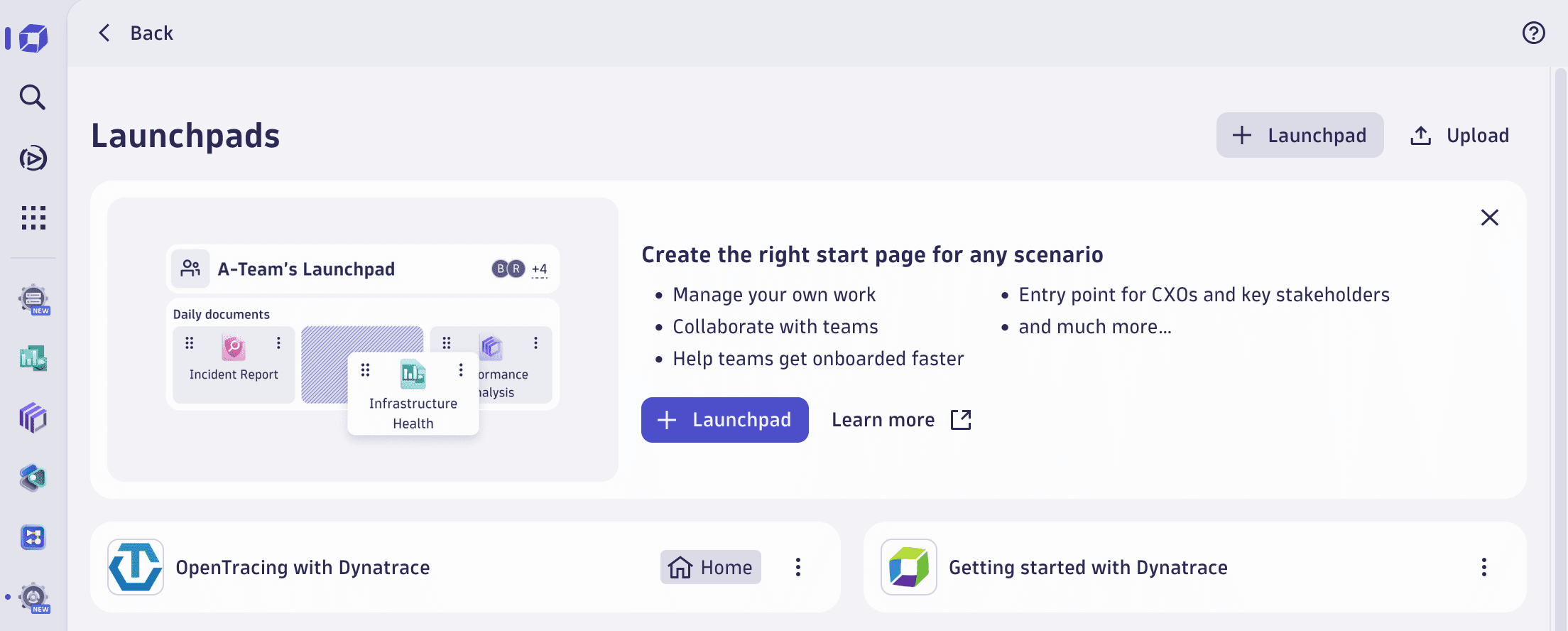
Select Browse all in the upper-left corner to display the Launchpads page.
Use the tabs over the table to display:
- All—all launchpads you have access to.
- Owned by me—all launchpads you own.
- Shared with me—all launchpads that have been shared with you.
- Ready-made—all ready-made launchpads.
- Trash—all launchpads in the trash can.
You can also use the search bar to search for a launchpad by name or ID.
-
To add a new launchpad, select Launchpad.
-
In the Customize panel, select a component type and start customizing it. Components you can add to your launchpad include:
- Links—a collection of links to Dynatrace apps and documents, as well as general links to internal or external resources
- Markdown—a tile of Markdown-formatted text, including links to web pages and images
- Cards—for each card, add a brief explanation, an optional image, and a button to take you to your destination
-
After you have built your launchpad, select Done.
Home launchpads
Home launchpads act as individual start pages, providing a customized experience when using Dynatrace, for focus and quick access to things people need most. For example, if you use certain apps and dashboards every day, you could add links to your home launchpad.
Set home launchpads for user groups
To set home launchpads for user groups
- Go to Settings.
- Select General.
- Select Launcher > Home launchpad.
- Select Add home launchpad.
- Select a launchpad from the list.
- Start typing to Select a user group, or select Everyone to change the start page for all users.
- Select Save.
After setting a home launchpad, it will be indicated as the Home launchpad and load as the start page when entering Dynatrace. Access to Getting started with Dynatrace, the default home launchpad, is retained on the launchpads overview page.
Set your personal home launchpad
To set your personal home launchpad
- Select Browse all.
The launchpads overview page opens. - Select the launchpad you want to switch to.
- Select > Set as Home.
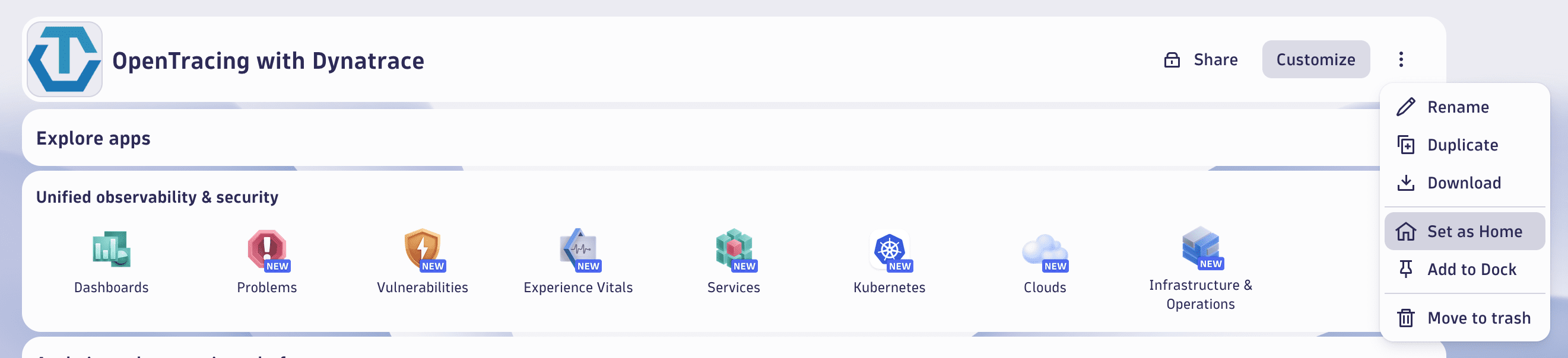
Setting a home launchpad for yourself will override any home launchpad set by your admin. Access to home launchpads set by your admin will be retained under Suggested on the launchpads overview page.
- Your personal home launchpad, set as Home
- Home launchpad set by your admin with highest rank
- Other home launchpads set by your admin with lower ranks and other groups you're member of
- Getting started with Dynatrace, the default home launchpad
If a home launchpad fails to load (for example, due to failing permissions), the next in line opens.
Common actions for launchpads
Select in a launchpad header or on the Launchpads page to access common actions:
-
Rename changes the name in the heading of the launchpad.
-
Duplicate makes a copy of the current launchpad so you can build a new launchpad based on the current launchpad.
-
Download saves the current launchpad as a local JSON file. See Download and upload a launchpad.
-
Change owner assigns launchpad ownership to a new owner.
-
Set as Home makes the current launchpad your personal home launchpad.
-
Add to Dock pins the selected launchpad to the Dynatrace dock.
-
Move to trash puts the selected launchpad in the trash.
- To retrieve a launchpad from the trash, go to Browse all, select the Trash tab, and select Restore for the launchpad.
- To permanently delete a launchpad, go to Browse all, select the Trash tab, and select Delete permanently for the launchpad.
Customize your launchpad
To customize a launchpad, open the launchpad and select Customize.
- Hover over a component you want to customize and select > Edit. You can also simply select a component when in Customize mode.
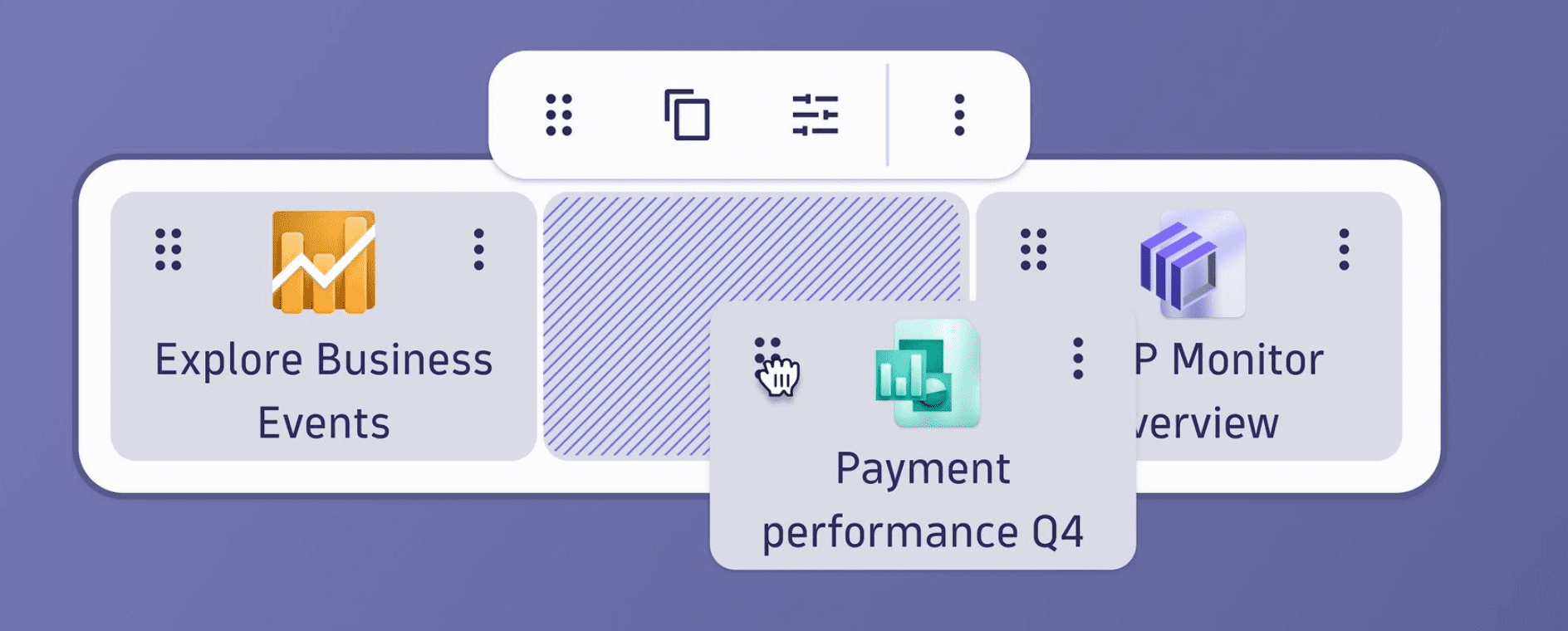
- Hover over a component and select to select and drag the component to a new position.
Add a launchpad icon
Adding an icon will help your team know which launchpad they're on and will make it easier to pick the right one from a list of launchpads.

To add a launchpad icon
- Select Customize
- Select Upload icon
- Select the image to use as this launchpad's icon.
- Select Save
- 1 MB for JPG, PNG, and WEBP images
- 10 KB for SVG images
Download and upload a launchpad
To move a launchpad between environments
- Select > Download to download the launchpad.
- Go to the destination environment, select Launchpads > Upload, and upload the JSON file you downloaded in the previous step.
Share launchpads
If you own a launchpad, you can share it with other users in your Dynatrace environment.
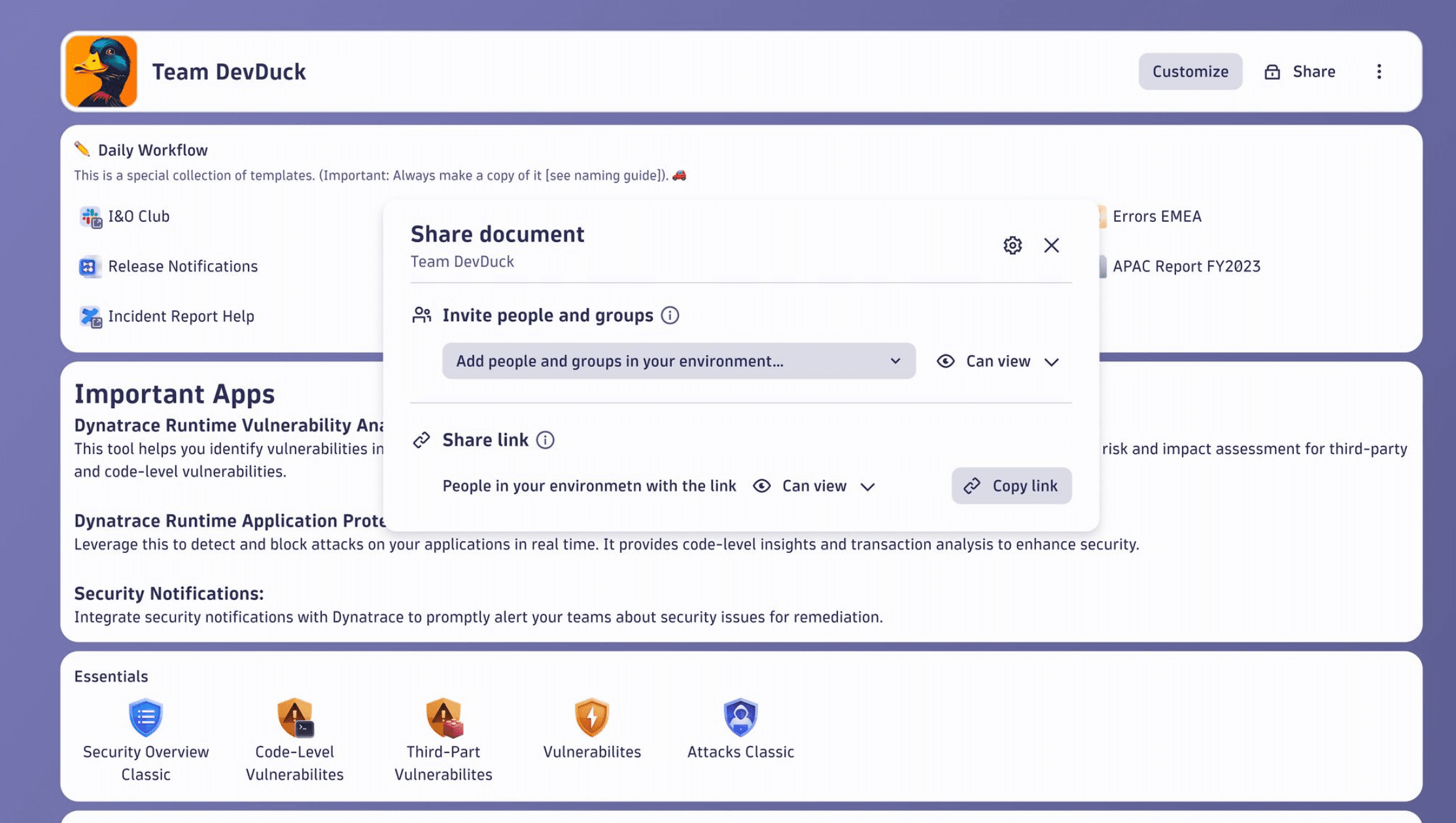
For details on sharing Dynatrace documents (including launchpads), see Share documents.
API for launchpads
Launcher uses the document service API to persist launchpads as documents.
Documents are content-agnostic, but have common metadata: a unique identifier, a name, and a description.
To distinguish different types of documents, and to make them visible to the respective apps, they need the correct type document attribute, in this case: launchpad. This attribute can also be used to query the API as shown in the following example.
https://environment/platform/document/v1/documents?filter=type='launchpad'
Access full document service documentation
For the full API reference of the document service, see the Document Service API.
Examples
Example 1: Basic launchpad creation
In this example, you make a very simple launchpad.
- Go to Launcher.
- Select Browse all.
- Select Launchpad.
- Select Markdown.
- To add some content, type some text in the edit box, such as
This is my first launchpad. - To name your launchpad, change "Untitled launchpad" to a name you can find later, such as
<your name>'s first launchpad.
- To add some content, type some text in the edit box, such as
- Select Done.
If your name was Alex, your launchpad would look something like this.

Example 2: Create your Home launchpad
Suppose you need to create and edit notebooks and dashboards multiple times in your daily work. This example creates a launchpad that links to  Notebooks and
  Dashboards, and designates the new launchpad as your home (default) launchpad.
-
Go to
Launcher. -
Select Browse all.
-
To create a new launchpad, select Launchpad.
-
Name your launchpad.
In the header, change
Untitled launchpadto something like<your name>'s Home Launchpad. -
Describe your launchpad.
- In the Customize panel, select Markdown.
- Type some text in the edit box, such as
This is my daily launchpad. You can select and format your text with standard Markdown formatting. - Close the Markdown panel to see your progress.
-
Add links to
Notebooks and Dashboards.- In the Customize panel, select Links and then select Add link.
- On the Quick link tab, search for
notebooksand select the Notebooks app. - Select Add link again.
- On the Quick link tab, search for
dashboardsand select the Dashboards app. - In the Links panel
- Set Title to something like
Daily Apps. - Set Description to something like
I use these apps every day.
- Set Title to something like
- Close the Links panel to see your progress.
-
Select Done.
-
In the launchpad header, open the menu and select Set as Home.
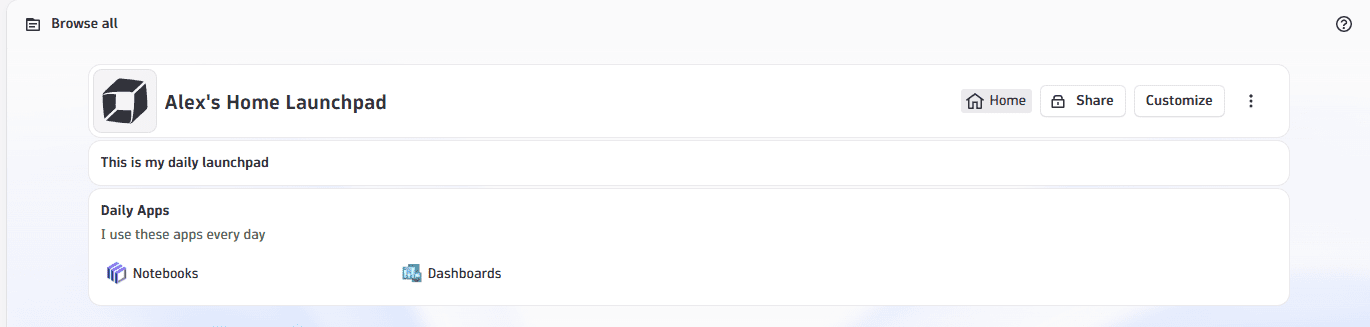
In this example, Alex created a launchpad with links to apps they use every day, and they made it their home (default) launchpad.
Example 3: Explore a launchpad in Dynatrace Playground
Dynatrace Playground is a public Dynatrace environment where you can explore features without affecting your own data. This example makes a copy of the Playground home launchpad so you can explore with editing a real launchpad.
-
Go to Playground.
The default Welcome to the Dynatrace Playground launchpad is displayed. You can't edit that launchpad, but you can make a copy and explore the copy.
-
Open the menu in the launchpad header and select Duplicate.
This makes a copy of the current launchpad and displays it with the name Copy of Welcome to the Dynatrace Playground.
-
Select Customize in the header to edit your copy.
-
Explore the existing launchpad component.
- For a menu of component-specific actions, hover over the component and select .
- To edit a Markdown component, select the text to display it in edit mode.
It's your launchpad. Feel free to make edits, try new things, and delete it if you no longer want it.
-
When you're finished editing, select Done to display your updated launchpad.