Ingest LevelBlue (AlienVault) OTX threat reports
- Latest Dynatrace
- Extension
- Published Jul 01, 2026
- Preview
Bring open threat intelligence from LevelBlue (AlienVault) OTX into Dynatrace to investigate threats and correlate external intelligence with your monitored environment.
Get started
Overview
Use the LevelBlue (AlienVault) OTX integration for Dynatrace to bring open threat intelligence from LevelBlue (AlienVault) Open Threat Exchange into Dynatrace.
The integration collects OTX pulses and their related indicators of compromise, such as IP addresses, domains, URLs, and file hashes, maps them to the Dynatrace Semantic Dictionary, and ingests them as normalized threat report events. This helps security teams investigate threats, correlate external intelligence with monitored environments, and automate response workflows.
Requirements
See below for the LevelBlue (AlienVault) OTX and Dynatrace requirements.
LevelBlue (AlienVault) OTX requirements
- An active LevelBlue (AlienVault) OTX account.
- A LevelBlue (AlienVault) OTX API key for authentication.
Dynatrace requirements
-
ActiveGate version 1.310+ that needs to be able to
- Run the Extensions 2.0 framework
- Recommended: use the Dedicated limits option for the performance profile — see ActiveGate performance profile configuration. This lets the extension process larger pulses without reaching the memory limits.
- Reach the LevelBlue (AlienVault) OTX API endpoints
-
Permissions: For a list of required permissions, open Hub, select
 Extensions, and display Technical information.
 -
Generate an access token with the
openpipeline.events_securityscope and save it for later. For details, see Dynatrace API - Tokens and authentication.
Activation and setup
-
In Dynatrace, search for LevelBlue (AlienVault) OTX and select Install.
-
Follow the on-screen instructions to configure the extension.
-
Verify the configuration by running the following query in
 Notebooks:
-
For threat report events:
fetch security.events| filter event.provider == "AlienVault OTX"AND event.type == "THREAT_REPORT"
-
-
After the extension is installed and working, you can access and manage it in Dynatrace via
Extensions. For details, see About Extensions.
Details
How it works
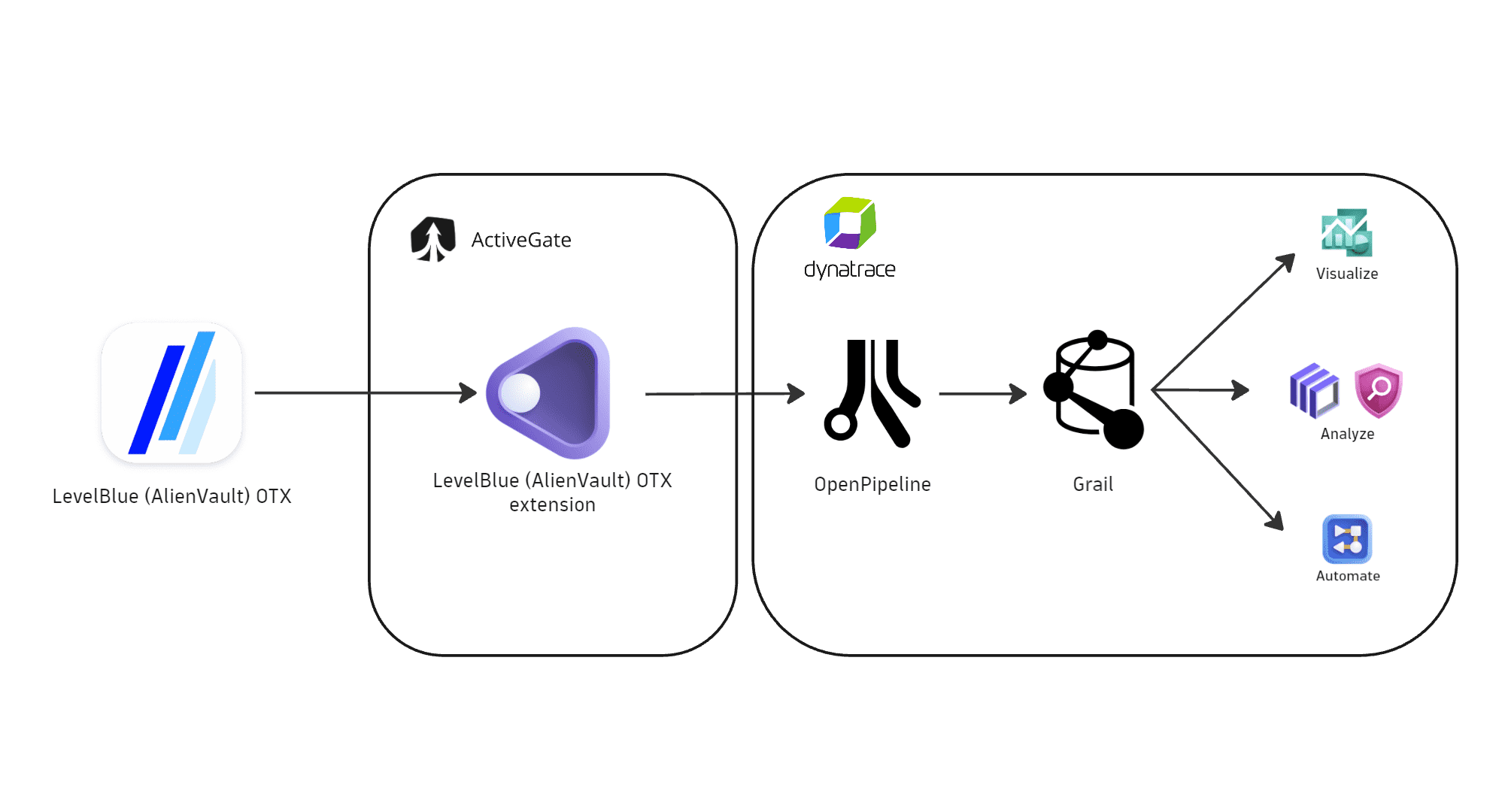
Dynatrace integration with LevelBlue (AlienVault) OTX is an extension running on Dynatrace ActiveGate. After you enable and configure the extension:
- It periodically collects threat intelligence from LevelBlue (AlienVault) OTX using the OTX DirectConnect APIs.
- The fetched data is ingested into Dynatrace and mapped to the Dynatrace Semantic Dictionary.
- Data is stored in the
default_securityeventsbucket (for details, see Built-in Grail buckets).
Licensing and costs
For billing information, see Events powered by Grail.
FAQ
Which LevelBlue product does this integration support?
The integration supports LevelBlue (AlienVault) Open Threat Exchange, also known as LevelBlue (AlienVault) OTX.
Which data model is used for LevelBlue (AlienVault) OTX events in Dynatrace?
Threat report events store the ingested pulses and their related indicators of compromise, such as IP addresses, domains, URLs, and file hashes. For a conceptual overview, see Threat report events.
Which types of indicators of compromise (IOCs) are supported?
The integration ingests and maps IOC types that are supported as threat observables in Dynatrace. When these indicators are present in an OTX pulse, they are extracted and added as observables to enrich the threat context.
| IOC type | Mapped to |
|---|---|
Email addresses |
|
IP addresses |
|
Domain names and host names |
|
URLs |
|
MD5 file hashes |
|
SHA-1 file hashes |
|
SHA-256 file hashes |
|
CVEs (Common Vulnerabilities and Exposures) |
|
Which LevelBlue (AlienVault) OTX threat intelligence events does Dynatrace import?
The integration ingests pulses from LevelBlue (AlienVault) OTX based on the configured ingestion options.
- On the first ingest, Dynatrace fetches pulses created or modified in the last
mdays, wheremis set by the Security events initial fetch time window option in the monitoring configuration. - On subsequent runs, the extension checks for new or updated pulses every
nminutes, wherenis set by the Security events ingest frequency option in the monitoring configuration. - Only new and updated pulses are ingested.
Which extension fields are added to the core fields of events ingested from LevelBlue (AlienVault) OTX?
The alienvault namespace is added for LevelBlue (AlienVault) OTX-specific attributes on top of the core security event schema. The full upstream payload is stored in event.original_content.
alienvault.pulse.public: Indicates whether the pulse is public.alienvault.pulse.tlp: Indicates the Traffic Light Protocol value for the pulse.