AWS DMS (Database Migration Service) monitoring
- How-to guide
- 9-min read
- Published Aug 12, 2020
Dynatrace ingests metrics for multiple preselected namespaces, including AWS DMS. You can view metrics for each service instance, split metrics into multiple dimensions, and create custom charts that you can pin to your dashboards.
Prerequisites
To enable monitoring for this service, you need
- ActiveGate version 1.197+
-
For Dynatrace Managed deployments, you can use any kind of ActiveGate.
For role-based access in Managed deployment, you need an Environment ActiveGate installed on an Amazon EC2 host.
-
Dynatrace version 1.200+
-
An updated AWS monitoring policy to include the additional AWS services.
To update the AWS IAM policy, use the JSON below, containing the monitoring policy (permissions) for all supporting services.
JSON predefined policy for all supporting services
{"Version": "2012-10-17","Statement": [{"Sid": "VisualEditor0","Effect": "Allow","Action": ["acm-pca:ListCertificateAuthorities","apigateway:GET","apprunner:ListServices","appstream:DescribeFleets","appsync:ListGraphqlApis","athena:ListWorkGroups","autoscaling:DescribeAutoScalingGroups","cloudformation:ListStackResources","cloudfront:ListDistributions","cloudhsm:DescribeClusters","cloudsearch:DescribeDomains","cloudwatch:GetMetricData","cloudwatch:GetMetricStatistics","cloudwatch:ListMetrics","codebuild:ListProjects","datasync:ListTasks","dax:DescribeClusters","directconnect:DescribeConnections","dms:DescribeReplicationInstances","dynamodb:ListTables","dynamodb:ListTagsOfResource","ec2:DescribeAvailabilityZones","ec2:DescribeInstances","ec2:DescribeNatGateways","ec2:DescribeSpotFleetRequests","ec2:DescribeTransitGateways","ec2:DescribeVolumes","ec2:DescribeVpnConnections","ecs:ListClusters","eks:ListClusters","elasticache:DescribeCacheClusters","elasticbeanstalk:DescribeEnvironmentResources","elasticbeanstalk:DescribeEnvironments","elasticfilesystem:DescribeFileSystems","elasticloadbalancing:DescribeInstanceHealth","elasticloadbalancing:DescribeListeners","elasticloadbalancing:DescribeLoadBalancers","elasticloadbalancing:DescribeRules","elasticloadbalancing:DescribeTags","elasticloadbalancing:DescribeTargetHealth","elasticmapreduce:ListClusters","elastictranscoder:ListPipelines","es:ListDomainNames","events:ListEventBuses","firehose:ListDeliveryStreams","fsx:DescribeFileSystems","gamelift:ListFleets","glue:GetJobs","inspector:ListAssessmentTemplates","kafka:ListClusters","kinesis:ListStreams","kinesisanalytics:ListApplications","kinesisvideo:ListStreams","lambda:ListFunctions","lambda:ListTags","lex:GetBots","logs:DescribeLogGroups","mediaconnect:ListFlows","mediaconvert:DescribeEndpoints","mediapackage-vod:ListPackagingConfigurations","mediapackage:ListChannels","mediatailor:ListPlaybackConfigurations","opsworks:DescribeStacks","qldb:ListLedgers","rds:DescribeDBClusters","rds:DescribeDBInstances","rds:DescribeEvents","rds:ListTagsForResource","redshift:DescribeClusters","robomaker:ListSimulationJobs","route53:ListHostedZones","route53resolver:ListResolverEndpoints","s3:ListAllMyBuckets","sagemaker:ListEndpoints","sns:ListTopics","sqs:ListQueues","storagegateway:ListGateways","sts:GetCallerIdentity","swf:ListDomains","tag:GetResources","tag:GetTagKeys","transfer:ListServers","workmail:ListOrganizations","workspaces:DescribeWorkspaces"],"Resource": "*"}]}
If you don't want to add permissions to all services, and just select permissions for certain services, consult the table below. The table contains a set of permissions that are required for All AWS cloud services and, for each supporting service, a list of optional permissions specific to that service.
"cloudwatch:GetMetricData""cloudwatch:GetMetricStatistics""cloudwatch:ListMetrics""sts:GetCallerIdentity""tag:GetResources""tag:GetTagKeys""ec2:DescribeAvailabilityZones"
Complete list of permissions for cloud services
| Name | Permissions |
|---|---|
All monitored Amazon services Required |
|
AWS Certificate Manager Private Certificate Authority |
|
Amazon MQ | |
Amazon API Gateway |
|
AWS App Runner |
|
Amazon AppStream |
|
AWS AppSync |
|
Amazon Athena |
|
Amazon Aurora |
|
Amazon EC2 Auto Scaling |
|
Amazon EC2 Auto Scaling (built-in) |
|
AWS Billing | |
Amazon Keyspaces | |
AWS Chatbot | |
Amazon CloudFront |
|
AWS CloudHSM |
|
Amazon CloudSearch |
|
AWS CodeBuild |
|
Amazon Cognito | |
Amazon Connect | |
Amazon Elastic Kubernetes Service (EKS) |
|
AWS DataSync |
|
Amazon DynamoDB Accelerator (DAX) |
|
AWS Database Migration Service (AWS DMS) |
|
Amazon DocumentDB |
|
AWS Direct Connect |
|
Amazon DynamoDB |
|
Amazon DynamoDB (built-in) |
|
Amazon EBS |
|
Amazon EBS (built-in) |
|
Amazon EC2 API | |
Amazon EC2 (built-in) |
|
Amazon EC2 Spot Fleet |
|
Amazon Elastic Container Service (ECS) |
|
Amazon ECS Container Insights |
|
Amazon ElastiCache (EC) |
|
AWS Elastic Beanstalk |
|
Amazon Elastic File System (EFS) |
|
Amazon Elastic Inference | |
Amazon Elastic Map Reduce (EMR) |
|
Amazon Elasticsearch Service (ES) |
|
Amazon Elastic Transcoder |
|
Amazon Elastic Load Balancer (ELB) (built-in) |
|
Amazon EventBridge |
|
Amazon FSx |
|
Amazon GameLift |
|
AWS Glue |
|
Amazon Inspector |
|
AWS Internet of Things (IoT) | |
AWS IoT Analytics | |
Amazon Managed Streaming for Kafka |
|
Amazon Kinesis Data Analytics |
|
Amazon Data Firehose |
|
Amazon Kinesis Data Streams |
|
Amazon Kinesis Video Streams |
|
AWS Lambda |
|
AWS Lambda (built-in) |
|
Amazon Lex |
|
Amazon Application and Network Load Balancer (built-in) |
|
Amazon CloudWatch Logs |
|
AWS Elemental MediaConnect |
|
AWS Elemental MediaConvert |
|
AWS Elemental MediaPackage Live |
|
AWS Elemental MediaPackage Video on Demand |
|
AWS Elemental MediaTailor |
|
Amazon VPC NAT Gateways |
|
Amazon Neptune |
|
AWS OpsWorks |
|
Amazon Polly | |
Amazon QLDB |
|
Amazon RDS |
|
Amazon RDS (built-in) |
|
Amazon Redshift |
|
Amazon Rekognition | |
AWS RoboMaker |
|
Amazon Route 53 |
|
Amazon Route 53 Resolver |
|
Amazon S3 |
|
Amazon S3 (built-in) |
|
Amazon SageMaker Batch Transform Jobs | |
Amazon SageMaker Endpoint Instances |
|
Amazon SageMaker Endpoints |
|
Amazon SageMaker Ground Truth | |
Amazon SageMaker Processing Jobs | |
Amazon SageMaker Training Jobs | |
AWS Service Catalog | |
Amazon Simple Email Service (SES) | |
Amazon Simple Notification Service (SNS) |
|
Amazon Simple Queue Service (SQS) |
|
AWS Systems Manager - Run Command | |
AWS Step Functions | |
AWS Storage Gateway |
|
Amazon SWF |
|
Amazon Textract | |
AWS IoT Things Graph | |
AWS Transfer Family |
|
AWS Transit Gateway |
|
Amazon Translate | |
AWS Trusted Advisor | |
AWS API Usage | |
AWS Site-to-Site VPN |
|
AWS WAF Classic | |
AWS WAF | |
Amazon WorkMail |
|
Amazon WorkSpaces |
|
Example of JSON policy for one single service.
JSON policy for Amazon API Gateway
{"Version": "2012-10-17","Statement": [{"Sid": "VisualEditor0","Effect": "Allow","Action": ["apigateway:GET","cloudwatch:GetMetricData","cloudwatch:GetMetricStatistics","cloudwatch:ListMetrics","sts:GetCallerIdentity","tag:GetResources","tag:GetTagKeys","ec2:DescribeAvailabilityZones"],"Resource": "*"}]}
In this example, from the complete list of permissions you need to select
"apigateway:GET"for Amazon API Gateway"cloudwatch:GetMetricData","cloudwatch:GetMetricStatistics","cloudwatch:ListMetrics","sts:GetCallerIdentity","tag:GetResources","tag:GetTagKeys", and"ec2:DescribeAvailabilityZones"for All AWS cloud services.
AWS endpoints that need to be reachable from ActiveGate with corresponding AWS services
| Endpoint | Service |
|---|---|
| Amazon EC2 Auto Scaling (built-in), Amazon EC2 Auto Scaling |
| AWS Lambda (built-in), AWS Lambda |
| Amazon Application and Network Load Balancer (built-in), Amazon Elastic Load Balancer (ELB) (built-in) |
| Amazon DynamoDB (built-in), Amazon DynamoDB |
| Amazon EBS (built-in), Amazon EC2 (built-in), Amazon EBS, Amazon EC2 Spot Fleet, Amazon VPC NAT Gateways, AWS Transit Gateway, AWS Site-to-Site VPN |
| Amazon RDS (built-in), Amazon Aurora, Amazon DocumentDB, Amazon Neptune, Amazon RDS |
| Amazon S3 (built-in) |
| AWS Certificate Manager Private Certificate Authority |
| Amazon API Gateway |
| AWS App Runner |
| Amazon AppStream |
| AWS AppSync |
| Amazon Athena |
| Amazon CloudFront |
| AWS CloudHSM |
| Amazon CloudSearch |
| AWS CodeBuild |
| AWS DataSync |
| Amazon DynamoDB Accelerator (DAX) |
| AWS Database Migration Service (AWS DMS) |
| AWS Direct Connect |
| Amazon Elastic Container Service (ECS), Amazon ECS Container Insights |
| Amazon Elastic File System (EFS) |
| Amazon Elastic Kubernetes Service (EKS) |
| Amazon ElastiCache (EC) |
| AWS Elastic Beanstalk |
| Amazon Elastic Transcoder |
| Amazon Elasticsearch Service (ES) |
| Amazon EventBridge |
| Amazon FSx |
| Amazon GameLift |
| AWS Glue |
| Amazon Inspector |
| Amazon Managed Streaming for Kafka |
| Amazon Lex |
| Amazon CloudWatch Logs |
| AWS Elemental MediaTailor |
| AWS Elemental MediaConnect |
| AWS Elemental MediaPackage Live |
| AWS Elemental MediaPackage Video on Demand |
| AWS OpsWorks |
| Amazon QLDB |
| Amazon Redshift |
| AWS RoboMaker |
| Amazon Route 53 |
| Amazon Route 53 Resolver |
| Amazon SageMaker Endpoints, Amazon SageMaker Endpoint Instances |
| Amazon Simple Notification Service (SNS) |
| Amazon Simple Queue Service (SQS) |
| AWS Storage Gateway |
| Amazon SWF |
| AWS Transfer Family |
| Amazon WorkMail |
| Amazon WorkSpaces |
Enable monitoring
To learn how to enable service monitoring, see Enable service monitoring.
View service metrics
You can view the service metrics in your Dynatrace environment either on the custom device overview page or on your Dashboards page.
View metrics on the custom device overview page
To access the custom device overview page
- Go to Technologies & Processes.
- Filter by service name and select the relevant custom device group.
- Once you select the custom device group, you're on the custom device group overview page.
- The custom device group overview page lists all instances (custom devices) belonging to the group. Select an instance to view the custom device overview page.
View metrics on your dashboard
After you add the service to monitoring, a preset dashboard containing all recommended metrics is automatically listed on your Dashboards page. To look for specific dashboards, filter by Preset and then by Name.
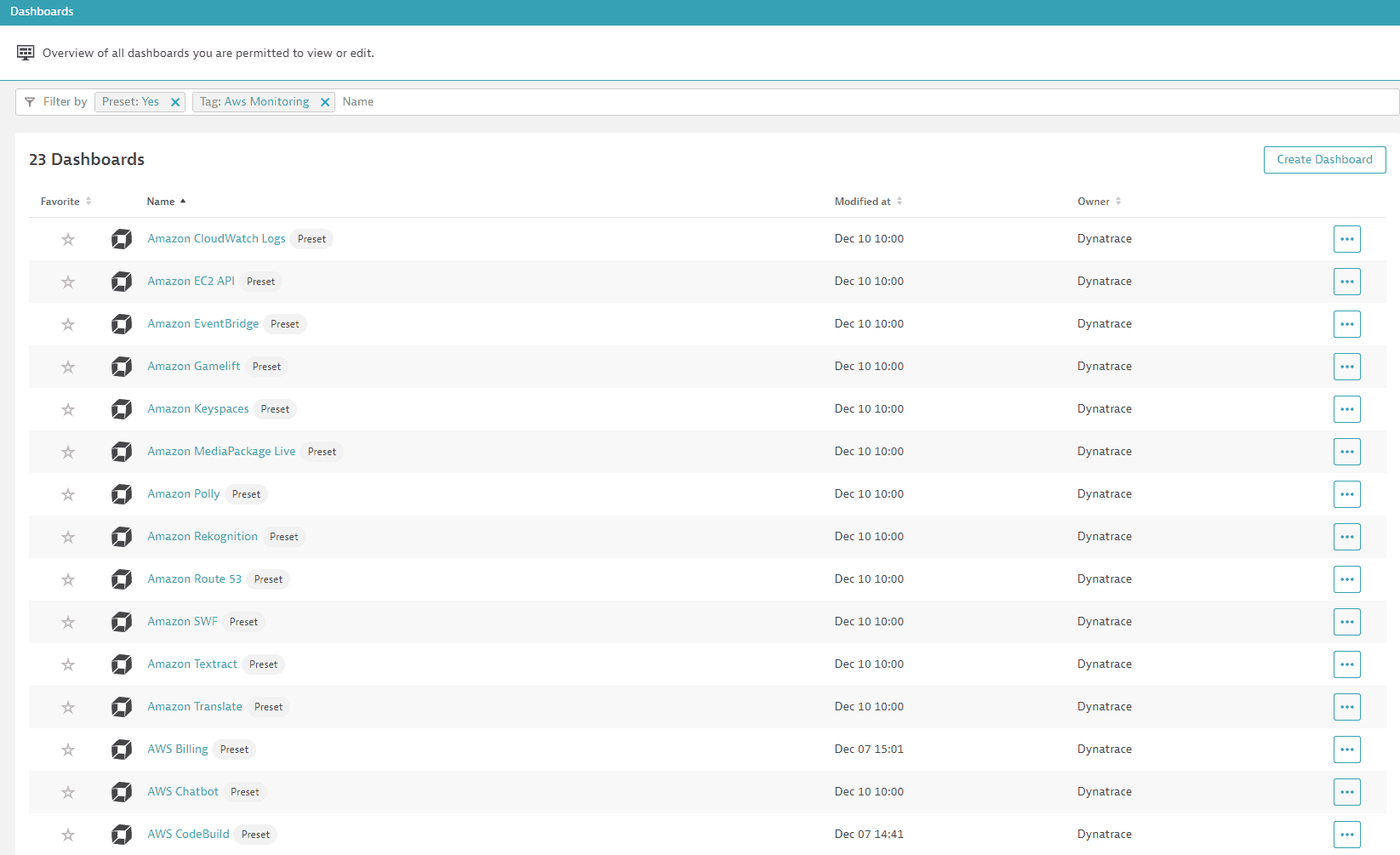
For existing monitored services, you might need to resave your credentials for the preset dashboard to appear on the Dashboards page. To resave your credentials, go to Settings > Cloud and virtualization > AWS, select the desired AWS instance, and then select Save.
You can't make changes on a preset dashboard directly, but you can clone and edit it. To clone a dashboard, open the browse menu (…) and select Clone.
To remove a dashboard from the dashboards page, you can hide it. To hide a dashboard, open the browse menu (…) and select Hide.
Hiding a dashboard doesn't affect other users.

To check the availability of preset dashboards for each AWS service, see the list below.
Preset dashboard availability list
| AWS service | Preset dashboard |
|---|---|
Amazon EC2 Auto Scaling (built-in) |
|
AWS Lambda (built-in) |
|
Amazon Application and Network Load Balancer (built-in) |
|
Amazon DynamoDB (built-in) |
|
Amazon EBS (built-in) |
|
Amazon EC2 (built-in) |
|
Amazon Elastic Load Balancer (ELB) (built-in) |
|
Amazon RDS (built-in) |
|
Amazon S3 (built-in) |
|
AWS Certificate Manager Private Certificate Authority |
|
All monitored Amazon services |
|
Amazon API Gateway |
|
AWS App Runner |
|
Amazon AppStream |
|
AWS AppSync |
|
Amazon Athena |
|
Amazon Aurora |
|
Amazon EC2 Auto Scaling |
|
AWS Billing |
|
Amazon Keyspaces |
|
AWS Chatbot |
|
Amazon CloudFront |
|
AWS CloudHSM |
|
Amazon CloudSearch |
|
AWS CodeBuild |
|
Amazon Cognito |
|
Amazon Connect |
|
AWS DataSync |
|
Amazon DynamoDB Accelerator (DAX) |
|
AWS Database Migration Service (AWS DMS) |
|
Amazon DocumentDB |
|
AWS Direct Connect |
|
Amazon DynamoDB |
|
Amazon EBS |
|
Amazon EC2 Spot Fleet |
|
Amazon EC2 API |
|
Amazon Elastic Container Service (ECS) |
|
Amazon ECS Container Insights |
|
Amazon Elastic File System (EFS) |
|
Amazon Elastic Kubernetes Service (EKS) |
|
Amazon ElastiCache (EC) |
|
AWS Elastic Beanstalk |
|
Amazon Elastic Inference |
|
Amazon Elastic Transcoder |
|
Amazon Elastic Map Reduce (EMR) |
|
Amazon Elasticsearch Service (ES) |
|
Amazon EventBridge |
|
Amazon FSx |
|
Amazon GameLift |
|
AWS Glue |
|
Amazon Inspector |
|
AWS Internet of Things (IoT) |
|
AWS IoT Things Graph |
|
AWS IoT Analytics |
|
Amazon Managed Streaming for Kafka |
|
Amazon Kinesis Data Analytics |
|
Amazon Data Firehose |
|
Amazon Kinesis Data Streams |
|
Amazon Kinesis Video Streams |
|
AWS Lambda |
|
Amazon Lex |
|
Amazon CloudWatch Logs |
|
AWS Elemental MediaTailor |
|
AWS Elemental MediaConnect |
|
AWS Elemental MediaConvert |
|
AWS Elemental MediaPackage Live |
|
AWS Elemental MediaPackage Video on Demand |
|
Amazon MQ |
|
Amazon VPC NAT Gateways |
|
Amazon Neptune |
|
AWS OpsWorks |
|
Amazon Polly |
|
Amazon QLDB |
|
Amazon RDS |
|
Amazon Redshift |
|
Amazon Rekognition |
|
AWS RoboMaker |
|
Amazon Route 53 |
|
Amazon Route 53 Resolver |
|
Amazon S3 |
|
Amazon SageMaker Batch Transform Jobs |
|
Amazon SageMaker Endpoints |
|
Amazon SageMaker Endpoint Instances |
|
Amazon SageMaker Ground Truth |
|
Amazon SageMaker Processing Jobs |
|
Amazon SageMaker Training Jobs |
|
AWS Service Catalog |
|
Amazon Simple Email Service (SES) |
|
Amazon Simple Notification Service (SNS) |
|
Amazon Simple Queue Service (SQS) |
|
AWS Systems Manager - Run Command |
|
AWS Step Functions |
|
AWS Storage Gateway |
|
Amazon SWF |
|
Amazon Textract |
|
AWS Transfer Family |
|
AWS Transit Gateway |
|
Amazon Translate |
|
AWS Trusted Advisor |
|
AWS API Usage |
|
AWS Site-to-Site VPN |
|
AWS WAF Classic |
|
AWS WAF |
|
Amazon WorkMail |
|
Amazon WorkSpaces |
|


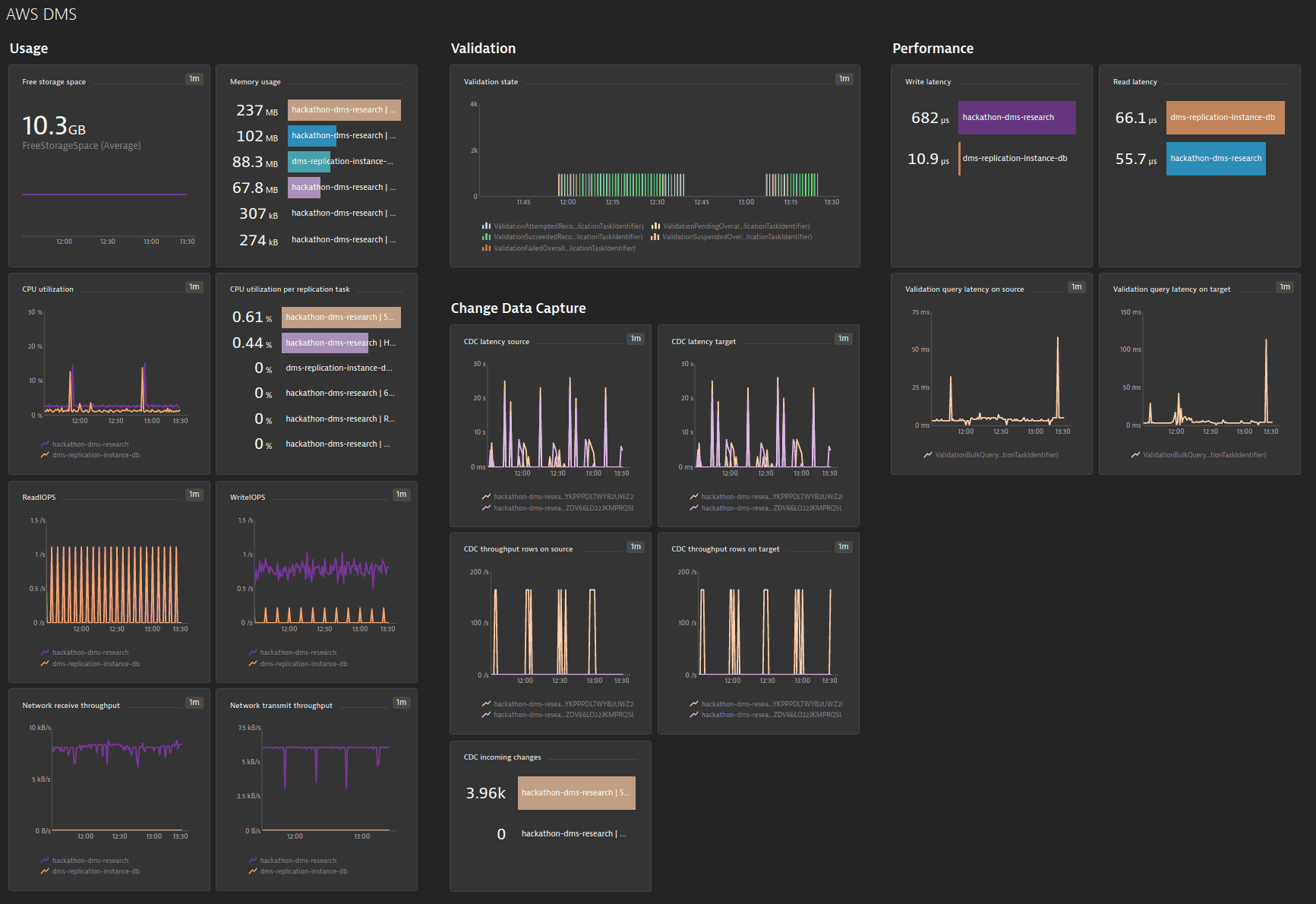
Available metrics
ReplicationInstanceIdentifier is the main dimension.
| Name | Description | Unit | Statistics | Dimensions | Recommended |
|---|---|---|---|---|---|
CDCChangesDiskSource | Amount of rows accumulating on disk and waiting to be committed from the source | Count | Sum | ReplicationInstanceIdentifier, ReplicationTaskIdentifier | |
CDCChangesDiskTarget | Amount of rows accumulating on disk and waiting to be committed to the target | Count | Sum | ReplicationInstanceIdentifier, ReplicationTaskIdentifier | |
CDCChangesMemorySource | Amount of rows accumulating in memory and waiting to be committed from the source | Count | Sum | ReplicationInstanceIdentifier, ReplicationTaskIdentifier | |
CDCChangesMemoryTarget | Amount of rows accumulating in memory and waiting to be committed to the target | Count | Sum | ReplicationInstanceIdentifier, ReplicationTaskIdentifier | |
CDCIncomingChanges | The total number of change events at a point in time that are waiting to be applied to the target | Count | Sum | ReplicationInstanceIdentifier, ReplicationTaskIdentifier |
|
CDCLatencySource | The gap, in seconds, between the last event captured from the source endpoint and the current system timestamp of the AWS DMS instance. CDCLatencySource represents the latency between source and replication instance. | Seconds | Multi | ReplicationInstanceIdentifier, ReplicationTaskIdentifier |
|
CDCLatencyTarget | The gap, in seconds, between the first event timestamp waiting to commit on the target and the current timestamp of the AWS DMS instance. CDCLatencyTarget represents the latency between replication instance and target. | Seconds | Multi | ReplicationInstanceIdentifier, ReplicationTaskIdentifier |
|
CDCThroughputBandwidthSource | Incoming data received for the source in KB per second | Kilobytes/Second | Multi | ReplicationInstanceIdentifier, ReplicationTaskIdentifier |
|
CDCThroughputBandwidthTarget | Outgoing data transmitted for the target in KB per second | Kilobytes/Second | Multi | ReplicationInstanceIdentifier, ReplicationTaskIdentifier |
|
CDCThroughputRowsSource | Incoming task changes from the source in rows per second | Count/Second | Multi | ReplicationInstanceIdentifier, ReplicationTaskIdentifier |
|
CDCThroughputRowsTarget | Outgoing task changes for the target in rows per second | Count/Second | Multi | ReplicationInstanceIdentifier, ReplicationTaskIdentifier |
|
CPUAllocated | The percentage of CPU maximally allocated for the task (0 means no limit) | Percent | Multi | ReplicationInstanceIdentifier, ReplicationTaskIdentifier | |
CPUUtilization | The amount of CPU used | Percent | Multi | ReplicationInstanceIdentifier, ReplicationTaskIdentifier |
|
CPUUtilization | Percent | Multi | ReplicationInstanceIdentifier |
| |
CPUUtilization | Percent | Multi | Region, ReplicationInstanceExternalResourceId |
| |
CPUUtilization | Percent | Multi | Region |
| |
CPUUtilization | Percent | Multi | Region, InstanceClass | ||
DiskQueueDepth | The number of outstanding I/Os (read/write requests) waiting to access the disk | Count | Multi | Region, ReplicationInstanceExternalResourceId | |
DiskQueueDepth | Count | Multi | Region | ||
DiskQueueDepth | Count | Multi | Region, InstanceClass | ||
DiskQueueDepth | Count | Multi | ReplicationInstanceIdentifier | ||
FreeStorageSpace | The amount of available storage space | Bytes | Multi | ReplicationInstanceIdentifier |
|
FreeStorageSpace | Bytes | Multi | Region, ReplicationInstanceExternalResourceId | ||
FreeStorageSpace | Bytes | Multi | Region | ||
FreeStorageSpace | Bytes | Multi | Region, InstanceClass | ||
FreeableMemory | The amount of available RAM | Bytes | Multi | ReplicationInstanceIdentifier |
|
FreeableMemory | Bytes | Multi | Region, ReplicationInstanceExternalResourceId | ||
FreeableMemory | Bytes | Multi | Region | ||
FreeableMemory | Bytes | Multi | Region, InstanceClass | ||
FullLoadThroughputBandwidthSource | Incoming data received from a full load from the source in kilobytes (KB) per second | Kilobytes/Second | Multi | ReplicationInstanceIdentifier, ReplicationTaskIdentifier |
|
FullLoadThroughputBandwidthTarget | Outgoing data transmitted from a full load for the target in kilobytes (KB) per second | Kilobytes/Second | Multi | ReplicationInstanceIdentifier, ReplicationTaskIdentifier |
|
FullLoadThroughputRowsSource | Incoming changes from a full load from the source in rows per second | Count/Second | Multi | ReplicationInstanceIdentifier, ReplicationTaskIdentifier |
|
FullLoadThroughputRowsTarget | Outgoing changes from a full load for the target in rows per second | Count/Second | Multi | ReplicationInstanceIdentifier, ReplicationTaskIdentifier |
|
MemoryAllocated | The maximum allocation of memory for the task (0 means no limits) | Megabytes | Multi | ReplicationInstanceIdentifier, ReplicationTaskIdentifier | |
MemoryUsage | The resident set size (RSS) occupied by a task. It indicates the portion of memory occupied by a task held in main memory (RAM). | Megabytes | Multi | ReplicationInstanceIdentifier, ReplicationTaskIdentifier |
|
NetworkReceiveThroughput | The incoming (receive) network traffic on the replication instance, including both customer database traffic and AWS DMS traffic used for monitoring and replication | Bytes/Second | Multi | ReplicationInstanceIdentifier |
|
NetworkReceiveThroughput | Bytes/Second | Multi | Region, ReplicationInstanceExternalResourceId | ||
NetworkReceiveThroughput | Bytes/Second | Multi | Region | ||
NetworkReceiveThroughput | Bytes/Second | Multi | Region, InstanceClass | ||
NetworkTransmitThroughput | The outgoing (transmit) network traffic on the replication instance, including both customer database traffic and AWS DMS traffic used for monitoring and replication | Bytes/Second | Multi | ReplicationInstanceIdentifier |
|
NetworkTransmitThroughput | Bytes/Second | Multi | Region, ReplicationInstanceExternalResourceId | ||
NetworkTransmitThroughput | Bytes/Second | Multi | Region | ||
NetworkTransmitThroughput | Bytes/Second | Multi | Region, InstanceClass | ||
ReadIOPS | The average number of disk read I/O operations per second | Count/Second | Multi | ReplicationInstanceIdentifier |
|
ReadIOPS | Count/Second | Multi | Region, ReplicationInstanceExternalResourceId | ||
ReadIOPS | Count/Second | Multi | Region | ||
ReadIOPS | Count/Second | Multi | Region, InstanceClass | ||
ReadLatency | The average amount of time taken per disk I/O (input) operation | Seconds | Multi | ReplicationInstanceIdentifier |
|
ReadLatency | Seconds | Multi | Region, ReplicationInstanceExternalResourceId | ||
ReadLatency | Seconds | Multi | Region | ||
ReadLatency | Seconds | Multi | Region, InstanceClass | ||
ReadThroughput | The average number of bytes read from disk per second | Bytes/Second | Multi | ReplicationInstanceIdentifier |
|
ReadThroughput | Bytes/Second | Multi | Region, ReplicationInstanceExternalResourceId | ||
ReadThroughput | Bytes/Second | Multi | Region | ||
ReadThroughput | Bytes/Second | Multi | Region, InstanceClass | ||
RecoveryCount | Count | Sum | ReplicationInstanceIdentifier, ReplicationTaskIdentifier |
| |
RunCounter | Count | Sum | ReplicationInstanceIdentifier, ReplicationTaskIdentifier |
| |
SwapUsage | The amount of swap space used on the replication instance | Bytes | Multi | ReplicationInstanceIdentifier |
|
SwapUsage | Bytes | Multi | Region, ReplicationInstanceExternalResourceId | ||
SwapUsage | Bytes | Multi | Region | ||
SwapUsage | Bytes | Multi | Region, InstanceClass | ||
ValidationAttemptedRecordCount | Number of rows that validation was attempted, per minute | Count | Sum | ReplicationInstanceIdentifier, ReplicationTaskIdentifier |
|
ValidationBulkQuerySourceLatency | AWS DMS can do data validation in bulk, especially in certain scenarios during a full-load or ongoing replication when there are many changes. This metric indicates the latency required to read a bulk set of data from the source endpoint. | Milliseconds | Multi | ReplicationInstanceIdentifier, ReplicationTaskIdentifier |
|
ValidationBulkQueryTargetLatency | AWS DMS can do data validation in bulk, especially in certain scenarios during a full-load or ongoing replication when there are many changes. This metric indicates the latency required to read a bulk set of data on the target endpoint. | Milliseconds | Multi | ReplicationInstanceIdentifier, ReplicationTaskIdentifier |
|
ValidationFailedOverallCount | Number of rows where validation failed | Count | Sum | ReplicationInstanceIdentifier, ReplicationTaskIdentifier |
|
ValidationItemQuerySourceLatency | During ongoing replication, data validation can identify ongoing changes and validate those changes. This metric indicates the latency in reading those changes from the source. | Milliseconds | Multi | ReplicationInstanceIdentifier, ReplicationTaskIdentifier | |
ValidationItemQueryTargetLatency | During ongoing replication, data validation can identify ongoing changes and validate the changes row by row. This metric gives us the latency in reading those changes from the target. | Milliseconds | Multi | ReplicationInstanceIdentifier, ReplicationTaskIdentifier | |
ValidationPendingOverallCount | Number of rows where the validation is still pending | Count | Sum | ReplicationInstanceIdentifier, ReplicationTaskIdentifier |
|
ValidationSucceededRecordCount | Number of rows that AWS DMS validated, per minute | Count | Sum | ReplicationInstanceIdentifier, ReplicationTaskIdentifier |
|
ValidationSuspendedOverallCount | Number of rows where validation was suspended | Count | Sum | ReplicationInstanceIdentifier, ReplicationTaskIdentifier |
|
WriteIOPS | The average number of disk write I/O operations per second | Count/Second | Multi | ReplicationInstanceIdentifier |
|
WriteIOPS | Count/Second | Multi | Region, ReplicationInstanceExternalResourceId | ||
WriteIOPS | Count/Second | Multi | Region | ||
WriteIOPS | Count/Second | Multi | Region, InstanceClass | ||
WriteLatency | The average amount of time taken per disk I/O (output) operation | Seconds | Multi | ReplicationInstanceIdentifier |
|
WriteLatency | Seconds | Multi | Region, ReplicationInstanceExternalResourceId | ||
WriteLatency | Seconds | Multi | Region | ||
WriteLatency | Seconds | Multi | Region, InstanceClass | ||
WriteThroughput | The average number of bytes written to disk per second | Bytes/Second | Multi | ReplicationInstanceIdentifier |
|
WriteThroughput | Bytes/Second | Multi | Region, ReplicationInstanceExternalResourceId | ||
WriteThroughput | Bytes/Second | Multi | Region | ||
WriteThroughput | Bytes/Second | Multi | Region, InstanceClass |
Limitations
To collect metrics about changes captured by the migration task (CDC metrics) on MySQL, the binary logging and automatic backup settings should be enabled.