Ready-made dashboards
- Latest Dynatrace
- Reference
- 9-min read
Dynatrace ready-made dashboards offer preconfigured data visualizations and filters designed for common scenarios like troubleshooting and optimization.
- Use them right out of the box
- Save a copy and customize your copy
Where to find ready-made dashboards
-
In Dynatrace, go to
 Dashboards.
-
Select All dashboards.
-
Select the Ready-made tab.
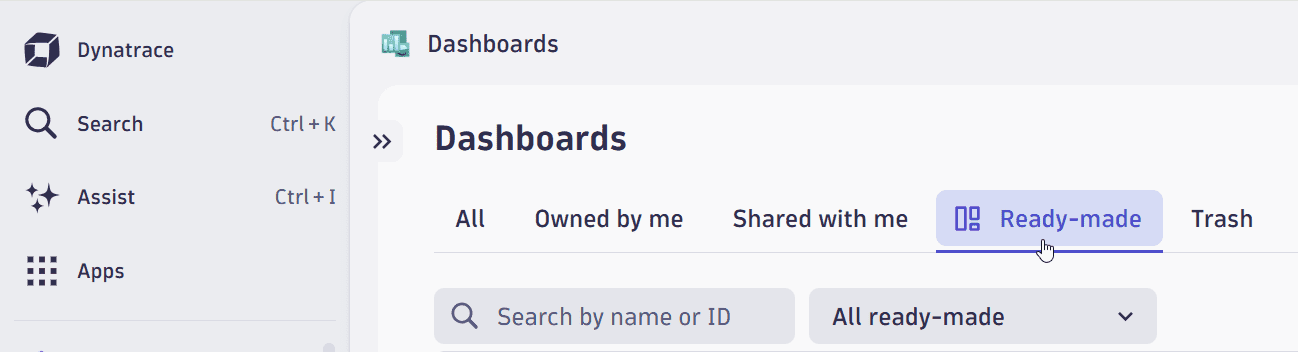 List ready-made dashboards
-
Select the ready-made dashboard you want to use.
Try the Explore in Playground links below to see them in action.
Using read-only dashboards
When you open a document (dashboard or notebook) for which you don't have write permission, you can still edit the document during your session. After you're finished, you have two options:
- Save your changes to a new document
- Discard your changes
Example:
-
Go to
Dashboards, list the ready-made dashboards, and select the Getting started dashboard.It says Ready-made in the upper-left corner, next to the document name.
-
Select the Pie chart tile and then select Edit.
-
Change the visualization from Pie to Donut.
Now you are offered two buttons: Save as new and Discard changes.
-
Use the updated dashboard as needed. You have full edit access for this session.
-
When you're finished, select what to do with your changes:
- Save as new—saves your changes in a new copy of the edited dashboard.
- Discard changes—discards your changes and returns you to the unedited read-only dashboard.
 AI Observability app
Explore ready-made dashboards owned by AI Observability app.
AI Data governance and audit trail - AI Observability
AI Evaluations and LLM-as-judge - AI Observability
Production quality, safety, drift, and runtime health for GenAI services — built on dt-evals business events.
The AI Evaluations and LLM-as-judge - AI Observability dashboard contains the following sections and tiles:
AI evaluation and LLM app performance
- Overall quality score single value
- Pass rate single value
- Failed evaluations single value
- Drift detections single value
- Evaluations single value
- Services evaluated single value
Evaluation trends and distribution
- Evaluator quality heatmap honeycomb chart
- Score distribution categorical chart
- Run cadence by service area chart
Per-AI-service evaluation health
- Service summary table
- Pass rate by service over time line chart
- Evaluations per service over time area chart
Run operations
- Recent dt-eval runs table
- Pass / fail volume area chart
Quality over time
- Pass rate by evaluator line chart
- Service × evaluator failure breakdown table
- Drift severity over time area chart
Runtime correlation
- Evaluation volume by judge provider pie chart
- Average score by judge model categorical chart
- Pass rate by service categorical chart
AI guardrail coverage
Monitor which AI services are protected by guardrails and how often safety policies are triggered.
The AI guardrail coverage dashboard contains the following sections and tiles:
Service coverage
-
Guardrail coverage by service table
Trace coverage per service - share of LLM traces that included at least one guardrail span. A service with low trace coverage may have guardrails configured but not applied to all requests.
Trace coverage
-
Trace guardrail coverage donut chart
Overall trace coverage - share of all LLM traces in the selected period that included at least one guardrail span, across all selected services.
-
LLM traces over time by guardrail status bar chart
LLM request volume over time, split by whether the trace was covered by a guardrail. A trace counts as covered when at least one guardrail span was observed within it.
Amazon Bedrock Guardrails
-
Bedrock calls - guardrail coverage donut chart
Bedrock trace coverage - Bedrock LLM spans split by whether a guardrail ID was attached. Spans without a guardrail ID were processed without going through a configured guardrail.
-
Guardrail inventory table
All Bedrock guardrails observed, with call volume and per-policy activation counts for content, PII/sensitive info, topics, and words policies. Requires AWS CloudWatch monitoring with the "Amazon Bedrock Guardrails" namespace enabled - see AWS CloudWatch metrics setup for instructions.
-
Policy activations by category donut chart
Policy activation counts by category - how often each Bedrock guardrail policy detected content matching its rules. An activation does not necessarily mean the request was blocked.
-
Activations by category over time bar chart
How often each Bedrock guardrail policy was activated over time. An activation means the policy evaluated and flagged content - not necessarily that the request was blocked.
Azure Content Safety
-
Input filter - activation rate donut chart
Share of Azure LLM spans where the content filter triggered on any category (hate, violence, sexual, self-harm, jailbreak). Safe = all categories returned severity 'safe' with no jailbreak detected.
-
Input filter - detections by category over time bar chart
Azure Content Safety prompt detections per category over time. Counts spans where hate/violence/sexual/self-harm severity was not 'safe', or jailbreak attempt was detected - not necessarily that the request was blocked.
AI Model versioning and A/B Testing - AI Observability
AI Observability Overview
Unified health, performance, cost, and conversation analytics across every GenAI provider, agent, and model.
The AI Observability Overview dashboard contains the following sections and tiles:
Health & performance overview
- Agents single value
- AI services single value
- Models single value
- LLM Providers single value
- Tokens single value
- Cost (approx.) single value
Agent performance — Agent Observability
- Provider list per agent table
Cost & token usage
- Token usage (input vs output) line chart
- Cost over time (approx.) line chart
- Approx. cost by model categorical chart
AI output quality — Online Evaluations
- Pass rate single value
- Failed evals single value
- Quality score single value
- Evaluations single value
- Quality score and pass rate over time line chart
Detected vulnerabilities in AI services
Overview of detected vulnerabilities in your AI services.
The Detected vulnerabilities in AI services dashboard contains the following sections and tiles:
Vulnerabilities
- All vulnerability findings single value
- Unique vulnerabilities single value
- Affected processes single value
- Affected packages single value
- Vulnerability details table
- Affected packages table
- Severity distribution pie chart
Coverage
- RVA coverage rate donut chart
- AI processes and RVA coverage table
 Anomaly Detection app
Explore ready-made dashboards owned by Anomaly Detection app.
Alert configuration health status
Track the health of custom alert detectors on your tenant. Identify failing detectors, the most common error messages, and which detectors trigger the most alerts.
The Alert configuration health status dashboard contains the following sections and tiles:
Custom alert health status
- Overall custom alerts last 24h honeycomb chart
- Last 24h single value
- Last 24h single value
- Last 24h single value
Breakdown by error messages
- Most common error messages categorical chart
- Error messages breakdown bar chart
- Summarized messages by config_id table
Breakdown by alerts triggered
- Summarized alerts by config_id over the last 24h table
- Summarized alerts by config_id over the last 24h honeycomb chart
Breakdown by billed bytes
- Top data usage per Custom Alerts Last 24h table
- Top data usage per Custom Alerts Last 24h line chart
Health alert health status
-
Last execution of alert configs honeycomb chart
Overall of all last execution result for each selected alert configuration.
-
Last execution - Success single value
Count the last success execution result for each selected alert configuration.
-
Last execution - Warning single value
Count the last warning execution result for each selected alert configuration.
-
Last execution - Failed single value
Count the last failed execution result for each selected alert configuration.
Breakdown by failed or warning messages
-
Warning or Failure Events bar chart
Shows all warning or failure events for each selected alert configuration.
-
FAILED Message table
-
WARNING Message table
 Clouds app
Explore ready-made dashboards owned by Clouds app.
AWS API Gateway HTTP and WebSocket
Quickly check high error rates for HTTP and WebSocket API Gateways.
The AWS API Gateway HTTP and WebSocket dashboard contains the following sections and tiles:
AWS API Gateway - HTTP and WebSocket
- Active Problems single value
- Active warning signals single value
- Active APIs single value
- API requests single value
- APIs error rate single value
- Error logs bar chart
- 4xx errors single value
- 5xx errors single value
Traffic
- Requests per API/stage line chart
- Data processed by stage line chart
- Errors by API/stage categorical chart
Latency
-
Integration latency line chart
The time between when API Gateway relays a request to the backend and when it receives a response from the backend.
-
Latency line chart
The time between when API Gateway receives a request from a client and when it returns a response to the client. The latency includes the integration latency and other API Gateway overhead.
Problems & Warnings
- Active problems details table
- Active warnings details table
Log Analytics
-
Log level distribution donut chart
Share of log records per severity level.
-
Log volume bar chart
Query Explanation: This DQL query visualizes pre-counted log status metrics (
dt.log.status_per_entity_count) grouped bystatusfor selected HTTP/WebSocket APIs, filtered by Smartscape ID ($SmartscapeId). It sorts the statuses in descending order based on their severity. -
Error and warning log patterns table
Query Explanation: This DQL query identifies recurring error and warning log patterns for selected HTTP/WebSocket APIs, filtered by AWS account (
$AccountId), region ($Region) and Smartscape ID ($SmartscapeId). Raw log messages are normalized by replacing volatile data (UUIDs, timestamps, IP addresses, numbers) with placeholders, then grouped by the resulting pattern and status to surface the most frequently occurring issues. -
Error and warning log stream table
Query Explanation: This DQL query fetches the 100 most recent error and warning logs from the last 15 minutes for selected HTTP/WebSocket APIs, filtered by AWS account (
$AccountId), region ($Region) and Smartscape ID ($SmartscapeId). Results are sorted by timestamp descending and display only the most relevant fields: time, status, content, API name and ID.
AWS API Gateway REST
Quickly check high error rates for REST API Gateways.
The AWS API Gateway REST dashboard contains the following sections and tiles:
AWS API Gateway - REST
- Active APIs single value
- API requests single value
- APIs error rate single value
- Error logs bar chart
- 4xx errors single value
- 5xx errors single value
- Cache hit ratio single value
Traffic
- Cache hits single value
- Errors by API/stage categorical chart
- Requests per API/stage line chart
- Cache misses single value
- Data processed by stage line chart
Latency
-
Integration latency line chart
The time between when API Gateway relays a request to the backend and when it receives a response from the backend.
-
Latency line chart
The time between when API Gateway receives a request from a client and when it returns a response to the client. The latency includes the integration latency and other API Gateway overhead.
Log Analytics
-
Log level distribution donut chart
Share of log records per severity level.
-
Log volume bar chart
Query Explanation: This DQL query visualizes pre-counted log status metrics (
dt.log.status_per_entity_count) grouped bystatusfor selected REST APIs, filtered by Smartscape ID ($SmartscapeId). It sorts the statuses in descending order based on their severity. -
Error and warning log patterns table
Query Explanation: This DQL query identifies recurring error and warning log patterns for selected REST APIs, filtered by AWS account (
$AccountId), region ($Region) and Smartscape ID ($SmartscapeId). Raw log messages are normalized by replacing volatile data (UUIDs, timestamps, IP addresses, numbers) with placeholders, then grouped by the resulting pattern and status to surface the most frequently occurring issues. -
Error and warning log stream table
Query Explanation: This DQL query fetches the 100 most recent error and warning logs from the last 15 minutes for selected REST APIs, filtered by AWS account (
$AccountId), region ($Region) and Smartscape ID ($SmartscapeId). Results are sorted by timestamp descending and display only the most relevant fields: time, status, content, API name and ID.
AWS Bedrock
View AWS Bedrock invocation counts, throttle rates, guardrail events, and average response time. Identify which models are driving the most traffic and where errors or throttles are occurring.
The AWS Bedrock dashboard contains the following sections and tiles:
Amazon Bedrock
- Agents single value
- Agent Alias single value
- Agent Alias per Agent categorical chart
- Guardrails single value
Invocations
- Total invocations single value
- Invocations line chart
- Top $Limit models per invocations line chart
- Input token vs Output token count bar chart
Latency
-
Average Total Time single value
The time it took for the server to process the request.
-
Total Time line chart
The time it took for the server to process the request.
-
Top $Limit models per latency line chart
Errors and Throttles
-
Total errors single value
The time it took for the server to process the request.
-
Client vs Server errors line chart
-
Invocation Throttles line chart
Agent throttles
Guardrail
-
Invocations line chart
Successful agent invocations
-
Invocations Intervened line chart
Successful agent invocations
-
Findings count line chart
Successful agent invocations
AWS DynamoDB
View the status of DynamoDB tables, including capacity unit usage, throttle rates, and latency. Spot user and system errors and track item return rates to detect unexpected query patterns.
The AWS DynamoDB dashboard contains the following sections and tiles:
AWS DynamoDB
-
Tables single value
Total DynamoDB tables across selected accounts and regions.
-
Throttled requests single value
Total throttled requests across all selected tables. Any value > 0 indicates capacity or hot partition issues.
-
System errors (5xx) single value
HTTP 500 errors — DynamoDB service-side issues.
-
User errors (4xx) single value
HTTP 400 errors — client-side issues (malformed requests, validation failures).
-
Conditional check failed requests single value
The number of failed attempts to perform conditional writes.
-
Transaction conflicts single value
Rejected item-level requests due to transactional conflicts between concurrent requests.
-
Active Problems single value
-
Active warning signals single value
-
Read capacity utilization % line chart
Consumed read capacity as a percentage of provisioned read capacity per table. Only applicable to provisioned capacity mode tables.
-
Write capacity utilization % line chart
Consumed write capacity as a percentage of provisioned write capacity per table. Only applicable to provisioned capacity mode tables.
Capacity and throttling
- Consumed read capacity units per second line chart
- Consumed write capacity units per second line chart
- Provisioned read capacity units line chart
- Provisioned write capacity units line chart
- Read throttle events by operation line chart
- Write throttle events by operation line chart
Latency
-
Max request latency single value
Maximum successful request latency across operations — reveals throttle-induced retry delays.
-
Successful request latency line chart
Average time (ms) for successful requests per operation. Does not include SDK retry time — correlate with Throttled Requests for full latency picture.
-
Average request latency single value
Maximum successful request latency across operations — reveals throttle-induced retry delays.
-
Latency by operation (avg) line chart
Average latency per DynamoDB operation. Latency varies by operation: GetItem ~5ms, Query ~10-50ms, Scan ~100ms+.
-
Latency by operation (max) line chart
Maximum latency per operation. High max latency often reveals throttle-induced SDK retries with exponential backoff.
Global Secondary Index (GSI) capacity
-
Consumed read capacity by GSI line chart
Consumed read capacity per GSI. GSIs have independent capacity from the base table.
-
Consumed write capacity by GSI line chart
Consumed write capacity per GSI. GSI write throttling causes ProvisionedThroughputExceededException on base table writes.
Problems & Warnings
- Active problems details table
- Active warnings details table
AWS EC2
View CPU utilization, network traffic, and disk activity for EC2 instances. See the breakdown by instance type, region, and account, plus Auto Scaling group status.
The AWS EC2 dashboard contains the following sections and tiles:
AWS EC2
-
Active EC2 instances single value
-
Active Problems single value
-
Active warning signals single value
-
Instances per region categorical chart
-
Instances per type categorical chart
-
Instances with highest CPU usage categorical chart
The most recent percentage of physical CPU time that Amazon EC2 uses to run the EC2 instance, which includes time spent to run both the user code and the Amazon EC2 code.
-
Status Check failures line chart
CPU and usage
- CPU utilization line chart
- CPU Credits Balance line chart
Network
-
Network input line chart
-
Network output line chart
-
Total network input single value
The total number of bytes received by the instance on all network interfaces.
-
Total network output single value
The total number of bytes sent out by the instance on all network interfaces.
AWS EBS
-
Volumes idle time bar chart
The total number of seconds in a specified period of time when no read or write operations were submitted. High idle time indicates underutilized resources like EBS volume attached to an EC2 instance that is not actively used.
-
Volumes queue length bar chart
The number of read and write operation requests waiting to be completed in a specified period of time.
-
Burst balance percentage line chart
Percentage of I/O credits (for gp2) or throughput credits (for st1 and sc1) remaining in the burst bucket.
Disk activity
- Read bytes line chart
- Write bytes line chart
- Read operations line chart
- Write operations line chart
AWS Auto Scaling groups
-
Auto Scaling groups by group max size categorical chart
-
Auto Scaling groups by desired capacity categorical chart
The number of instances that the Auto Scaling groups attempt to maintain.
-
In-service instances line chart
The number of instances that are running as part of the Auto Scaling group.
-
Pending instances bar chart
The number of instances that are pending. A pending instance is not yet in service.
-
Standby instances bar chart
The number of instances that are in a Standby state. Instances in this state are still running but are not actively in service.
-
Terminating instances line chart
The number of instances that are in the process of terminating. This metric does not include instances that are in service, pending, or returning to a warm pool after Auto Scaling group scale in.
Problems & Warnings
- Active problems details table
- Active warnings details table
AWS ECS
Track CPU and memory reservation and utilization for ECS tasks across clusters. Monitor network I/O to spot containers under resource pressure.
The AWS ECS dashboard contains the following sections and tiles:
AWS Elastic Container Service
-
Clusters single value
-
Average CPU utilization single value
-
Average memory utilization single value
The total percentage of memory being used by containers in the resource in a given period.
-
Active Problems single value
-
Active warning signals single value
-
CPU utilization by cluster line chart
-
Memory utilization by cluster line chart
-
CPU utilization by cluster and service line chart
-
Memory utilization by cluster and service line chart
Container Insights
-
Services single value
The number of services in the clusters in a given period.
-
Container instances single value
-
Deployments single value
-
Task sets single value
-
Tasks single value
-
Pending tasks single value
-
Desired tasks single value
-
Running tasks single value
CPU
- Average CPU units utilized single value
- CPU units utilized line chart
- CPU units reserved line chart
- Average CPU units reserved single value
Memory
- Average memory utilized single value
- Memory utilized line chart
- Memory reserved line chart
- Average memory reserved single value
Network
- Average network received single value
- Network received line chart
- Network transmitted line chart
- Average network transmitted single value
Storage
- Average storage read bytes single value
- Storage read bytes line chart
- Storage write bytes line chart
- Average storage write bytes single value
- Average ephemeral storage bytes utilized single value
- Ephemeral storage bytes utilized line chart
- Ephemeral storage bytes reserved line chart
- Average ephemeral storage bytes reserved single value
Problems & Warnings
- Active problems details table
- Active warnings details table
AWS Edge Networking
Monitor Route 53 health check status and CloudFront distribution performance. Track connection time, time to first byte, and health check outcomes by location.
The AWS Edge Networking dashboard contains the following sections and tiles:
AWS Edge Networking
- Active Problems single value
- Active warning signals single value
- CloudFront distributions error rate single value
- Health checks status split donut chart
- DNS queries per hosted zone donut chart
- CloudFront distributions single value
- Route 53 health checks single value
- Route 53 hosted zones single value
CloudFront distributions
-
Total bytes downloaded single value
-
Bytes downloaded line chart
The total number of bytes downloaded by viewers for GET and HEAD requests.
-
Total bytes uploaded single value
-
Bytes uploaded line chart
The total number of bytes that viewers uploaded to CloudFront, using OPTIONS, POST and PUT requests.
-
4xx error rate bar chart
The percentage of all viewer requests for which the response's HTTP status code is 4xx.
-
5xx error rate bar chart
The percentage of all viewer requests for which the response's HTTP status code is 5xx.
Route 53 Health Checks
-
Average connection time single value
-
Connection time line chart
The average time, in milliseconds, that it took Route 53 health checkers to establish a TCP connection with the endpoint.
-
Average time to first byte single value
-
Time to first byte line chart
The average time, in milliseconds, that it took Route 53 health checkers to receive the first byte of the response to an HTTP or HTTPS request.
Problems & Warnings
- Active problems details table
- Active warnings details table
AWS EFS
View throughput, storage size, and client connection counts for EFS file systems. Identify throughput bottlenecks and track permitted throughput utilization over time.
The AWS EFS dashboard contains the following sections and tiles:
AWS Elastic File System
- File systems by client connections categorical chart
- File systems by storage size categorical chart
- File systems single value
- Mounted targets single value
Usage
-
Average percentage of permitted throughput utilization single value
-
Percentage of permitted throughput utilization line chart
Ratio between metered IO bytes and total permitted throughput, in percentage. If you are reaching maximum capacity, then you are consuming the entire amount of throughput allocated to your file system. In this situation, you might consider changing the file system's throughput mode to get higher throughput.
-
Total IO processed bytes single value
-
Total IO bytes line chart
The actual number of bytes for each file system operation processed by Amazon EFS, without any read discounts.
-
Burst credit balance line chart
The number of burst credits that a file system has. Burst credits allow a file system to burst to throughput levels above a file system’s baseline level for periods of time.
AWS EKS
Monitor EKS cluster health, including pod and node resource usage, scheduler activity, and API server performance. Identify pending pods, webhook latency issues, and storage configuration.
The AWS EKS dashboard contains the following sections and tiles:
Amazon Elastic Kubernetes Service — Control Plane
-
Active Problems single value
-
Active warning signals single value
-
Clusters single value
Number of EKS clusters matching the current filters
-
Pending pods single value
Total number of pods pending scheduling — a rising trend indicates insufficient cluster capacity or scheduling constraints blocking pod placement
-
API 5XX errors single value
Total API server 5XX error rate — any non-zero value means the control plane is failing requests; investigate etcd connectivity and API server logs immediately
-
Error logs bar chart
Query Explanation: This DQL query shows the number of
ERRORlogs over time for the selected AWS EKS clusters. It uses thedt.log.status_per_entity_countmetric and groups the result by Smartscape source ID, so each selected EKS cluster is represented as a separate time series. The query filters the data to the selected Smartscape IDs ($SmartscapeId) and includes only logs withERRORstatus. The number of returned series is controlled by the$Limitdashboard variable. To make the result easier to read in a dashboard, the query performs a lookup againstAWS_EKS_CLUSTERSmartscape nodes and resolves each Smartscape source ID to the corresponding EKS cluster name. The resolved cluster name is exposed asaws.resource.name, while intermediate lookup fields and the raw Smartscape source ID are removed from the final result. -
Total API requests single value
Total API server request rate across selected clusters — a sudden drop may indicate the control plane is unreachable or severely throttled
-
Scheduler errors single value
Total scheduler error rate — errors mean pods could not be assigned to a node; non-zero values require investigation of node capacity, taints, or resource quotas
API server
-
API Requests by Cluster line chart
Total API server request rate per cluster — sorted by highest traffic to identify clusters under load
-
API Errors by Cluster line chart
Client (4XX) and server (5XX) error rates per cluster — sorted by highest 5XX rate to surface the most unreliable clusters first
-
etcd storage size by cluster line chart
etcd database size per cluster — a growing trend approaching the storage quota causes write failures and switches the cluster to read-only mode; consider compacting history or reviewing resource object retention policies
Scheduler
-
Schedule Attempts by Cluster line chart
Scheduler attempt rate split by outcome — error attempts mean the scheduler tried but failed to place a pod; sustained errors require investigation of resource constraints, taints, or affinity rules
-
Pending Pods by Cluster line chart
Breakdown of pending pods by queue state — unschedulable pods have no fitting node; backoff pods hit repeated failures; gated pods are held by scheduling gates; activeq pods are queued for immediate scheduling
Admission Webhooks
-
Webhook Requests by Cluster line chart
Admission webhook request rate split by type — mutating (admit) webhooks run first and may modify objects; validating webhooks enforce policy; a spike in either can slow or block deployments
-
Webhook Rejections by Cluster line chart
Admission webhook rejection count per cluster — rejections block resource creation or updates; a spike indicates policy violations or misconfigured webhooks causing deployment failures
-
Webhook Admission Duration by Cluster line chart
Average admission webhook processing time per cluster — slow webhooks (>1 s) directly extend API request latency and can cause controller timeouts; identify and optimize high-latency webhooks
Container Insights — Cluster
-
Total Nodes single value
Total number of worker nodes across selected clusters
-
Failed Nodes single value
Number of failed worker nodes — any non-zero value requires immediate investigation of node health and availability
-
Running Pods single value
Total number of running pods across selected clusters
Container Insights — Nodes
-
Node CPU Utilization by Cluster line chart
Average CPU utilization per node per cluster — sustained high values indicate under-provisioned capacity or resource-intensive workloads
-
Node Memory Utilization by Cluster line chart
Average memory utilization per node per cluster — high values risk OOM kills; consider scaling nodes or adjusting workload memory limits
-
Node Filesystem Utilization by Cluster line chart
Average filesystem utilization per node per cluster — nodes approaching full disk risk pod evictions and log pipeline failures
-
Node Network Traffic by Cluster line chart
Total network bytes across nodes per cluster — unexpected spikes may indicate data exfiltration, traffic amplification, or storage-intensive workloads
-
Running Pods & Containers by Cluster line chart
Running pods and containers per cluster — a large gap between the two indicates multi-container pods or sidecar overhead
Container Insights — Pods
-
Pod CPU Utilization by Cluster line chart
Average CPU utilization across pods per cluster — high values combined with pending pods indicate a need for cluster scaling
-
Pod Memory Utilization by Cluster line chart
Average memory utilization across pods per cluster — sustained high values combined with restart spikes typically indicate OOM kills
-
Pod Network Traffic by Cluster line chart
Network receive and transmit bytes across pods per cluster — correlate with application activity to identify traffic anomalies or bandwidth saturation
-
Container Restarts by Cluster bar chart
Total container restart count per cluster — high restart counts indicate crashlooping or OOM-killed workloads; clusters at the top need immediate investigation
-
Node GPU Usage by Cluster line chart
Total GPU units in use across nodes per cluster — only populated for clusters with GPU-accelerated instance types
-
Pod GPU Usage by Cluster line chart
Total GPU units in use across pods per cluster — only populated for clusters running GPU-accelerated workloads
Problems & Warnings
- Active problems details table
- Active warnings details table
Log Analytics
-
Log level distribution donut chart
Share of log records per severity level.
-
Log volume bar chart
Query Explanation: This DQL query shows log volume over time for the selected AWS EKS Smartscape entities. It uses the
dt.log.status_per_entity_countmetric to calculate the number of logs grouped by log status, such asERROR,WARN,INFOandNONE. The query filters the data to the selected Smartscape ID ($SmartscapeId), making the chart specific to the selected EKS cluster or related Kubernetes entity. A customsort_orderfield is added to control the display order of statuses by severity, with higher-severity statuses shown first. This helps quickly identify whether the selected EKS resources are producing warning or error logs during the selected timeframe. -
Error and warning log patterns (last 15 minutes) table
Query Explanation: This DQL query identifies recurring
ERRORandWARNlog patterns for selected AWS EKS clusters. It fetches logs for the selected Smartscape IDs, AWS account and region, then normalizes the log content to reduce high-cardinality noise caused by values such as UUIDs, ARNs, container runtime IDs, image digests, timestamps, IP addresses, hexadecimal values, Kubernetes-generated suffixes and standalone numbers. Logs are grouped by normalized pattern, status and cluster name. For each recurring pattern, the query keeps the EKS cluster with the highest number of occurrences, helping identify which cluster is most affected by a repeated issue. Results are sorted by frequency and include a sample raw log entry for investigation. -
Live log stream (last 15 minutes) table
Query Explanation: This DQL query fetches the 100 most recent logs from a fixed 15-minute timeframe for selected AWS EKS clusters. It filters logs by selected Smartscape ID (
$SmartscapeId), AWS account ($AccountId) and AWS region ($Region). The query displays the raw log content asLog messageand derives the cluster name from available EKS, Kubernetes or AWS resource metadata. Results are sorted by timestamp descending and show the most relevant fields for live troubleshooting: time, status, log message, cluster name and Smartscape source ID.
AWS ElastiCache
View the status and resource usage of ElastiCache clusters for both Redis/Valkey and Memcached. Track cache hits and misses, current connections, and available cluster counts.
The AWS ElastiCache dashboard contains the following sections and tiles:
AWS Elasticache
-
Active Problems single value
-
Active warning signals single value
-
Available cache clusters donut chart
-
Cache clusters by engine categorical chart
-
Current connections line chart
-
Evictions by cache categorical chart
Number of keys that have been evicted due to max memory limit.
-
Engine memory usage line chart
Host-level metrics
-
CPU utilization (host) line chart
The percentage of CPU utilization for the entire host.
-
Freeable memory (host) line chart
The amount of free memory available on the host.
-
Total network bytes in (host) single value
-
Network bytes in (host) line chart
-
Network bytes out (host) line chart
-
Total network bytes out (host) single value
Redis/Valkey
-
Cache hit rate line chart
Efficiency of the cache instance. If the cache ratio is lower than about 0.8, it means that a significant number of keys are evicted, expired, or don't exist.
-
Hits and misses by cache categorical chart
Number of successful and unsuccessful key lookups in the cache.
-
Engine CPU utilization line chart
-
Bytes used line chart
-
Average successful read request latency single value
-
Successful read request latency line chart
-
Successful write request latency line chart
-
Average successful write request latency single value
Memcached
-
Cache hit rate line chart
Efficiency of the cache instance. If the cache ratio is lower than about 0.8, it means that a significant number of keys are evicted, expired, or don't exist.
-
Hits and misses by cache categorical chart
Number of successful and unsuccessful key lookups in the cache.
-
Unused memory line chart
-
Bytes used table
-
Total network bytes in single value
-
Network bytes in line chart
-
Network bytes out line chart
-
Total network bytes out single value
Problems & Warnings
- Active problems details table
- Active warnings details table
AWS ELB
Monitor ALB, Classic, and NLB load balancers. Track 4xx/5xx error rates, target health, and response times to identify unhealthy backends or load balancers under excessive error load.
The AWS ELB dashboard contains the following sections and tiles:
AWS Elastic Load Balancing
-
Elastic load balancers single value
-
ALB unhealthy rate single value
Percentage of targets that are considered unhealthy in a given period.
-
NLB unhealthy rate single value
Percentage of targets that are considered unhealthy in a given period.
-
CLB unhealthy rate single value
Percentage of unhealthy instances registered with your load balancer in a given period.
-
Active Problems single value
-
Active warning signals single value
-
ALB error rate single value
Percentage of errors hat originate from the load balancer in a given period.
-
ALB target error rate single value
Percentage of errors generated by the targets in a given period.
-
CLB backend error rate single value
Percentage of HTTP response codes generated by registered instances in a given period.
AWS Application Load Balancer
-
Active connections single value
-
Healthy and unhealthy hosts by load balancer categorical chart
-
Healthy hosts single value
-
Unhealthy hosts single value
-
Requests line chart
The number of requests processed over IPv4 and IPv6 through time in a given period. This metric is only incremented for requests where the load balancer node was able to choose a target. Requests that are rejected before a target is chosen are not reflected in this metric.
-
Target response time line chart
The time elapsed, in seconds, after the request leaves the load balancer until the target starts to send the response headers through time in a given period.
Errors
- ELB 4xx responses single value
- ELB error and successful requests by load balancer categorical chart
- ELB 5xx responses single value
- Target 4xx responses single value
- Target error and successful requests by load balancer categorical chart
- Target 5xx responses single value
AWS Network Load Balancer
-
Active flows (TCP+TLS+UDP) single value
The total number of concurrent flows (or connections) from clients to targets in a given period, summed across TCP, TLS, and UDP protocols.
-
Total TCP client resets single value
The total number of reset (RST) packets sent from a client to a target in a given period. These resets are generated by the client and forwarded by the load balancer.
-
Total TCP ELB resets single value
The total number of reset (RST) packets generated by the load balancer in a given period.
-
Total TCP target resets single value
The total number of reset (RST) packets sent from a target to a client in a given period. These resets are generated by the target and forwarded by the load balancer.
-
Healthy hosts single value
-
Healthy and unhealthy hosts by load balancer categorical chart
-
Unhealthy hosts single value
AWS Classic Load Balancer
-
Healthy hosts single value
-
Healthy and unhealthy hosts by load balancer categorical chart
Distribution of healthy and unhealthy instances registered with your load balancer in a given period.
-
Unhealthy hosts single value
-
Requests line chart
The number of requests completed or connections made during the specified interval through time in a given period.
-
Latency line chart
The total time elapsed, in seconds, from the time the load balancer sent the request to a registered instance until the instance started to send the response headers through time in a given period.
Errors
-
ELB 4xx responses single value
-
ELB 5xx responses single value
-
Backend error and successful requests by load balancer categorical chart
-
Backend 4xx responses single value
-
Backend 5xx responses single value
-
Backend connection errors line chart
The number of connections that were not successfully established between the load balancer and the registered instances through time in a given period.
-
Backend connection errors by load balancer categorical chart
Problems & Warnings
- Active problems details table
- Active warnings details table
AWS EventBridge
Track EventBridge event flow and reliability. Monitor matched events, invocation attempts, and ingestion-to-invocation latency to identify delivery delays or failures.
The AWS EventBridge dashboard contains the following sections and tiles:
AWS EventBridge
-
Active Problems single value
-
Active warning signals single value
-
Active EventBridge instances single value
Number of all active event buses in the environment.
-
invocation attempts categorical chart
Number of times each target EventBus was successfully invoked.
-
Successful invocation attempts single value
A percentage of times target was successfully invoked.
-
Invocation attempts line chart
Number of times EventBridge attempted invoking a target.
-
Matched events donut chart
The number of events that matched with any rule.
-
Triggered rules donut chart
The number of rules that have run and matched with any event.
-
Throttled rules donut chart
The number of times rule execution was throttled.
-
Ingestion to invocation start latency line chart
The time to process events, measured from when an event is ingested by EventBridge to the first invocation of a target.
-
Ingestion to invocation success latency line chart
The time taken from event ingestion to successful target delivery, using the invocation end time as cutoff.
-
Ingestion to invocation complete latency line chart
The time taken from event ingestion to completion of the first invocation attempt.
Problems & Warnings
- Active problems details table
- Active warnings details table
AWS Foundation Networking
Monitor AWS NAT Gateway connection status and PrivateLink endpoint performance. Track active connections, packet flows, and port allocation errors to diagnose network path issues.
The AWS Foundation Networking dashboard contains the following sections and tiles:
AWS Foundation Networking
-
Percentage of established connections through NAT gateways single value
The percentage established connections made through the NAT gateway in a given period.
-
NAT gateways single value
Number of NAT Gateways in the environment.
-
PrivateLink connections single value
The number of endpoints connected to all endpoint services.
AWS NAT Gateway
- Active connections single value
- Idle timeouts single value
- Packet drops single value
- Port allocation errors single value
- Connection attempts line chart
- Established connections line chart
Bytes received/sent by the Gateway
-
Total bytes received from source single value
-
Bytes received from source line chart
The number of bytes received by the NAT gateway from clients in your VPC.
-
Bytes sent to source line chart
The number of bytes sent through the NAT gateway to the clients in your VPC.
-
Total bytes sent to source single value
-
Total bytes sent to destination single value
-
Bytes sent to destination line chart
The number of bytes sent out through the NAT gateway to the destination.
-
Bytes received from destination line chart
The number of bytes received by the NAT gateway from the destination.
-
Total bytes received from destination single value
Packets received/sent by the Gateway
- Total packets received from source single value
- Packets received from source line chart
- Packets sent to source line chart
- Total packets sent to source single value
- Total packets sent to destination single value
- Packets sent to destination line chart
- Packets received from destination line chart
- Total packets received from destination single value
Providers - Endpoint Services
-
Active connections by endpoint service ID categorical chart
-
Bytes processed line chart
The number of bytes exchanged between endpoint services and endpoints, in both directions.
-
Reset packets sent line chart
Consumers - Interface or Gateway LB endpoints
-
Active connections by service name bar chart
-
Bytes processed line chart
The number of bytes exchanged between endpoints and endpoint services, aggregated in both directions. This is the number of bytes billed to the owner of the endpoint.
-
Packets dropped line chart
-
Reset packets received line chart
AWS Health Events
View account-specific and public AWS health events by region, account, and service. Filter between event categories to quickly assess the impact of AWS service disruptions on your environment.
The AWS Health Events dashboard contains the following sections and tiles:
AWS Health events
- Health events by account pie chart
- Account-specific health events by region pie chart
- Account-specific health events by service pie chart
Account-specific events
- Total events single value
- Events by status categorical chart
- Events by category categorical chart
Public events
- Total events single value
- Events by status categorical chart
- Events by category categorical chart
All events
- Account-specific health events table
AWS Lambda
Monitor Lambda function invocations, error rates, duration, and concurrency. View per-function error counts to identify failing functions and track execution trends over time.
The AWS Lambda dashboard contains the following sections and tiles:
AWS Lambda
-
Errors % single value
Percentage value of invocations that resolved in errors for every Lambda function that fits filtering.
-
Errors single value
Count of invocations that resolved in errors for every Lambda function that fits filtering.
-
Throttles single value
Percentage value of execution of Lambda functions to that were limiting to prevent overwhelming the function.
-
Invocations single value
Total number of invocations for every Lambda function that fits filtering.
-
Active Problems single value
-
Active warning signals single value
Errors
-
Errors line chart
Time series of invocations that result in a function error.
-
Function invocations and error count categorical chart
The invocations count in comparison to the invocation that resulted in an error.
-
Error logs bar chart
Usage and performance
-
Duration line chart
The amount of time that function code spends processing an event - does not include cold start time.
-
Concurrent executions line chart
Number of function instances that are actively processing events at given time.
-
Throttles line chart
The number of invocation requests that were throttled because the concurrency limit was exceeded.
-
Async events dropped table
The number of asynchronous events that were dropped without being successfully processed.
-
Post runtime extensions duration table
The time spent by Lambda Extensions to complete final tasks, after your function's code has finished executing.
Problems & Warnings
- Active problems details table
- Active warnings details table
Log Analytics
-
Log level distribution donut chart
Share of log records per severity level.
-
Log volume bar chart
Query Explanation: This DQL query visualizes pre-counted log status metrics (
dt.log.status_per_entity_count) grouped bystatusfor selected Lambda functions, filtered by Smartscape ID ($SmartscapeId). It sorts the statuses in descending order based on their severity. Why this visualization is useful: Using a bar chart to display this data provides a clear visual representation of log severity distribution across the selected Lambda functions. It helps quickly identify the prevalence of critical issues (ERROR) compared to less severe statuses (INFO,WARNorNONE), enabling efficient prioritization of troubleshooting efforts. -
Error and warning log patterns (last 15 minutes) table
Query Explanation: This DQL query identifies recurring error and warning log patterns for selected Lambda functions, filtered by AWS account (
$AccountId), region ($Region) and Smartscape ID ($SmartscapeId). Raw log messages are normalized by replacing volatile data (UUIDs, timestamps, IP addresses, numbers) with placeholders, then grouped by the resulting pattern and status to surface the most frequently occurring issues. Why this visualization is useful: Using a table to display this data provides a clear overview of the most common error and warning patterns across the selected Lambda functions. By normalizing volatile fields, similar log messages are grouped together rather than appearing as unique entries - making it easy to spot recurring issues, prioritize the most impactful problems by occurrence count, and focus troubleshooting efforts where they matter most. -
Live log stream (last 15 minutes) table
Query Explanation: This DQL query fetches the 100 most recent error and warning logs from the last 15 minutes for selected Lambda functions, filtered by AWS account (
$AccountId), region ($Region) and Smartscape ID ($SmartscapeId). Results are sorted by timestamp descending and display only the most relevant fields: time, status, message, function name and ID. Why this visualization is useful: Using a table to display this data provides a real-time stream of the latest critical log entries across selected Lambda functions. It enables immediate visibility into ongoing errors and warnings, allowing teams to quickly react to live issues, trace problems to specific functions via theFunction Namecolumn, and monitor the health of their Lambda environment as it happens.
AWS Managed Streaming for Apache Kafka
Track throughput, replication health, and connection status for MSK Kafka clusters. Monitor bytes in/out per second and messages per second to detect bottlenecks or replication lag.
The AWS Managed Streaming for Apache Kafka dashboard contains the following sections and tiles:
Amazon Managed Streaming for Apache Kafka
- Clusters single value
- CPU system line chart
- CPU user line chart
- Total connections single value
- Client connections single value
Health
- Active controller count line chart
- Offline partitions count line chart
- Partitions per broker line chart
- Network Rx errors line chart
- Network Tx errors line chart
Performance
- Max offset lag single value
- Estimated max time lag single value
- Sum offset lag line chart
Throughput
- Average Bytes In per cluster categorical chart
- Bytes in per second line chart
- Bytes out per second line chart
- Average Bytes Out per cluster categorical chart
- Messages in per second line chart
Replication
- Under replicated partitions line chart
- Replication bytes in per second line chart
- Replication bytes out per second line chart
AWS Overview
High-level view of EC2 instances alongside CloudWatch logs and service problems. See instance distribution by type, availability zone, and account, plus network I/O trends.
The AWS Overview dashboard contains the following sections and tiles:
Problems
-
Active problems single value
-
Problems by region pie chart
-
Active problem details pie chart
-
Error logs bar chart
Query Explanation: This DQL query shows the number of ERROR logs over time for AWS-related Smartscape entities. It uses the dt.log.status_per_entity_count metric and groups the result by Smartscape source ID, so each AWS resource is represented as a separate time series. The query includes only sources whose Smartscape type starts with AWS_ and filters the data to logs with ERROR status. To make the result easier to read in an AWS overview dashboard, the query performs a lookup against AWS Smartscape nodes and resolves each Smartscape source ID to the corresponding resource name. The resolved name is exposed as aws.resource.name, while intermediate lookup fields and the raw Smartscape source ID are removed from the final result.
-
Active warning signals single value
-
Active problems details table
-
Active warnings details table
EC2 overview
- EC2 instances single value
- Top 10 AWS accounts with EC2 instances categorical chart
- Top 10 Availability zones running EC2 instances categorical chart
- Top 10 EC2 instance types categorical chart
- Network: EC2 instances by Network out (bytes) line chart
- Network: EC2 instances by Network in (bytes) line chart
- EC2 CPU utilization honeycomb chart
Autoscaling groups
- Auto scaling groups single value
- Top 10 AWS accounts with Autoscaling groups categorical chart
- Desired Capacity line chart
- In Service Instances line chart
EKS clusters
- EKS Clusters single value
- Top 10 accounts with EKS clusters categorical chart
- 5xx errors line chart
- 4xx errors line chart
ECS clusters
- ECS Services single value
- Top 10 accounts with ECS clusters categorical chart
- CPU Utilization line chart
- Memory Utilization line chart
Non compute resources
- Databases pie chart
- Storage and File System pie chart
- Serverless pie chart
- Networking and Content Delivery pie chart
Log Analytics
-
Log level distribution donut chart
Share of log records per severity level.
-
Log volume bar chart
Query Explanation: This DQL query shows AWS log volume over time grouped by log status. It uses the dt.log.status_per_entity_count metric and includes only logs from Smartscape sources whose type starts with AWS_, making it suitable for an AWS overview dashboard across multiple AWS services and resource types. The query groups the time series by status, such as ERROR, WARN, INFO and NONE. A custom sort_order field is added to control the display order by severity. ERROR logs are assigned the highest priority, followed by WARN, INFO, NONE and any other statuses. The result is sorted by this severity order in descending order, so the most important log statuses appear first in the dashboard visualization.
-
Error and warning log patterns (last 15 minutes) table
Query Explanation: This DQL query identifies recurring ERROR and WARN log patterns across AWS-related Smartscape entities. It fetches logs from sources whose Smartscape type starts with AWS_, making it suitable for an AWS overview dashboard that spans multiple AWS services and resource types. The query derives key AWS context fields, including source type, resource, account and region. It then normalizes the raw log content to reduce high-cardinality noise caused by values such as UUIDs, ARNs, timestamps, IP addresses, hexadecimal values, alphanumeric identifiers and standalone numbers. Logs are grouped by normalized pattern, status and AWS resource metadata. For each recurring pattern, the query keeps the AWS resource with the highest number of occurrences, helping identify which resource is most affected by a repeated warning or error. Results are sorted by frequency and include a sample raw log entry to support investigation.
-
Live log stream (last 15 minutes) table
Query Explanation: This DQL query fetches the 100 most recent logs from AWS-related Smartscape entities. It selects logs where the Smartscape source type starts with AWS_, making the result suitable for an AWS overview dashboard that spans multiple AWS services and resource types. The query displays the raw log content as Log message and derives a readable AWS Resource value from available AWS metadata, using the resource name first, then the resource ID, and finally the Smartscape source ID as a fallback. Additional AWS context is included, such as source type, account and region. Results are sorted by timestamp descending and show the key fields needed for live troubleshooting: time, status, log message, AWS source type, AWS resource, AWS account, AWS region and Smartscape source ID.
AWS RDS
Analyze RDS instance storage, network throughput, and query latency. Monitor read and write latency, free storage space, and swap usage to detect performance degradation early.
The AWS RDS dashboard contains the following sections and tiles:
AWS Relational Database Service
-
Active Problems single value
-
Active warning signals single value
-
Database instances single value
-
Average network receive throughput single value
-
Average read latency single value
-
Error logs bar chart
Query Explanation: This DQL query shows the number of
ERRORlogs over time for the selected Amazon RDS instances. It uses thedt.log.status_per_entity_countmetric and groups the result by Smartscape source ID, so each selected RDS instance is represented as a separate time series. The query filters the data to the selected RDS Smartscape IDs ($InstanceSmartscapeId) and includes only logs withERRORstatus. The number of returned series is controlled by the$Limitdashboard variable. To make the result easier to read in a dashboard, the query performs a lookup against AWS RDS Smartscape nodes and resolves each Smartscape source ID to the corresponding database instance name. The resolved name is exposed asaws.resource.name, while intermediate lookup fields and the raw Smartscape source ID are removed from the final result. -
Average network transmit throughput single value
-
Average write latency single value
-
Database instances by class categorical chart
-
Database instances by engine categorical chart
-
CPU utilization line chart
-
Database connections line chart
Network
- Network receive throughput line chart
- Network transmit throughput line chart
Latency
- Read latency line chart
- Write latency line chart
Storage
-
Free storage space line chart
-
Freeable memory line chart
The amount of available random access memory.
-
Swap usage line chart
AWS Aurora
-
Read IO operations line chart
The number of billed read I/O operations from a cluster volume within a 5-minute interval.
-
Write IO operations line chart
The number of write disk I/O operations to the cluster volume, reported at 5-minute intervals.
-
Volume bytes used line chart
Problems & Warnings
- Active problems details table
- Active warnings details table
Log Analytics
-
Log level distribution donut chart
Share of log records per severity level.
-
Log volume bar chart
Query Explanation: This DQL query shows log volume over time by status for the selected Amazon RDS instances. It uses the
dt.log.status_per_entity_countmetric and groups results by log status, such asERROR,WARN,INFOandNONE. The query filters the data to the selected RDS Smartscape IDs ($InstanceSmartscapeId), making the result specific to the selected database instances. A customsort_orderfield is added to control how statuses are displayed in the dashboard. Statuses are ordered by severity, withERRORandWARNprioritized above informational or empty-status logs. This makes it easier to quickly assess whether selected RDS instances are producing warning or error logs during the selected timeframe. -
Error and warning log patterns (last 15 minutes) table
Query Explanation: This DQL query identifies recurring
ERRORandWARNlog patterns for selected Amazon RDS instances. It fetches logs for the selected RDS Smartscape IDs, AWS account and region, then normalizes the raw log content to reduce high-cardinality noise caused by values such as UUIDs, ARNs, timestamps, client IP addresses, hexadecimal values, durations and numeric identifiers. Logs are grouped by normalized pattern, status and DB instance. For each recurring pattern, the query keeps the RDS instance with the highest number of occurrences, helping identify which database instance is most affected by a repeated issue. Results are sorted by frequency and include a sample raw log entry to support investigation. -
Live log stream (last 15 minutes) table
Query Explanation: This DQL query fetches the 100 most recent logs for selected Amazon RDS instances. It filters logs by selected RDS Smartscape ID, AWS account and AWS region. The query displays the raw log content as
Log messagewithout parsing or transforming the payload. It also derives a readableDB instancevalue from available AWS resource metadata, falling back to the Smartscape source ID when no resource name is available. Results are sorted by timestamp descending and show the key fields needed for live troubleshooting: time, status, log message, DB instance, AWS resource ID and Smartscape source ID.
AWS S3
Identify S3 buckets with high error rates relative to their request volume. Track 4xx and 5xx errors, request counts by bucket, and latency trends.
The AWS S3 dashboard contains the following sections and tiles:
AWS S3
- S3 buckets single value
- Error rate by bucket categorical chart
- Request count by bucket categorical chart
Errors
- Total 4xx error count single value
- 4xx errors line chart
- 5xx errors line chart
- Total 5xx error count single value
Latencies
-
Average request latency single value
The elapsed per-request time from the first byte received to the last byte sent to an Amazon S3 bucket.
-
Request latency line chart
The elapsed per-request time from the first byte received to the last byte sent to an Amazon S3 bucket.
-
First byte latency line chart
The elapsed per-request time from the first byte received to the last byte sent to an Amazon S3 bucket.
-
Average first byte latency single value
The elapsed per-request time from the first byte received to the last byte sent to an Amazon S3 bucket.
Usage
- Total bytes downloaded single value
- Bytes downloaded line chart
- Bytes uploaded line chart
- Total bytes uploaded single value
Requests
-
All requests count single value
-
All requests bar chart
-
Get requests line chart
-
Total count of GET requests for all buckets single value
-
Head requests count line chart
The number of HEAD requests made for objects in an S3 bucket.
AWS SNS
View the delivery status of SNS notifications, including total published messages, failed deliveries, and filtered-out notifications across topics.
The AWS SNS dashboard contains the following sections and tiles:
AWS SNS
- Topics single value
- Messages published single value
- Notifications failed single value
- Notifications delivered single value
- Notifications filtered out single value
- Active Problems single value
- Active warning signals single value
- Number of subscriptions by topic categorical chart
- Size of published messages by topic categorical chart
Notification status over time
- Messages published line chart
- Notifications delivered line chart
- Notifications failed line chart
- Notifications filtered out line chart
- SMS success rate line chart
- Notifications driven to DLQ line chart
Problems & Warnings
- Active problems details table
- Active warnings details table
AWS SQS
Track message flow across SQS queues, including sent, received, and deleted message counts. Monitor empty receive rates to detect idle queues or backlog buildup.
The AWS SQS dashboard contains the following sections and tiles:
AWS SQS
- Queues single value
- Messages received single value
- Messages sent single value
- Empty receives single value
- Messages deleted single value
- Active Problems single value
- Active warning signals single value
- Last age of oldest message by queue bar chart
- Total size of messages by queue categorical chart
Messages status over time
-
Messages received line chart
-
Messages sent line chart
-
Empty receives line chart
-
Messages deleted line chart
-
Age of oldest message line chart
Timeseries of age of the oldest message, per queue.
-
Approximate messages visible line chart
-
Approximate messages not visible line chart
-
Approximate messages delayed per queue line chart
Problems & Warnings
- Active problems details table
- Active warnings details table
Azure AKS Cluster
Monitor the health and performance of your Azure Kubernetes Service clusters.
The Azure AKS Cluster dashboard contains the following sections and tiles:
Azure Kubernetes Service
-
Active Problems single value
-
Active warning signals single value
-
Clusters single value
Number of AKS managed clusters matching the current filters
-
Avg Node CPU single value
Average node CPU utilization across all selected clusters - values above 80% risk pod evictions and scheduling failures
-
Max Node CPU single value
Peak node CPU utilization across all selected clusters - a hotspot node above 90% may cause pod throttling or OOMkills on co-located workloads
-
Avg Node Memory single value
Average node memory working set utilization across all selected clusters - above 85% risks pod evictions due to memory pressure
-
Avg API Server CPU single value
Average Kubernetes API server CPU utilization across all selected clusters - elevated values indicate heavy request load or inefficient controllers; sustained high CPU can increase API request latency
-
Avg API Server Memory single value
Average Kubernetes API server memory utilization across all selected clusters - high memory usage can lead to OOM restarts of the API server, causing temporary control plane unavailability
API Server Resource Utilization
-
API Server CPU usage percentage by Cluster line chart
API server CPU utilization per cluster; clusters with highest average shown first - a rising trend often correlates with increased request volume or runaway controllers issuing excessive LIST or WATCH calls
-
API Server Memory usage percentage by Cluster line chart
API server memory utilization per cluster; clusters with highest average shown first - memory growth above 85% risks OOM kills of the API server process, causing brief control plane outages until the pod restarts
-
Inflight Requests by Cluster line chart
Number of currently active in-flight requests to the API server per cluster - a sustained high count indicates the API server is under heavy load and may start throttling or rejecting requests
-
Inflight Requests by Cluster and Request Kind line chart
In-flight API server requests broken down by cluster and request kind (mutating vs read-only) - a spike in mutating requests often signals a deployment rollout or a misconfigured controller creating excessive write traffic
Node Resource Utilization
-
Node CPU usage percentage by Cluster line chart
Average node CPU utilization per cluster; clusters with highest average shown first - sustained high usage indicates a need to scale out node pools
-
Node Memory usage percentage by Cluster line chart
Average node memory working set utilization per cluster; clusters with highest average shown first - memory pressure above 85% triggers the kubelet eviction manager
-
Node Memory Working Set by Cluster line chart
Node memory working set in bytes per cluster - the active working set excludes reclaimable pages and is the primary figure kubelet uses for eviction decisions
-
Allocatable CPU Cores by Cluster bar chart
Discrete CPU core capacity allocatable to pods per cluster - changes reflect node pool scaling events; compare against CPU usage % to assess headroom
-
Allocatable Memory by Cluster line chart
Memory allocatable to pods per cluster in bytes - a falling trend without a corresponding drop in usage indicates nodes were removed and capacity is shrinking
etcd Resource utilization
-
etcd DB Usage percentage by Cluster line chart
etcd database usage percentage per cluster - high values approaching 100% risk write failures and cluster instability; consider compacting or defragmenting the etcd database
-
etcd CPU percentage by Cluster line chart
etcd CPU usage percentage per cluster - elevated CPU on the etcd control plane can slow key-value operations and delay Kubernetes API responses across the cluster
-
etcd Memory percentage by Cluster line chart
etcd memory usage percentage per cluster - high memory pressure on etcd can trigger OOM events that restart the control plane component, causing temporary API unavailability
Cluster Autoscaling
-
Cluster safe to autoscale honeycomb chart
Whether the cluster autoscaler considers the cluster safe to scale per cluster - an unsafe state means autoscaling is blocked, which can prevent the cluster from responding to workload demand
-
Scale down in cooldown honeycomb chart
Whether the cluster autoscaler scale-down is in a cooldown period per cluster - during cooldown no nodes are removed, which is normal after a recent scale event but a prolonged cooldown may delay cost savings
-
Unneeded nodes count bar chart
Number of nodes the cluster autoscaler has identified as unneeded and eligible for removal - a persistently high count with scale-down blocked may indicate autoscaler misconfiguration or pod disruption budgets preventing eviction
-
Unschedulable pods count bar chart
Number of pods that cannot be scheduled due to insufficient cluster capacity - a non-zero value means workloads are pending; investigate node pool limits or resource requests that exceed available headroom
Problems & Warnings
- Active problems details table
- Active warnings details table
Azure API Management Service
High-level overview of the status, traffic, and reliability of your Azure API Management resources.
The Azure API Management Service dashboard contains the following sections and tiles:
Azure API Management Service
-
Active Problems single value
-
Active warning signals single value
-
Instances single value
Total number of Azure API Management Service instances matching the current filter selection.
-
Total Requests single value
Total API gateway requests handled by selected APIM instances during the selected timeframe.
-
Average Gateway Capacity percentage single value
Average gateway capacity utilization percentage. Values above 70% indicate scale-out should be considered; above 90% risks dropped requests.
-
4xx Gateway Errors single value
Total 4xx client errors returned by the API gateway. High volumes may indicate invalid API usage, bad URLs, or authentication failures.
-
5xx Gateway Errors single value
Total 5xx server-side errors returned by the API gateway. Server errors indicate backend failures or APIM policy faults.
-
Successful Requests single value
Total requests returning 2xx success codes through the API gateway.
Capacity
-
Gateway Capacity percentage by Instance line chart
Gateway capacity utilization per APIM instance over time. Sustained values above 70% indicate a need to scale out gateway units.
-
Gateway Capacity percentage by Location line chart
Capacity utilization broken down by gateway deployment location (for multi-region APIM). Helps identify regional capacity hotspots.
Traffic
-
Total Requests by Instance line chart
Total request volume per APIM instance over time. Use to correlate traffic peaks with capacity spikes.
-
Requests by Gateway Response Code area chart
Request volume broken down by gateway response code category (2xx, 4xx, 5xx). Reveals the overall health of client requests reaching the gateway.
-
Requests by Backend Response Code area chart
Request volume broken down by backend response code category. Isolates backend API failures from APIM policy failures.
Errors
-
5xx Gateway Errors by Instance bar chart
5xx server errors per APIM instance returned to the gateway client. Identify which instances are generating the most server-side failures.
-
4xx Gateway Errors by Instance bar chart
4xx client errors per APIM instance. High 4xx volumes typically signal authentication failures, rate limit violations, or incorrect API usage patterns.
-
5xx Backend Errors by Instance bar chart
5xx errors from the backend API as proxied through APIM. Distinguishing from gateway 5xx errors helps determine whether the failure originates in APIM policies or the underlying APIs.
Problems & Warnings
- Active problems details table
- Active warnings details table
Azure App Service Plan
High-level overview of the status, performance, and reliability of your Azure App Service Plans.
The Azure App Service Plan dashboard contains the following sections and tiles:
Azure App Service Plans
-
Active Problems single value
-
Active warning signals single value
-
App Service Plans single value
Total number of Azure App Service Plans matching the current filter selection.
-
Avg CPU Utilization single value
Average CPU utilization across all selected App Service Plans. Values consistently above 80% indicate the plan needs scaling up or out.
-
Avg Memory Utilization single value
Average memory utilization across all selected App Service Plans. High values signal capacity pressure and may require a higher SKU tier.
-
Avg Disk Queue Length single value
Average disk queue length across selected plans. A sustained non-zero queue indicates disk I/O saturation that can degrade all apps on the plan.
-
Avg HTTP Queue Length single value
Average HTTP request queue length across selected plans. A growing queue means requests are waiting for a worker thread and users experience increased latency.
Resource Utilization
-
CPU Utilization by Plan line chart
CPU percentage per App Service Plan. Plans sustained above 80% CPU are at risk of throttling the apps they host — consider scaling up or enabling autoscale.
-
Memory Utilization by Plan line chart
Memory percentage per App Service Plan. High memory on a shared plan affects all apps hosted on that plan and may cause out-of-memory crashes.
Queue Depths
-
Disk Queue Length by Plan line chart
Disk I/O queue depth per App Service Plan. A persistent non-zero queue means disk operations are serializing and will slow all hosted apps equally.
-
HTTP Queue Length by Plan line chart
HTTP request queue depth per App Service Plan. A non-zero queue means incoming requests wait for a free worker — a leading indicator of latency spikes and timeouts.
Network I/O
-
Bytes Received Rate by Plan line chart
Average inbound bytes per minute per App Service Plan sorted by highest receivers. Use this to spot traffic spikes and identify plans receiving disproportionate load.
-
Bytes Sent Rate by Plan line chart
Average outbound bytes per minute per App Service Plan sorted by highest senders. Use this to spot egress spikes and identify plans making data-intensive calls to downstream services.
TCP Connection States
-
TCP Established Connections by Plan line chart
Active established TCP connections per App Service Plan. A sudden drop signals connection resets or worker crashes; sustained growth may indicate connection leaks.
-
TCP State Distribution (Aggregate) line chart
All nine TCP connection states averaged across the filtered plans. A spike in FinWait, TimeWait, or CloseWait states indicates slow connection teardown or upstream service timeouts.
Sockets
-
Socket Traffic Overview line chart
Total inbound and outbound socket counts aggregated across the filtered plans. A growing gap between inbound and outbound may indicate socket exhaustion or asymmetric load.
-
Outbound Socket Detail by Plan line chart
Outbound socket breakdown per App Service Plan: established, time-wait, and loopback. Sort by any column to surface the problematic plan. High time-wait counts indicate rapid connection churn; high loopback counts suggest heavy intra-host communication.
Problems & Warnings
- Active problems details table
- Active warnings details table
Azure Application Gateway
Monitor Azure Application Gateway traffic and reliability. Track total and failed requests, error rates, active connections, and per-gateway throughput trends.
The Azure Application Gateway dashboard contains the following sections and tiles:
Azure Application Gateway
-
Active Problems single value
-
Active warning signals single value
-
Total requests single value
Total number of requests processed in the selected timeframe and scope.
-
Failed requests single value
Total number of failed requests in the selected timeframe and scope.
-
Error rate % single value
Percentage of requests that failed (FailedRequests divided by total ResponseStatus).
-
Avg active connections single value
Average number of active client connections across the selected timeframe and scope.
-
Throughput (bytes/s) by gateway line chart
Average data throughput (bytes per second) per gateway over time.
-
Failed requests by gateway line chart
Failed requests over time per gateway, ranked by total failures.
-
Total requests by gateway line chart
Total requests over time per gateway, ranked by volume.
-
Healthy hosts bar chart
Average count of healthy backend hosts per gateway over time.
-
Unhealthy hosts bar chart
Average count of unhealthy backend hosts per gateway over time.
-
HTTP status distribution line chart
Responses grouped by HTTP status class (2xx/3xx/4xx/5xx) per gateway over time.
-
Healthy host ratio (%) by gateway line chart
Percentage of healthy hosts out of all hosts per gateway.
-
Current connections by gateway line chart
Active client connections per gateway over time, ranked by total.
-
HTTP 4xx by gateway line chart
Client error responses (HTTP 4xx) per gateway over time.
-
HTTP 5xx by gateway line chart
Server error responses (HTTP 5xx) per gateway over time.
-
Throughput by resource group line chart
Average data throughput per resource group over time.
-
Failed requests (total) line chart
Trend of failed requests across the selected scope and timeframe.
-
Error rate % by gateway line chart
Percentage of failed requests per gateway over time.
Problems & Warnings
- Active problems details table
- Active warnings details table
Azure Blob Storage
Identify Blob Storage containers with high error rates. Track transactions, ingress and egress, and E2E and server latency to detect availability or performance issues.
The Azure Blob Storage dashboard contains the following sections and tiles:
Azure Blob Storage
-
Active Problems single value
-
Active warning signals single value
-
Average Blob availability single value
-
Blob count single value
Total number of blobs per storage account across the selected scope.
-
Container count single value
Total number of containers across all selected storage accounts.
-
Blob availability and count by resource table
Performance
- Successful E2E latency line chart
- Successful server latency line chart
Usage
- Blob capacity categorical chart
- Container count by resource categorical chart
Throughput and Workloads
- Ingress line chart
- Egress line chart
- Ingress / Egress by resource table
- Transactions (blob service) line chart
- Transactions (blob service) table
Problems & Warnings
- Active problems details table
- Active warnings details table
Azure Cache for Redis
Monitor Azure Cache for Redis instance performance. Track connected clients, command throughput, cache hit ratio, average latency, and server load to detect slowdowns or connection pressure.
The Azure Cache for Redis dashboard contains the following sections and tiles:
Azure Cache for Redis
-
Active Problems single value
-
Active warning signals single value
-
Instances single value
Number of Redis instances matching the current filter selection.
-
Total cache hits single value
Total successful key lookups across all selected instances — compare with cache misses to understand overall hit efficiency.
-
Average latency single value
Fleet-wide average server-side command latency — time spent by the server processing each request, excluding network overhead.
-
Total commands processed single value
Total number of commands executed across all selected instances for the chosen time range.
-
Total cache misses single value
Total failed key lookups across all selected instances — compare with cache hits to understand overall hit efficiency.
-
Connected clients line chart
Number of client connections currently active on each instance — a sudden drop to zero may indicate a failover.
-
Errors line chart
Count of errors per instance, including client, failover, replica, and throttling errors.
Performance
-
Cache read line chart
Data read throughput per instance — reflects bandwidth consumed by client reads from the cache.
-
Cache write line chart
Data write throughput per instance — reflects bandwidth consumed by client writes to the cache.
-
Server latency line chart
Average server-side command latency per instance — time the server spends processing each request, excluding network and client-side overhead.
-
Latency P99 line chart
99th-percentile server-side command latency per instance — highlights worst-case response times experienced by the slowest 1% of requests.
-
Processor Time line chart
The CPU utilization of the Azure Redis Cache server as a percentage
-
Server load line chart
The percentage of cycles in which the Redis server is busy processing and not waiting idle for messages
-
Used memory line chart
Percentage of available memory in use per instance — sustained high values risk triggering key eviction.
Keys
-
Cache hits line chart
Successful key lookups per instance — compare with cache misses to understand per-instance hit efficiency.
-
Cache misses line chart
Failed key lookups per instance — a rising miss rate may indicate cache eviction or changing access patterns.
-
Total keys table
Current number of keys stored per instance across all databases.
-
Evicted keys line chart
Keys forcibly removed per instance due to memory pressure — non-zero values mean the cache is full and data loss is occurring.
-
Expired keys line chart
Keys removed per instance due to TTL expiration — high counts may indicate overly aggressive expiry settings.
Problems & Warnings
- Active problems details table
- Active warnings details table
Azure Container Apps
Monitor CPU, memory, and network utilization for Azure Container Apps. View HTTP error trends and active replica counts per resource to detect overloaded or failing container apps.
The Azure Container Apps dashboard contains the following sections and tiles:
Azure Container Apps
- Active Problems single value
- Active warning signals single value
- Requests count single value
- Total HTTP Errors single value
- HTTP 4xx Errors single value
- HTTP 5xx Errors single value
- HTTP Error Rate single value
- Average Latency single value
HTTP Insights
- HTTP Errors by Resource line chart
- Max Requests by Resource line chart
- HTTP 4xx Errors by Resource line chart
- HTTP 5xx Errors by Resource line chart
- Latency by Resource line chart
CPU Performance
- CPU Utilization [%] line chart
Memory Performance
- Memory Utilization [%] line chart
Network Health
- Request Retries line chart
- Rx Total single value
- Received Bytes line chart
- Tx Total single value
- Transmitted Bytes line chart
- Pending Connection Pool Requests bar chart
Infrastructure Health
- Active Replicas by Resource line chart
- Replica Restarts by Resource line chart
Problems & Warnings
- Active problems details table
- Active warnings details table
Azure Cosmos DB for MongoDB
Monitor throughput consumption, latency, availability, and storage for Azure Cosmos DB accounts (MongoDB API).
The Azure Cosmos DB for MongoDB dashboard contains the following sections and tiles:
Azure Cosmos DB for MongoDB
-
Active Problems single value
-
Active warning signals single value
-
MongoDB Accounts single value
Total number of Azure Cosmos DB (MongoDB API) accounts matching the current filter selection.
-
Avg Normalized RU Consumption single value
Average normalized RU consumption across all selected accounts. Values consistently above 80% indicate provisioned throughput is approaching its limit.
-
Total Requests single value
Total number of requests made to Cosmos DB accounts during the selected timeframe.
-
Throttled Requests (429) single value
Total HTTP 429 (Too Many Requests) responses across all selected accounts. 429s indicate provisioned throughput (RU/s) is being exceeded — requests are throttled and must be retried. Sustained throttling requires scaling up RUs or enabling autoscale.
-
Avg Server-Side Latency single value
Average server-side request latency across all selected accounts. Elevated latency combined with high RU consumption indicates throughput saturation.
-
Server Errors (5xx) single value
Total Cosmos DB server-side errors. Any 5xx errors indicate service-level problems requiring investigation.
Throughput
-
Normalized RU Consumption line chart
Normalized RU consumption per account over time (0–100%). Sustained values near 100% cause throttled requests (HTTP 429). Compare accounts to identify which ones need their provisioned throughput increased.
-
Total Requests line chart
Total request count per account. Sudden spikes may indicate unexpected load increases or retry storms following throttling events.
Latency & Availability
-
Server-Side Latency line chart
Average server-side request latency per account. Elevated latency combined with high RU consumption suggests the account is saturated and may need autoscale or additional RU provisioning.
-
Service Availability line chart
Service availability per MongoDB account over time. Warning (orange) when availability drops below 99.9%; critical (red) below 99.0%. Azure Cosmos DB targets 99.99% SLA for multi-region accounts and 99.9% for single-region.
Storage
-
Data Usage line chart
Total data storage consumed per account. Monitor for unexpected growth that could indicate uncontrolled document inserts or missing TTL policies.
-
Index Usage line chart
Total index storage consumed per account. Disproportionately large index sizes relative to data usage may indicate over-indexed containers.
-
Document Count line chart
Total document count per account. Rapid growth in document count can predict future RU saturation and storage capacity issues.
Errors & Throttling
-
Client Errors (4xx) bar chart
Client-side error count per account (bad requests, authorization failures, conflicts). HTTP 429 (too many requests) indicates RU throttling — scale up provisioned throughput or enable autoscale to reduce throttle rate.
-
Server Errors (5xx) bar chart
Cosmos DB service-side errors per account. Any 5xx errors indicate platform-level problems — persistent occurrences warrant Azure support escalation.
Problems & Warnings
- Active problems details table
- Active warnings details table
Azure Cosmos DB for NoSQL
Monitor throughput consumption, latency, availability, and storage for Azure Cosmos DB accounts (NoSQL API / GlobalDocumentDB).
The Azure Cosmos DB for NoSQL dashboard contains the following sections and tiles:
Azure Cosmos DB for NoSQL (GlobalDocumentDB)
-
Active Problems single value
-
Active warning signals single value
-
Cosmos DB Accounts single value
Total number of Azure Cosmos DB (NoSQL) accounts matching the current filter selection.
-
Avg Normalized RU Consumption single value
Average normalized RU consumption across all selected accounts. Values consistently above 80% indicate provisioned throughput is approaching its limit.
-
Total Requests single value
Total number of requests made to Cosmos DB accounts during the selected timeframe.
-
Avg Server-Side Latency single value
Average server-side request latency across all selected accounts. Elevated latency combined with high RU consumption indicates throughput saturation.
-
Server Errors (5xx) single value
Total Cosmos DB server-side errors. Any 5xx errors indicate service-level problems requiring investigation.
-
Available Accounts donut chart
Breakdown of accounts by availability. Cosmos DB ServiceAvailability = % of successful requests; 100% = fully available.
Throughput
-
Normalized RU Consumption by Account line chart
Normalized RU consumption per account over time (0–100%). Sustained values near 100% cause throttled requests (HTTP 429). Compare accounts to identify which ones need their provisioned throughput increased.
-
Total Requests by Account line chart
Total request count per account. Sudden spikes may indicate unexpected load increases or retry storms following throttling events.
Latency & Availability
-
Server-Side Latency by Account line chart
Average server-side request latency per account. Elevated latency combined with high RU consumption suggests the account is saturated and may need autoscale or additional RU provisioning.
-
Service Availability by Account line chart
Service availability percentage per account over time. Values below 100% indicate request failures and potential SLA breaches. Azure Cosmos DB targets 99.99% availability for single-region accounts.
Storage
-
Data Usage by Account line chart
Total data storage consumed per account. Monitor for unexpected growth that could indicate uncontrolled document inserts or missing TTL policies.
-
Index Usage by Account line chart
Total index storage consumed per account. Disproportionately large index sizes relative to data usage may indicate over-indexed containers.
-
Document Count by Account line chart
Total document count per account. Rapid growth in document count can predict future RU saturation and storage capacity issues.
Errors & Throttling
-
Client Errors (4xx) by Account bar chart
Client-side error count per account (bad requests, authorization failures, conflicts). HTTP 429 (too many requests) indicates RU throttling — scale up provisioned throughput or enable autoscale to reduce throttle rate.
-
Server Errors (5xx) by Account bar chart
Cosmos DB service-side errors per account. Any 5xx errors indicate platform-level problems — persistent occurrences warrant Azure support escalation.
Problems & Warnings
- Active problems details table
- Active warnings details table
Azure Data Factory V2
High-level overview of the orchestration health of your Azure Data Factory V2 instances, including pipeline, activity, and trigger runs and integration runtime utilization.
The Azure Data Factory V2 dashboard contains the following sections and tiles:
Azure Data Factory (V2)
-
Active Problems single value
-
Active warning signals single value
-
Data factories single value
Number of Azure Data Factory (V2) instances matching the current filter selection.
-
Succeeded pipeline runs single value
Total number of successful pipeline runs across all selected factories for the chosen time range.
-
Failed pipeline runs single value
Total number of failed pipeline runs across all selected factories — the primary signal for orchestration problems.
-
Failed activity runs single value
Total number of failed activity runs across all selected factories — pinpoints the individual steps causing pipeline failures.
Pipeline runs
-
Succeeded pipeline runs line chart
Successful pipeline runs per factory over time — establishes the baseline of expected orchestration throughput.
-
Failed pipeline runs line chart
Failed pipeline runs per factory over time — spikes indicate orchestration issues that warrant investigation.
Activity runs
-
Succeeded activity runs line chart
Successful activity runs per factory over time — reflects the volume of individual steps executed within pipelines.
-
Failed activity runs line chart
Failed activity runs per factory over time — identifies which factories contain the failing pipeline steps.
Trigger runs
-
Succeeded trigger runs line chart
Successful trigger runs per factory over time — confirms that scheduled and event-based triggers are firing as expected.
-
Failed trigger runs line chart
Failed trigger runs per factory over time — a failing trigger can silently prevent downstream pipelines from ever starting.
Integration runtime
-
Integration runtime CPU utilization line chart
Average CPU utilization of the integration runtime nodes per factory — sustained high values indicate the compute is a bottleneck for data movement and transformation.
-
Integration runtime available memory line chart
Average available memory on the integration runtime nodes per factory — a persistent decline signals memory pressure that can throttle or fail data flows.
Problems & Warnings
- Active problems details table
- Active warnings details table
Azure Database for MySQL Flexible Server
High-level overview of the status, traffic, and reliability of your Azure Database for MySQL Flexible Servers.
The Azure Database for MySQL Flexible Server dashboard contains the following sections and tiles:
Azure Database for MySQL Flexible Server
-
Active Problems single value
-
Active warning signals single value
-
Servers single value
Number of MySQL Flexible Servers matching the current filters
-
Active connections single value
Total active client connections across all selected servers at the latest data point - approaching the combined max_connections limit causes new connections to be rejected
-
Avg CPU utilization single value
Average CPU utilization across all selected servers - sustained values above 80% indicate the server is compute-bound and may need a larger SKU
-
Max memory utilization single value
Peak memory utilization across all selected servers - a single server above 90% risks OOM-induced query failures even when the fleet average looks healthy
-
Max storage utilization single value
Peak storage utilization across all selected servers - the server becomes read-only when storage reaches 100%, so values approaching the limit require immediate scaling or auto-grow
-
Avg IO consumption single value
Average percentage of provisioned IOPS consumed across all selected servers - sustained values near 100% mean the server is I/O throttled; consider higher IOPS or auto IO scaling
Resource Utilization
-
CPU utilization by Server line chart
Average CPU utilization per server; servers with highest average shown first - sustained high usage indicates a compute-bound workload that may need a larger compute tier
-
Memory utilization by Server line chart
Average memory utilization per server; servers with highest average shown first - high memory pressure pushes temporary tables and sorts to disk, increasing query latency
-
IO consumption by Server line chart
Average percentage of provisioned IOPS consumed per server; servers with highest average shown first - sustained values near 100% mean the server is I/O throttled
-
CPU credits remaining by Server line chart
Average CPU credits remaining per server (Burstable B-series tiers only); servers with lowest balance shown first - when credits reach zero the server is throttled to its baseline CPU
Storage
-
Storage utilization by Server line chart
Storage utilization per server; servers with highest usage shown first - the server is forced read-only at 100%, so enable storage auto-grow or scale before reaching the limit
-
Data storage used (bytes) by Server line chart
Bytes of data storage consumed per server; servers with highest usage shown first - tracks the growth of table and index data over time
-
Backup storage used (bytes) by Server line chart
Bytes of backup storage consumed per server; servers with highest usage shown first - backup storage beyond the provisioned size incurs additional cost, and high values may indicate a long backup retention window
Connections & Throughput
-
Active connections by Server line chart
Average active client connections per server; servers with highest count shown first - compare against the server max_connections to assess headroom before connections are rejected
-
Aborted connections by Server line chart
Count of aborted client connections per server; servers with highest count shown first - spikes usually point to failed authentication, client timeouts, or undersized connection pools
-
Network ingress (bytes) by Server line chart
Total network bytes received per server; servers with highest total shown first - large ingress spikes can indicate bulk data loads or replication catch-up
-
Network egress (bytes) by Server line chart
Total network bytes sent per server; servers with highest total shown first - heavy egress usually reflects large result sets returned to clients or replication traffic
-
Queries by Server line chart
Total statements executed per server; servers with highest throughput shown first - establishes the baseline query load to correlate against CPU and I/O
-
Slow queries by Server line chart
Count of queries exceeding long_query_time per server; servers with highest count shown first - a rising trend signals missing indexes or inefficient queries that drive up CPU and latency
Problems & Warnings
- Active problems details table
- Active warnings details table
Azure Database for PostgreSQL Flexible Server
High-level overview of the status, performance, and reliability of your Azure Database for PostgreSQL Flexible Server instances.
The Azure Database for PostgreSQL Flexible Server dashboard contains the following sections and tiles:
Azure Database for PostgreSQL Flexible Server
-
Active Problems single value
-
Active warning signals single value
-
Flexible Servers single value
Number of selected PostgreSQL Flexible Server instances.
-
Total active connections single value
Sum of active connections across all selected server instances at the latest data point.
-
Avg CPU utilization single value
Average CPU utilization across all selected server instances.
-
Max memory utilization single value
Highest memory utilization across all selected server instances — the server closest to an out-of-memory condition.
-
Max storage utilization single value
Highest storage utilization across all selected server instances — the server closest to running out of provisioned disk.
-
Avg IOPS single value
Average IOPS consumed across all selected server instances.
Resource utilization
-
CPU utilization by Server line chart
CPU utilization per server. High values sustained above 80% indicate the need to scale up the compute tier.
-
Memory utilization by Server line chart
Memory utilization per server. Persistent usage above 90% can lead to out-of-memory conditions and query failures.
Storage
-
Storage utilization by Server line chart
Percentage of provisioned storage in use per server. Plan capacity increases before reaching 85% to avoid auto-grow or service disruption.
-
Storage used (bytes) by Server line chart
Absolute storage consumed per server instance in bytes.
-
Transaction log storage used (bytes) by Server line chart
Space used by WAL/transaction logs. Spikes here can indicate long-running transactions or replication slot lag.
Connections
-
Active connections by Server line chart
Number of open client connections per server. Approaching the max_connections limit can cause new connections to be refused.
-
Failed connections by Server line chart
Number of failed connection attempts. Consistent failures may indicate authentication issues or connection pool exhaustion.
I/O
-
IOPS by Server line chart
Storage I/O operations per second consumed per server. Compare against the provisioned IOPS limit of the selected SKU.
-
Disk queue depth by Server line chart
Number of outstanding I/O requests waiting for disk. A persistently high queue depth indicates I/O saturation.
-
Read throughput (bytes/s) by Server line chart
Data read throughput in bytes per second per server.
-
Write throughput (bytes/s) by Server line chart
Data write throughput in bytes per second per server.
Network
-
Network in (bytes) by Server line chart
Total bytes received by the server from clients over the selected time window.
-
Network out (bytes) by Server line chart
Total bytes sent by the server to clients over the selected time window.
Problems & Warnings
- Active problems details table
- Active warnings details table
Azure Event Hub
High-level overview of the status, throughput, and reliability of your Azure Event Hubs namespaces.
The Azure Event Hub dashboard contains the following sections and tiles:
Azure Event Hub
-
Active Problems single value
-
Active warning signals single value
-
Namespaces single value
Total number of Event Hub Namespaces matching the current filter selection.
-
Incoming Requests single value
Total incoming publish requests to selected Event Hub Namespaces during the selected timeframe.
-
Successful Requests single value
Total successful Event Hub namespace requests. Compare with incoming to compute the implicit failure rate.
-
Active Connections single value
Average active AMQP connections across selected Event Hub Namespaces.
-
Namespaces Size single value
Total storage consumed across selected Event Hub Namespaces. Monitor against byte retention limits.
-
Failed Requests single value
Estimated failed requests (incoming minus successful). Any persistent failures warrant investigation of producer connectivity or throttling.
Throughput
-
Incoming Requests by Namespace line chart
Incoming publish request rate per Event Hub Namespace. Spikes correlate with upstream data-burst events.
-
Successful Requests by Namespace line chart
Successful request count per namespace. A widening gap compared to incoming requests signals error or throttling conditions.
Capacity
-
Active Connections by Namespace bar chart
Active AMQP connection count per namespace. Approaching the namespace connection limit triggers throttling.
-
Namespace Size by Namespace line chart
Storage size per Event Hub Namespace over time. Increasing size indicates events are being retained but not processed or expired.
Per Event Hub Entity
-
Incoming Requests by Entity line chart
Incoming requests broken down by individual Event Hub entity (topic). Identifies which hubs receive the most traffic.
-
Successful Requests by Entity line chart
Successful requests per Event Hub entity. Identify per-hub success rate by comparing to the incoming requests for the same entity.
-
Size by Entity line chart
Storage size per individual Event Hub entity. Growing storage in specific entities may indicate retention policy limitations or stalled consumers.
Problems & Warnings
- Active problems details table
- Active warnings details table
Azure ExpressRoute Circuit
High-level overview of the status, traffic, and reliability of your Azure ExpressRoute circuits.
The Azure ExpressRoute Circuit dashboard contains the following sections and tiles:
ExpressRoute Circuits
-
Active Problems single value
-
Active warning signals single value
-
Circuits single value
Number of ExpressRoute Circuits matching filters
-
Avg Bits In/s single value
Fleet-wide average inbound throughput
-
Avg Bits Out/s single value
Fleet-wide average outbound throughput
-
BGP Availability single value
Average BGP session availability - below 99% signals routing instability
-
ARP Availability single value
Average ARP table availability - failures block L2 resolution
-
QoS Drop In/s single value
Inbound bits dropped by QoS - any non-zero means throttling
Throughput
-
Bits In/s by Circuit line chart
Inbound throughput per circuit - compare against provisioned bandwidth
-
Bits Out/s by Circuit line chart
Outbound throughput per circuit - asymmetric indicates unbalanced routing
Peering Availability
-
BGP Availability by Circuit line chart
BGP session availability - dips indicate session flaps
-
ARP Availability by Circuit line chart
ARP availability - failures precede BGP drops
QoS Drops
-
QoS Drop Bits In/s by Circuit line chart
Inbound bits dropped by QoS per circuit
-
QoS Drop Bits Out/s by Circuit line chart
Outbound bits dropped by QoS per circuit
ExpressRoute Ports
-
Ports single value
Number of ExpressRoute Ports matching filters
-
Avg Rx Light Level single value
Average optical receive power - healthy range is -10 to -20 dBm
-
Min Rx Light Level single value
Worst-case receive power - a sudden drop signals imminent link failure
-
Avg Tx Light Level single value
Average optical transmit power - drops indicate failing transceiver
-
Min Tx Light Level single value
Worst-case transmit power - deviation indicates degrading transceiver
Rx Light Level
-
Rx Light Level by Port line chart
Receive optical power per port - sorted lowest first
-
Rx Light Level by Link and Lane line chart
Lane-level Rx power to pinpoint degraded fiber paths
Tx Light Level
-
Tx Light Level by Port line chart
Transmit optical power per port
-
Tx Light Level by Link and Lane line chart
Lane-level Tx power to isolate failing transceiver lanes
Problems & Warnings
- Active problems details table
- Active warnings details table
Azure Files
Check availability, throughput, and capacity for Azure Files shares. View per-resource availability and file counts, and track latency and I/O performance over time.
The Azure Files dashboard contains the following sections and tiles:
Azure File Service
- Active Problems single value
- Active warning signals single value
Availability
- Average availability single value
- Files count single value
- Container count single value
- Blob availability and count by resource table
Capacity & Quotas
- Availability by resource bar chart
- File share capacity quota line chart
- File capacity categorical chart
- File share count single value
- File count single value
Performance
- Successful E2E latency line chart
- Successful server latency line chart
Throughput
- Ingress line chart
- Egress line chart
- Ingress & egress table table
Workload
- Transactions by resource bar chart
- Transactions table table
Problems & Warnings
- Active problems details table
- Active warnings details table
Azure Functions
Monitor Azure Function App execution units, error rates, and network I/O. Identify failing function apps and track 5xx error trends to detect reliability regressions.
The Azure Functions dashboard contains the following sections and tiles:
Azure Function Apps
-
Active Problems single value
-
Active warning signals single value
-
Functions single value
-
Errors % single value
Considering 4xx and 5xx errors for all requests
-
Errors single value
Considering 4xx and 5xx errors for all requests
-
Average response time single value
Errors
-
5xx errors line chart
-
4xx errors line chart
-
Requests single value
All requests (considering correct executions, failures and rejections)
-
Executions single value
Out of all the incoming requests, the count of those which ended in any function execution
-
Executions vs Requests categorical chart
Requests which ended in any function execution vs all of these requests (considering correct executions, failures and rejections)
-
5xx errors single value
-
4xx errors single value
Usage and performance
-
Response time line chart
-
Execution Units line chart
Combines execution time and memory usage into “execution units,” useful for estimating resource consumption and optimizing memory allocation
-
Bytes received vs bytes sent categorical chart
-
Memory Working Set line chart
Amount of memory used by the Function App process
Problems & Warnings
- Active problems details table
- Active warnings details table
Azure Key Vault
High-level overview of the status, usage, and reliability of your Azure Key Vault resources.
The Azure Key Vault dashboard contains the following sections and tiles:
Azure Key Vault
-
Active Problems single value
-
Active warning signals single value
-
Key Vaults single value
Total number of Azure Key Vaults matching the current filter selection.
-
Total API Hits single value
Total number of API calls made to the selected Key Vaults during the selected timeframe.
-
Average Availability single value
Average availability percentage across all selected Key Vaults. Values below 99.9% should trigger investigation.
-
Average API Latency single value
Average API response latency across all selected Key Vaults. Elevated latency can indicate vault throttling or network issues.
-
5xx Errors single value
Total server-side (5xx) error responses from Key Vault APIs. Any 5xx errors indicate vault or service degradation.
-
4xx Errors single value
Total client-side (4xx) error responses from Key Vault APIs. High 4xx rates typically indicate authentication or authorization failures.
Performance
-
Availability by Instance line chart
Availability percentage per Key Vault over time. Instances sorted ascending so low-availability vaults appear prominently.
-
API Latency by Instance line chart
Average API latency per Key Vault. Spikes indicate throttling, vault overload, or regional network issues.
Traffic
-
API Hits by Instance line chart
Total API calls per Key Vault. Sudden spikes or drops indicate unexpected load or application issues.
-
API Latency by Activity Type line chart
Average API latency broken down by activity type (vault vs key/secret operations). Helps identify which operation class is slow.
Errors
-
API Results by Status Code Class area chart
API result counts grouped by HTTP status code class (2xx, 4xx, 5xx). A rising non-2xx portion signals authentication, authorization, or vault issues.
-
5xx Errors by Instance bar chart
Count of 5xx server errors per Key Vault instance. Persistent 5xx errors indicate vault service degradation or misconfiguration.
-
4xx Errors by Instance bar chart
Count of 4xx client errors per Key Vault instance. Spike in 4xx typically indicates access policy misconfigurations or certificate/token expiry.
Problems & Warnings
- Active problems details table
- Active warnings details table
Azure Load Balancer
View VIP and DIP availability across Azure Load Balancer resources. Track packet counts and availability trends to identify degraded load balancer endpoints.
The Azure Load Balancer dashboard contains the following sections and tiles:
Azure Load Balancer
-
Active Problems single value
-
Active warning signals single value
-
Average VIP availability single value
Average data path availability to the front-end (VIP) across the selected timeframe.
-
Average DIP availability single value
Average backend endpoint (DIP) health across the selected timeframe.
-
VIP vs DIP (by resource) table
Side-by-side view of average VIP and DIP availability per load balancer.
-
VIP availability by load balancer line chart
Front-end data path availability (VIP) per load balancer over time.
-
DIP availability by load balancer line chart
Backend endpoint health (DIP) per load balancer over time.
-
VIP availability (overall trend) line chart
Overall VIP availability trend across the selected scope.
-
DIP availability (overall trend) line chart
Overall DIP availability trend across the selected scope.
-
Packet count by load balancer line chart
Total packets processed per load balancer over time (Gateway SKU).
-
Byte count by load balancer line chart
Total bytes transmitted per load balancer over time.
Problems & Warnings
- Active problems details table
- Active warnings details table
Azure Managed Redis
Overview of instance usage and performance with guidance to identify low performance and potential optimizations through activity.
The Azure Managed Redis dashboard contains the following sections and tiles:
Azure Managed Redis
-
Active Problems single value
-
Active warning signals single value
-
Instances single value
Number of Azure Managed Redis instances matching the current filters.
-
Connected clients per instance bar chart
Active client connections per instance — sudden drops or spikes may indicate connectivity issues.
Performance & Latency
-
CPU utilization (percentProcessorTime) line chart
Processor time consumed by the Redis process — sustained values above ~80% risk latency spikes.
-
Server load line chart
Fraction of time the Redis server is actively processing commands — high sustained values precede latency degradation.
-
Average cache latency single value
Mean command latency across all selected instances over the selected timeframe.
-
Cache latency per instance line chart
Per-instance command latency — use to identify which nodes are slow or under heavy load.
Usage & Effectiveness
-
Total operations single value
Cumulative commands processed across all selected instances.
-
Operations per second per instance bar chart
Average request throughput per instance — use to identify hot or underutilized nodes.
-
Total cache hits single value
Commands that successfully served data from cache — compare with misses to compute the effective hit rate.
-
Total cache misses single value
Commands that found no data in cache — high counts indicate a cold cache or key eviction pressure.
-
Total evicted keys single value
Keys removed due to memory pressure — non-zero values indicate the cache may be undersized.
-
Total expired keys single value
Keys removed after reaching their TTL — expected churn driven by application expiry policies.
-
Read throughput line chart
Average bytes read from cache per second — reflects read workload volume.
-
Write throughput line chart
Average bytes written to cache per second — reflects write workload volume.
-
Used memory percentage line chart
Fraction of allocated memory in use — approaching 100% triggers key eviction.
-
Used memory line chart
Absolute memory consumed per instance — use alongside percentage to assess remaining headroom.
Problems & Warnings
- Active problems details table
- Active warnings details table
Azure OpenAI
High-level overview of the status, usage, and reliability of your Azure OpenAI resources.
The Azure OpenAI dashboard contains the following sections and tiles:
Azure OpenAI
- Active Problems single value
- Active warning signals single value
- Total tokens single value
- Instances by kind donut chart
- Availability rate by kind categorical chart
Latency
- Tokens per second line chart
- Time to response line chart
- Time to last token line chart
- Time to response by model line chart
Usage
- Processed prompt tokens line chart
- Generated tokens line chart
- Total tokens by model line chart
Problems & Warnings
- Active problems details table
- Active warnings details table
Azure Overview
High-level view of Azure VM instances alongside Monitor logs and service problems. See instance distribution by size, location, and subscription, plus network I/O trends.
The Azure Overview dashboard contains the following sections and tiles:
Problems
-
Active Problems single value
-
Problems by region pie chart
-
Active problem details pie chart
-
Error logs bar chart
Query Explanation: This DQL query shows the number of
ERRORlogs over time for Azure-related Smartscape entities. It uses thedt.log.status_per_entity_countmetric and groups the result by Smartscape source ID, so each Azure resource is represented as a separate time series. The query includes only sources whose Smartscape type starts withAZURE_and filters the data to logs withERRORstatus. To make the result easier to read in an Azure overview dashboard, the query performs a lookup against Azure Smartscape nodes and resolves each Smartscape source ID to the corresponding resource name. The resolved name is exposed asazure.resource.name, while intermediate lookup fields and the raw Smartscape source ID are removed from the final result. -
Active warning signals single value
-
Active problems details table
-
Active warnings details table
Azure Virtual Machines
- Azure VM's single value
- Top 10 VM by Azure Subscription categorical chart
- Top 10 locations running VM categorical chart
- Top 10 VM instance sizes categorical chart
- Network: VM Network In Total (bytes) line chart
- Network: VM Network Out Total (bytes) line chart
- VM CPU utilization honeycomb chart
Other compute resources
- VM Scale Sets single value
- Top 10 VM Scale Sets subscriptions categorical chart
- CPU Utilization line chart
- Network in (bytes) line chart
- Azure Container Apps single value
- Top 10 Container Apps subscriptions categorical chart
- CPU usage (nanocores) line chart
- Network in (bytes) line chart
Non compute resources
- Databases pie chart
- Storage pie chart
- Serverless pie chart
- Networking pie chart
Log Analytics
-
Log level distribution donut chart
Share of log records per severity level.
-
Log volume bar chart
Query Explanation: This DQL query shows Azure log volume over time grouped by log status. It uses the
dt.log.status_per_entity_countmetric and includes only logs from Smartscape sources whose type starts withAZURE_, making it suitable for an Azure overview dashboard across multiple Azure services and resource types. The query groups the time series by status, such asERROR,WARN,INFOandNONE. A customsort_orderfield is added to control the display order by severity.ERRORlogs are assigned the highest priority, followed byWARN,INFO,NONEand any other statuses. The result is sorted by this severity order in descending order, so the most important log statuses appear first in the dashboard visualization. -
Error and warning log patterns (last 15 minutes) table
Query Explanation: This DQL query identifies recurring
ERRORandWARNlog patterns across Azure-related Smartscape entities. It fetches logs from sources whose Smartscape type starts withAZURE_, making it suitable for an Azure overview dashboard that covers multiple Azure services and resource types. The query derives key Azure context fields, including source type, resource name, subscription, location and resource group. It then normalizes the raw log content to reduce high-cardinality noise caused by values such as UUIDs, Azure resource IDs, timestamps, IP addresses, hexadecimal values, alphanumeric identifiers and standalone numbers. Logs are grouped by normalized pattern, status and Azure resource metadata. For each recurring pattern, the query keeps the Azure resource with the highest number of occurrences, helping identify which resource is most affected by a repeated warning or error. Results are sorted by frequency and include a sample raw log entry to support investigation. -
Live log stream (last 15 minutes) table
Query Explanation: This DQL query fetches the 100 most recent logs from Azure-related Smartscape entities. It selects logs where the Smartscape source type starts with
AZURE_, making the result suitable for an Azure overview dashboard that spans multiple Azure services and resource types. The query displays the raw log content asLog messagewithout parsing or transforming the payload. It also derives a readableAzure Resourcevalue from available Azure metadata, falling back to the Smartscape source ID when the resource name or ID is not available. Additional Azure context is included, such as source type, subscription, location and resource group. Results are sorted by timestamp descending and show the key fields needed for live troubleshooting: time, status, log message, Azure source type, Azure resource, subscription, location, resource group and Smartscape source ID.
Azure Queue
Track Azure Queue Storage transaction volumes, message I/O, and availability. Monitor ingress, egress, E2E latency, and queue capacity usage across resources.
The Azure Queue dashboard contains the following sections and tiles:
Azure Queue Storage
- Active Problems single value
- Active warning signals single value
- Average Queue availability single value
- Queue message count single value
- Queue count single value
- Availability by resource table
Availability and Latency
- Successful E2E latency line chart
- Successful server latency line chart
Capacity
- Queue capacity line chart
- Queue count line chart
- Queue count and capacity table
I/O
- Ingress line chart
- Egress line chart
- Ingress and Egress by resource table
- Transactions requests by resource bar chart
- Transactions by resource table
- Transactions (Success) line chart
- Transactions (Errors) line chart
- Transactions categorical chart
Problems & Warnings
- Active problems details table
- Active warnings details table
Azure Service Bus Namespace
High-level overview of the status, message throughput, and reliability of your Azure Service Bus namespaces.
The Azure Service Bus Namespace dashboard contains the following sections and tiles:
Azure Service Bus Namespace
-
Active Problems single value
-
Active warning signals single value
-
Namespaces single value
Total number of Azure Service Bus Namespaces matching the current filter selection.
-
Incoming Messages single value
Total messages received by the selected Service Bus Namespaces during the selected timeframe.
-
Outgoing Messages single value
Total messages delivered by the selected Service Bus Namespaces during the selected timeframe.
-
Dead-lettered Messages single value
Total dead-lettered messages across namespaces. Growing counts indicate consumer failures or poison-message patterns that disrupt processing.
-
Server Errors single value
Total Service Bus service-side errors. Any server errors indicate platform degradation that may impact message delivery.
-
Active Connections single value
Total active AMQP connections across selected namespaces. Sudden drops indicate client disconnections or network disruptions.
Throughput
-
Incoming Messages by Namespace line chart
Incoming message rate per Service Bus Namespace. Compare with outgoing to detect processing backlogs.
-
Outgoing Messages by Namespace line chart
Outgoing message rate per Service Bus Namespace. A rate significantly below incoming indicates consumer lag or processing issues.
Messages & Capacity
-
Dead-lettered Messages by Namespace bar chart
Dead-lettered message count per namespace. Growing dead-letter queues signal consumer failures or poison messages requiring immediate attention.
-
Active Messages by Namespace line chart
Average number of active (unprocessed) messages per namespace. Persistent growth indicates consumer lag.
-
Namespace Size line chart
Current storage size of the namespace. Monitor against quota limits to avoid disruption when capacity is exhausted.
Errors & Throttling
-
Server Errors by Namespace bar chart
Service Bus service-side errors per namespace. Persistent server errors indicate platform-level problems requiring Azure support escalation.
-
User Errors by Namespace bar chart
Client-originated errors per namespace (e.g. bad requests, unauthorized). Elevated user errors suggest application-level misconfigurations or expired tokens.
-
Throttled Requests by Namespace bar chart
Throttled request count per namespace. Throttling indicates the namespace has reached its messaging unit capacity limit.
Network
-
Network Bytes by Namespace line chart
Incoming and outgoing bytes per Service Bus Namespace. Large asymmetry between bytesIn and bytesOut may indicate a processing bottleneck.
-
Active Connections by Namespace bar chart
Active AMQP connections per namespace over time. Sudden drops indicate mass client disconnection events.
Premium Tier - Resource Utilization
-
CPU Usage percentage (Premium) line chart
CPU utilization percentage for Premium-tier namespaces. Sustained high CPU may require scaling up messaging units.
-
Memory Usage percentage (Premium) line chart
Memory (working set) utilization for Premium-tier namespaces. High memory usage combined with elevated DLQ counts indicates CPU and memory pressure.
Problems & Warnings
- Active problems details table
- Active warnings details table
Azure SQL Database
Analyze Azure SQL Database CPU usage, storage consumption, active sessions, connections, and deadlocks. Identify capacity problems and unhealthy databases quickly.
The Azure SQL Database dashboard contains the following sections and tiles:
Azure SQL Database
- Active Problems single value
- Active warning signals single value
- SQL Databases single value
- Available databases donut chart
- Databases by pricing tier categorical chart
- Databases per server categorical chart
- SQL Servers single value
- CPU usage line chart
- Storage usage line chart
Connections
- Total active sessions single value
- Active sessions line chart
- Connection system errors line chart
- Connection user errors line chart
- Firewall blocks line chart
Usage
- Deadlocks table
- DTU consumption table
- Workers usage line chart
- Data IO usage line chart
- TempDB log space usage table
Problems & Warnings
- Active problems details table
- Active warnings details table
Azure Storage Accounts
Overview of Azure Storage Accounts covering availability, ingress and egress, latency, and throttling across blob, file, queue, and table storage types.
The Azure Storage Accounts dashboard contains the following sections and tiles:
Azure Storage Overview
- Active Problems single value
- Active warning signals single value
- Availability single value
- Transactions single value
- Ingress single value
- Egress single value
- Error count single value
- Throttled requests single value
- Storage count by type line chart
- Storage capacity by type line chart
Blob Storage
- Average Blob availability single value
- Blob Count single value
- Blob availability and count by resource (Top $Limit) table
- Blob capacity (Top $Limit) table
- Used Capacity single value
- Transactions by reponse categorical chart
- Ingress line chart
- Egress line chart
Queue Storage
- Average Queue availability single value
- Queue Count single value
- Availability by Resource table
- Message count single value
- Ingress line chart
- Egress line chart
- Successful E2E Latency line chart
- Success Server Latency line chart
File Storage
- File Storage availability single value
- File count single value
- Availability by Resource table
- File share count single value
- File service transaction by response categorical chart
- File service errors by resource over time bar chart
- Ingress line chart
- Egress line chart
Table Service
- Table Storage availability single value
- Table count single value
- Entities by resource table
- Table Capacity by resource table
- Table Entity Count single value
- Ingress line chart
- Egress line chart
- Table service transaction by response categorical chart
- Table service errors by resource over time bar chart
Problems & Warnings
- Active problems details table
- Active warnings details table
Azure Table Storage
Track transaction volumes, throughput, and latency for Azure Table Storage resources. Monitor ingress, egress, and E2E latency to identify slow or error-prone tables.
The Azure Table Storage dashboard contains the following sections and tiles:
Azure Table Storage
- Active Problems single value
- Active warning signals single value
Availability
- Average availability single value
- Availability by resource bar chart
- Availability & table count table table
Workload
- Transactions by resource bar chart
- Transactions table table
Throughput
- Egress line chart
- Ingress line chart
- Ingress & egress table table
Performance
- Successful E2E latency line chart
- Successful server latency line chart
Capacity & Quotas
- Table capacity categorical chart
- Table count single value
- Table entity count single value
Problems & Warnings
- Active problems details table
- Active warnings details table
Azure Virtual Machine Scale Set
View health, scaling, and resource utilization of Azure Virtual Machine Scale Sets. Track CPU usage per VM instance, disk I/O rates, and total instance counts.
The Azure Virtual Machine Scale Set dashboard contains the following sections and tiles:
Azure Virtual Machine Scale Sets
- Active Problems single value
- Active warning signals single value
- Total Scale Sets single value
- Average CPU Utilization (%) single value
- Average Disk Read Ops/Sec single value
- Average Disk Write Ops/Sec single value
- CPU Usage (%) by VM line chart
- Available Memory (%) by VM line chart
- CPU Credits Remaining by VM line chart
Disk I/O
- Disk Read Operations/Sec line chart
- Disk Write Operations/Sec line chart
- Disk Read (bytes) line chart
- Disk Write (bytes) line chart
Network
- Network In (bytes) line chart
- Network Out (bytes) line chart
- Inbound Network Flows line chart
- Outbound Network Flows line chart
- OS Disk Latency (ms) line chart
- OS Disk IOPS Consumed (%) line chart
- OS Disk Bandwidth Consumed (%) line chart
Problems & Warnings
- Active problems details table
- Active warnings details table
Azure Virtual Machines
View network, disk, and memory usage for Azure VMs. Track network in/out, disk read/write, I/O operations per second, and available memory across your VM environment.
The Azure Virtual Machines dashboard contains the following sections and tiles:
Azure Virtual Machines
-
Total Virtual Machine instances single value
-
Active Problems single value
-
Active warning signals single value
-
Virtual machines per region categorical chart
-
Virtual machines per VM size categorical chart
-
Virtual machines with highest CPU usage categorical chart
The most recent percentage of physical CPU time that Azure Virtual Machines uses to run the VM instance, which includes time spent to run both the user code and the Azure code.
-
VM availability line chart
Aggregated host signal indicating whether the virtual machine is running and available. 1 = available, 0 = unavailable (stopped or rebooting), null = state unknown (e.g., stopped via Azure portal/CLI/PowerShell).
CPU and usage
- CPU utilization line chart
- CPU credits consumed line chart
- CPU credits remaining line chart
Network
- Network in line chart
- Network out line chart
- Total Network in single value
- Total Network out single value
- Inbound vs outbound flows categorical chart
Disk
- Disk write bytes bar chart
- Disk read bytes bar chart
- Disk I/O operations/sec line chart
- OS disk latency line chart
- Available memory line chart
- Available memory percentage line chart
Scale sets
-
CPU utilization line chart
-
VM availability line chart
Aggregated host signal indicating whether the VM scale set instance is running and available. 1 = available, 0 = unavailable (stopped or rebooting), null = state unknown (e.g., stopped via Azure portal/CLI/PowerShell).
-
CPU credits remaining bar chart
-
Available memory line chart
-
Disk read/write bytes line chart
-
Disk IOPS line chart
Problems & Warnings
- Active problems details table
- Active warnings details table
Azure Virtual Network
High-level overview of the status, traffic, and health of your Azure Virtual Networks.
The Azure Virtual Network dashboard contains the following sections and tiles:
Azure Virtual Networks
-
Active Problems single value
-
Active warning signals single value
-
Virtual Networks single value
Number of Virtual Networks matching the current filters
-
Under DDoS Attack single value
1 = at least one VNet is actively under DDoS attack; 0 = all VNets are safe - red background signals an active incident
-
Peak Packets In DDoS single value
Peak total inbound DDoS packet rate - the raw volume of attack traffic entering the scrubbing system
-
Peak Bytes In DDoS single value
Peak total inbound DDoS byte rate - indicates the volumetric magnitude of attack traffic
-
Avg Ping RTT single value
Average VM-to-VM ping round-trip time within VNets - elevated latency indicates network path degradation or congestion
-
Ping Probes Failed single value
Percentage of failed VM-to-VM ping probes - any value above 0 indicates connectivity loss between VMs in the VNet
DDoS Attack Status
-
Under DDoS Attack by Instance bar chart
DDoS attack status per VNet - bar height of 1 indicates an active DDoS attack; 0 means the VNet is safe
-
DDoS Mitigation Triggers by Instance line chart
SYN, TCP, and UDP packet rates that triggered DDoS mitigation - identifies the attack protocol and helps classify the attack type
DDoS Traffic: Packets
-
Packets In DDoS by Instance line chart
Total inbound DDoS packet rate entering the scrubbing system - represents the full attack volume before mitigation
-
Packets Dropped DDoS by Instance line chart
DDoS packet drop rate - packets per second being scrubbed; compare with Packets In to verify mitigation effectiveness
-
Packets Forwarded DDoS by Instance line chart
DDoS packets forwarded to the destination after scrubbing - legitimate traffic that passed through; Dropped + Forwarded = In
DDoS Traffic: Bytes
-
Bytes In DDoS by Instance line chart
Total inbound DDoS byte rate - high values indicate a large volumetric flood attack; compare with Dropped to gauge mitigation coverage
-
Bytes Dropped DDoS by Instance line chart
DDoS byte drop rate - the bandwidth of attack traffic being successfully scrubbed by DDoS Protection
-
Bytes Forwarded DDoS by Instance line chart
DDoS bytes forwarded to destination - legitimate traffic that passed scrubbing; should remain stable during an attack
Network Connectivity (PingMesh)
-
Ping RTT by Instance line chart
Average VM-to-VM ping round-trip time per VNet - sudden increases indicate network path degradation, congestion, or routing anomalies
-
Ping Probes Failed % by Instance line chart
Percentage of failed VM-to-VM ping probes per VNet - any non-zero value indicates VMs within the VNet cannot reach each other
Problems & Warnings
- Active problems details table
- Active warnings details table
Azure Virtual Network Gateway
High-level overview of the status, traffic, and reliability of your Azure Virtual Network Gateways.
The Azure Virtual Network Gateway dashboard contains the following sections and tiles:
Azure Virtual Network Gateways
-
Active Problems single value
-
Active warning signals single value
-
Gateways single value
Number of Virtual Network Gateways matching the current filters
-
Avg ER CPU single value
Average ExpressRoute gateway CPU utilization - sustained values above 80% risk packet drops and latency spikes
-
Avg ER Bits/sec single value
Average ExpressRoute gateway throughput in bits per second - compare against circuit SKU limit to gauge saturation
-
Total Tunnel Ingress single value
Total bytes received across all VPN tunnels in the selected timeframe
-
Total Tunnel Egress single value
Total bytes sent across all VPN tunnels in the selected timeframe
-
TS Mismatch Drops single value
Total tunnel ingress packets dropped due to traffic-selector policy mismatch - any non-zero value indicates an IKE/IPsec policy misconfiguration
ExpressRoute Gateway
-
ER CPU Utilization by Instance line chart
ExpressRoute gateway CPU utilization per instance - sorted by highest average to surface overloaded gateways; sustained values above 80% risk circuit instability
-
ER Active Flows by Instance line chart
Number of active flows through the ExpressRoute gateway per instance - a rapid increase can indicate sudden traffic spikes or a flow-table exhaustion risk
-
ER Packets/sec by Instance line chart
ExpressRoute gateway packet rate per instance - high pps with relatively flat CPU suggests large numbers of small packets; correlated with CPU tells you whether the gateway is packet-rate or byte-rate bound
-
ER Bits/sec by Instance line chart
ExpressRoute gateway received throughput in bits per second per instance - compare against the provisioned circuit bandwidth to gauge utilization and plan capacity upgrades
VPN Tunnel Throughput
-
Tunnel Ingress Bytes by Instance line chart
Bytes received through VPN tunnels per gateway instance; highest-volume instances shown first - sudden drops can signal tunnel disconnection
-
Tunnel Egress Bytes by Instance line chart
Bytes sent through VPN tunnels per gateway instance; highest-volume instances shown first - should be compared with ingress to detect asymmetric traffic or failures
-
Tunnel Average Bandwidth by Instance line chart
Average VPN tunnel bandwidth in bytes per second per gateway - sustained usage near the Gateway SKU bandwidth limit indicates a need to scale up or add connections
Tunnel Packets and Drop Health
-
Tunnel Ingress Packets by Instance bar chart
Discrete packet count received through VPN tunnels per gateway; compare with egress to spot asymmetry or retransmission patterns
-
Tunnel Egress Packets by Instance bar chart
Discrete packet count sent through VPN tunnels per gateway; compare with ingress packets to identify one-sided connectivity issues
-
Ingress TS Mismatch Drops by Instance bar chart
Inbound packets dropped due to traffic-selector mismatch per gateway - any drops indicate the remote peer is sending traffic from a subnet not in the local IPsec policy, requiring IKE reconfiguration
-
Egress TS Mismatch Drops by Instance bar chart
Outbound packets dropped due to traffic-selector mismatch per gateway - drops mean the Azure gateway is attempting to send to a destination not matching the remote peer policy; fix by aligning IPsec traffic selectors on both sides
Problems & Warnings
- Active problems details table
- Active warnings details table
Azure Web App
High-level overview of the status, requests, and reliability of your Azure Web Apps.
The Azure Web App dashboard contains the following sections and tiles:
Azure Web App
-
Active Problems single value
-
Active warning signals single value
-
Apps single value
Total number of Azure Web Apps (kind=app*) matching the current filter selection.
-
Total Requests single value
Total HTTP requests handled by selected Web Apps during the selected timeframe.
-
5xx Errors single value
Total HTTP 5xx server errors. Any 5xx response signals an application or infrastructure fault requiring investigation.
-
Average Response Time single value
Average HTTP response time across selected Web Apps. Rising response times are leading indicators of performance degradation or capacity issues.
-
Average Memory Working Set single value
Average memory working set across all selected Web Apps. Values approaching the App Service plan memory limit indicate a need to scale up or out.
-
Average Connections single value
Average socket connections per Web App. Connection pool exhaustion causes request queuing and elevated response times.
Traffic
-
Requests by App line chart
HTTP request rate per Web App. Compare against response time and error charts to identify apps under load-induced stress.
-
Network Bytes by App line chart
Bytes received and sent per Web App. High outbound traffic on specific apps may indicate large response payloads or data exfiltration risk.
HTTP Status
-
HTTP Status Breakdown by App area chart
HTTP response code breakdown per Web App showing 2xx, 4xx, and 5xx counts as a stacked area chart.
-
5xx Errors by App bar chart
5xx error count per individual Web App. Identify which apps have the most server-side failures.
-
4xx Errors by App bar chart
4xx client error count per individual Web App. Common causes include missing routes (404), expired tokens, and rate limiting.
Performance
-
Average Response Time by App line chart
Average HTTP response time per Web App. Spot slowest apps and correlate latency spikes with traffic, memory and connection trends.
-
HTTP Response Time by App line chart
HTTP response time metric (time-to-first-byte + body transfer) per Web App. Complements AverageResponseTime for end-to-end latency analysis.
Resources
-
Memory Working Set by App line chart
Memory working set per Web App. Monotonically increasing memory is a sign of memory leaks requiring a restart or code fix.
-
Disk I/O Rate by App line chart
Disk read and write bytes per second per Web App. Heavy write I/O on shared storage may indicate disk-bound workloads that benefit from SSD-backed plans.
Connections & Threads
-
App Connections by App bar chart
Socket connection count per Web App. Connection pool exhaustion from connection leaks causes request queuing and timeout errors.
-
Thread Count by App bar chart
Thread count per Web App. Unbounded thread growth indicates thread-leak bugs or excessive parallelism that can exhaust the process queue.
Problems & Warnings
- Active problems details table
- Active warnings details table
Classic AWS overview
Classic view of EC2 instance distribution and CloudWatch logs alongside Davis problems. Shows instance counts by type, availability zone, and account, and network I/O trends.
The Classic AWS overview dashboard contains the following sections and tiles:
Davis problems
-
Active Problems single value
Displays the total number of active problems detected by Davis, Dynatrace's AI engine. This chart provides a quick snapshot of the current health of your monitored environment. A value of "0" indicates no active issues requiring attention.
-
Problems by region pie chart
Breaks down active problems by geographic region, helping identify areas with recurring or localized issues.
-
Active problem details pie chart
Provides information about currently active problems types.
Cloud Watch logs
-
Cloud Watch error logs by log level bar chart
Shows the count of CloudWatch error logs grouped by severity over time.
-
Latest logs table
Displays the most recent CloudWatch logs, including timestamps, log content severity levels, service, account id and region.
EC2 overview
-
EC2 instances single value
Displays the total count of active EC2 instances in the monitored environment.
-
Top 10 AWS accounts with EC2 instances categorical chart
Shows the top 10 AWS accounts by the number of EC2 instances they are running. Each bar represents an account, with the length indicating the total instances.
-
Top 10 Availability zones running EC2 instances categorical chart
Highlights the top 10 AWS availability zones where EC2 instances are deployed.
-
Top 10 EC2 instance types categorical chart
Shows the most commonly used EC2 instance types (e.g., t2.micro, t3.nano).
-
Network: EC2 instances by Network out(bytes) line chart
Shows the outgoing network data (in bytes) for individual EC2 instances over time.
-
Network: EC2 instances by Network in (bytes) line chart
Shows the incoming network data (in bytes) for individual EC2 instances over time.
-
EC2 CPU utilization honeycomb chart
Represents the CPU utilization of EC2 instances. Each hexagon corresponds to an instance, with colors ranging from green (low utilization) to red (high utilization).
Autoscaling groups
-
Auto scaling groups single value
Displays the total number of auto-scaling groups available in the AWS environment.
-
Top 10 AWS accounts with Autoscaling groups categorical chart
Displays the top 10 AWS accounts with the highest number of auto-scaling groups, sorted by count.
-
Desired Capacity line chart
Monitors the desired capacity of auto-scaling groups, showing trends in the number of instances required to meet scaling policies.
-
In Service Instances table
Tracks the average number of in-service instances within auto-scaling groups, providing insights into resource availability and usage.
EKS clusters
-
Elastic Kubernetes Services single value
Shows the count of Elastic Kubernetes Service (EKS) clusters currently active in the AWS environment.
-
Top 10 accounts with EKS clusters categorical chart
Highlights the top 10 AWS accounts with the most EKS clusters, providing insights into Kubernetes resource distribution.
-
Node CPU limit line chart
Tracks the CPU limit for nodes in the environment, showing the maximum values over time for each node.
-
Memory limit line chart
Tracks the maximum memory limits for nodes in the environment.
Non compute resources
-
Databases pie chart
Visualizes the distribution of various database services in the environment, such as Amazon RDS, DynamoDB, Aurora, and others.
-
Storage and File System pie chart
Represents the usage of storage services such as Amazon S3, EBS, EFS, and FSx.
-
Serverless pie chart
Displays the count of serverless resources such as AWS Lambda, EventBridge, Step Functions, and API Gateway.
-
Networking and Content Delivery pie chart
Highlights the usage of networking and content delivery resources like Elastic Load Balancers, Amazon CloudFront, and Route 53.
Classic Azure overview
Classic view of Azure VM distribution and Monitor logs alongside Davis problems. Shows instance counts by size, region, and subscription, and network I/O trends.
The Classic Azure overview dashboard contains the following sections and tiles:
Davis problems
-
Active Problems single value
Displays the total number of active problems detected by Davis, Dynatrace's AI engine. This chart provides a quick snapshot of the current health of your monitored environment. A value of "0" indicates no active issues requiring attention.
-
Problems by region pie chart
Breaks down active problems by geographic region, helping identify areas with recurring or localized issues.
-
Active problem details pie chart
Provides information about currently active problems types.
Azure Monitor logs
-
Azure Monitor error logs by service line chart
Displays a breakdown of Azure Monitor error logs grouped by service.
-
Latest logs table
Shows the most recent logs collected from Azure Monitor.
Azure Virtual Machines
-
Azure VM's single value
Displays the total number of active Azure Virtual Machines (VMs) in the environment.
-
Top 10 VM by Azure Subscription categorical chart
Highlights the top 10 Azure subscriptions hosting the highest number of VMs.
-
Top 10 VM Sizes categorical chart
Lists the top 10 most commonly used VM sizes in the environment.
-
Top 10 regions with Azure VM categorical chart
Displays the top 10 Azure regions hosting the highest number of VMs.
-
Network: VM Network In Total (bytes) line chart
Tracks the total incoming network traffic (in bytes) for Azure VMs over time.
-
Network: VM Network Out Total (bytes) line chart
Tracks the total outgoing network traffic (in bytes) for Azure VMs over time.
-
VM CPU utilization honeycomb chart
A hexagonal heatmap representing CPU utilization across Azure VMs. Each hexagon corresponds to a VM, with colors indicating the level of CPU usage, from low (green) to high (red).
Other compute resources
-
VM Scale Sets single value
Displays the total number of active Azure Virtual Machine Scale Sets (VMSS) in the environment.
-
Top 10 VM Scale Sets subscriptions categorical chart
Highlights the top 10 Azure subscriptions hosting the highest number of VM Scale Sets.
-
VM Scale Sets CPU Utilization line chart
Tracks the CPU utilization percentage for each VM Scale Set over time.
-
VM Scale Sets Network In Total (bytes) line chart
Monitors the total incoming network traffic (in bytes) for VM Scale Sets over time.
-
Azure Kubernetes Services single value
Displays the total number of active Azure Kubernetes Service (AKS) clusters in the environment.
-
Top 10 AKS subscriptions categorical chart
Highlights the top 10 Azure subscriptions hosting the most AKS clusters.
-
Azure Kubernetes Service: CPU cores available / cluster line chart
Tracks the number of CPU cores available per AKS cluster over time.
-
Azure Kubernetes Service: Memory available / cluster line chart
Monitors the memory (in GB) available per AKS cluster over time.
-
Azure Container Apps single value
Displays the total number of Azure Container Apps in the environment.
-
Top 10 Container Apps subscriptions categorical chart
Highlights the top 10 Azure subscriptions hosting the most container apps.
-
Container apps CPU usage / resource line chart
Tracks the CPU usage for individual Azure Container Apps over time.
-
Container apps Network in bytes / resource line chart
Monitors the incoming network traffic (in bytes) for individual Azure Container Apps over time.
Non compute resources
-
Databases pie chart
Displays the distribution of database resources in the environment, such as Azure SQL Server.
-
Storage Accounts pie chart
Represents the total number of Azure Storage Accounts in the environment.
-
Serverless pie chart
Visualizes the distribution of serverless resources, such as App Service Plans, Function Apps, Web App Deployment Slots, and Web Apps.
-
Network devices pie chart
Displays data about network devices in the environment. Currently, no records are available.
Google Cloud API
Monitor API request volumes, error rates, latencies, and quota consumption across your Google Cloud projects.
The Google Cloud API dashboard contains the following sections and tiles:
Google Cloud API
-
Projects single value
Number of Google Cloud projects matching the current filter.
-
Total Produced API Requests single value
Total number of requests to APIs exposed by the selected projects during the timeframe.
-
Produced API 5xx Errors single value
Total server-side (5xx) errors on produced APIs. Non-zero values indicate backend failures or misconfigurations.
-
Total Consumed API Requests single value
Total number of Google Cloud API calls made by the selected projects during the timeframe.
-
Quota Exceeded Events single value
Number of quota exceeded events across all selected projects. Any value above zero warrants immediate review.
Produced API Traffic
-
Producer API Requests by Service line chart
Request volume per exposed API service over time. Use to identify high-traffic services and spot sudden traffic changes.
-
Producer API Requests by Response Code Class line chart
Request distribution by HTTP response code class (2xx, 4xx, 5xx) across all selected projects. Growing 4xx or 5xx shares indicate client or server errors respectively.
-
Producer API Errors (4xx + 5xx) by Service line chart
Total client and server errors per exposed API service. High 4xx rates can indicate misconfigured consumers; 5xx spikes point to backend issues.
Produced API Latency
-
End-to-End Latency by Service line chart
Average total round-trip latency per exposed API service, as observed by the API framework. Includes backend processing and infrastructure overhead.
-
Backend Latency by Service line chart
Average time spent in backend processing per API service, excluding infrastructure overhead. High values indicate slow application logic.
-
Overhead Latency by Service line chart
Average infrastructure overhead added by the API framework per service. Persistent high values may indicate platform-level issues.
Consumed API Traffic
-
Consumed API Requests by Service line chart
Volume of calls each selected project makes to Google Cloud APIs, broken down by API service. Use to understand API dependencies and spot unexpected call patterns.
-
Consumed API Errors (4xx + 5xx) by Service line chart
Failed calls to Google Cloud APIs by service. 4xx errors suggest quota exhaustion, permission issues, or misconfigured requests; 5xx errors indicate upstream API incidents.
-
Consumed API Request Sizes by Project line chart
Total bytes sent in API requests per project over time. Sudden increases may signal unintended large payload uploads or runaway automation.
-
Consumed API Response Sizes by Project line chart
Total bytes received in API responses per project over time. High response sizes relative to request count can drive egress costs.
Quota
-
Consumer Quota Usage by Quota Metric line chart
Current quota consumption for APIs this project calls, broken down by quota metric. Values approaching the limit are a risk for request failures.
-
Producer Quota Usage by Quota Metric line chart
Current quota usage for APIs this project exposes to consumers. High usage across limits indicates the need for quota increases before consumers are rejected.
-
Quota Exceeded Events by Service and Quota Metric line chart
Instances where API quota was exceeded, grouped by service and quota metric. Each spike represents requests that were rejected due to quota exhaustion.
Google Cloud Apigee
High-level overview of the status, traffic, and reliability of your Google Cloud Apigee resources.
The Google Cloud Apigee dashboard contains the following sections and tiles:
Google Cloud Apigee API Management
-
Active Environments single value
Number of Apigee environments currently active.
-
Total API Calls single value
Total Apigee environment API call count across all selected environments and projects.
-
Security Detection Rate single value
Percentage of security-evaluated requests flagged as threats. High values indicate active attack traffic.
-
Anomaly Events single value
Total anomaly events detected in Apigee environments. Non-zero values warrant investigation.
-
Security Detected Requests single value
Requests flagged by Apigee API Security. High values indicate potential abuse, DDoS, or policy violations.
-
Security Total Requests single value
Total requests evaluated by Apigee API Security.
Traffic
-
API Call Count by Environment line chart
Apigee environment API call count over time per environment. Reveals per-environment traffic distribution.
-
API Call Count by Deployment Type line chart
Environment API call count broken down by proxy deployment type. Shows share of standard vs. extensible proxy traffic.
-
Proxy Request Count line chart
Cumulative proxy request count over time per proxy. Use to spot traffic spikes and compare proxy-level demand.
Errors and Faults
-
Proxy Response Codes bar chart
Proxy response count broken down by response code per proxy. Elevated 4xx/5xx counts indicate client errors or backend failures.
-
Target Response Codes bar chart
Target backend response count broken down by response code per proxy. Elevated 5xx counts indicate backend degradation.
Latency
-
Proxy Response Latency Percentile line chart
Proxy response latency percentiles (p50/p90/p95/p99) per proxy. Rising p99 values indicate intermittent slowness or policy overhead.
-
Target Response Latency Percentile line chart
Target backend response latency percentiles per proxy. Elevated target latency that exceeds proxy latency indicates backend degradation distinct from proxy policy overhead.
-
Policy Response Latency Percentile line chart
Policy latency percentiles per policy name. High policy latency relative to proxy latency indicates expensive policy processing (auth, transformation, rate limiting).
Security
-
Security Detected Requests over Time line chart
API Security detected request count over time by proxy. Spikes indicate active threats or policy enforcement events.
-
Security Total Requests over Time line chart
Total requests evaluated by API Security over time by proxy. Compare with detected count to assess threat exposure per proxy.
-
Anomaly Event Count over Time bar chart
Apigee anomaly event count per environment over time. Recurring anomalies may indicate systematic issues with backend services.
Google Cloud App Engine
Monitor instance health, HTTP traffic patterns, and resource utilization for your App Engine application services.
The Google Cloud App Engine dashboard contains the following sections and tiles:
Instances
-
Instances line chart
Number of running App Engine instances broken down by lifecycle state (active, idle). Use this to understand scaling behavior and detect abnormal instance counts.
-
Billed instance estimate line chart
Estimated number of instances used to calculate billing. Consistently high values indicate sustained load; spikes may signal unexpected traffic surges driving cost.
HTTP
-
HTTP responses line chart
Total HTTP responses served by the application, broken down by response code. Rising 4xx or 5xx codes indicate application errors or resource exhaustion.
-
HTTP response latencies line chart
Average end-to-end HTTP response time measured by the App Engine infrastructure. Increasing latency often indicates CPU saturation, memory pressure, or slow downstream dependencies.
-
DoS intercepts line chart
Requests blocked by App Engine's built-in DoS protection before reaching application code. Sustained counts indicate active attack traffic being filtered at the platform level.
-
Quota denials line chart
Requests rejected because a project quota was exceeded. Any non-zero value means traffic is being silently dropped; review quota limits and request increases if needed.
CPU
-
CPU utilization line chart
Average fraction of available CPU used per instance (0–1). Values consistently above 0.8 indicate under-provisioning; very low values across many instances may suggest over-provisioning.
-
CPU usage line chart
Delta CPU time consumed across instances, split by source (user vs. system). Useful for identifying CPU-intensive workloads and distinguishing application code from infrastructure overhead.
Memory
-
Memory usage line chart
Average memory footprint per instance in bytes. Monitor for gradual increases over time that may indicate memory leaks; values near the instance memory limit risk OOM terminations.
Network
-
Received bytes line chart
Bytes received from the network by Standard environment instances. Use to identify inbound traffic spikes and correlate with instance count and CPU to detect processing bottlenecks.
-
Sent bytes line chart
Bytes sent by Standard environment instances to the network. Large response payloads or chatty clients drive this up; unexpected spikes may also affect egress cost.
Flex Environment
-
Flex CPU utilization line chart
Average CPU utilization of Flex environment container instances. Values consistently near 1.0 signal that the autoscaler should provision additional instances to handle the load.
-
Flex connections line chart
Current number of active TCP connections to Flex environment instances. Sudden drops may indicate instance restarts; sustained highs point to heavy concurrent load.
-
Flex autoscaler capacity line chart
Target number of instances the Flex autoscaler has allocated. Compare with actual instance count and CPU utilization to assess how quickly scaling responds to load changes.
-
Flex disk read bytes line chart
Bytes read from persistent disk by Flex environment instances. High read throughput may indicate disk I/O as a performance bottleneck; correlate with CPU utilization and response latency.
-
Flex disk write bytes line chart
Bytes written to persistent disk by Flex environment instances. Unexpected spikes can indicate logging anomalies, excessive session persistence, or inefficient data write patterns.
-
Flex network received bytes line chart
Bytes received from the network by Flex environment instances. Isolates Flex-specific inbound traffic from Standard environment traffic for accurate per-environment analysis.
-
Flex network sent bytes line chart
Bytes sent to the network by Flex environment instances. Isolates Flex-specific egress from Standard environment traffic; high sustained values may contribute to network egress cost.
Memcache
-
Memcache hit ratio line chart
Fraction of Memcache lookups that returned a cached value (0–1). Values below 0.8 indicate poor cache utilization; investigate key eviction rates or access pattern mismatches.
-
Memcache operations line chart
Count of Memcache operations broken down by command (get, set, delete) and status (hit, miss). Use to understand cache access patterns and diagnose inefficiencies like high miss rates on gets.
-
Memcache used cache size line chart
Bytes of Memcache storage currently occupied. As this approaches the total cache limit, eviction rates increase and hit ratio degrades — consider reviewing key TTLs or requesting a larger cache.
Agent
-
Agent uptime line chart
Time elapsed since each Cloud Ops Agent instance started, per agent version. Frequent restarts or low values indicate agent instability, OOM kills, or misconfiguration.
-
Agent memory usage line chart
Memory consumed by the Cloud Ops Agent process. Gradual growth over time may indicate a memory leak in the agent; high values compete with application memory and can trigger OOM kills.
-
Agent requests line chart
Count of requests processed by the Cloud Ops Agent, broken down by response code. Non-2xx codes indicate issues with agent-to-backend communication such as quota exhaustion or network errors.
Google Cloud BigQuery
Monitor query performance, slot utilization, storage, and job health for your BigQuery projects.
The Google Cloud BigQuery dashboard contains the following sections and tiles:
Jobs & Queries
- Statement scanned bytes by priority line chart
- Query count by priority line chart
- Query execution times by priority line chart
Slots
- Slots allocated line chart
- Slots allocated for reservation line chart
- Slots assigned area chart
- Slots capacity committed line chart
- Slots max assigned area chart
- Slots total allocated for reservation area chart
Reservation
- Reservation total bytes area chart
- Reservation used bytes area chart
Storage API
- Storage API uploaded bytes area chart
- Storage API uploaded rows area chart
- Storage API server-side latency line chart
Google Cloud Cloud Run
This dashboard allows you to monitor and examine performance, health and reliability of your Cloud Run services.
The Google Cloud Cloud Run dashboard contains the following sections and tiles:
Google Cloud Run
- Active Problems single value
- Active warning signals single value
Instances
- Instances categorical chart
- Startup latencies line chart
- Billable instance time line chart
Requests
- Requests line chart
- Request latencies line chart
- Max request concurrencies line chart
CPU
- CPU utilizations line chart
- CPU allocation time line chart
Memory
- Memory utilizations line chart
- Memory allocation time line chart
Network
- Received bytes line chart
- Sent bytes line chart
Problems & Warnings
- Active problems details table
- Active warnings details table
Google Cloud Cloud SQL
Take a deep look into the aspects of your Cloud SQL instances.
The Google Cloud Cloud SQL dashboard contains the following sections and tiles:
Google Cloud SQL
- Active Problems single value
- Active warning signals single value
Instance Status
- DB instance state line chart
- DB up line chart
- DB uptime line chart
CPU
- CPU utilization line chart
- CPU usage time line chart
- CPU reserved cores line chart
Memory
- Memory utilization line chart
- Memory total usage line chart
- Memory quota line chart
Disk
- Disk utilization line chart
- Disk bytes used line chart
- Disk read ops line chart
- Disk write ops line chart
- Disk quota line chart
Network
- Connections line chart
- Received bytes line chart
- Sent bytes line chart
Problems & Warnings
- Active problems details table
- Active warnings details table
Google Cloud Dataflow
Monitor job health, resource allocation, processing throughput, and streaming lag for GCP Dataflow jobs.
The Google Cloud Dataflow dashboard contains the following sections and tiles:
Google Cloud Dataflow
-
Jobs single value
Number of Dataflow jobs matching the current filter.
-
Total vCPUs single value
Total number of vCPUs currently allocated across all selected Dataflow jobs.
-
Avg System Lag single value
Average system lag across all selected streaming jobs. High lag indicates the pipeline is falling behind real-time data.
-
Total Elements Processed single value
Total number of elements processed across all selected jobs during the timeframe.
Resources
-
vCPUs per Job line chart
Number of vCPUs allocated per job over time. Spikes indicate autoscaling events; a flat ceiling may indicate resource saturation.
-
Memory Capacity per Job line chart
Total memory allocated per job over time. Compare against processing load to assess headroom.
-
Disk Space per Job line chart
Persistent disk capacity allocated per job over time. Growth alongside stable vCPU count may indicate shuffle or state storage accumulation.
Throughput
-
Element Count by Job line chart
Number of elements processed per job over time. Drops indicate backpressure, data source issues, or pipeline stalls.
-
Bundle Processing Latency by Job line chart
Average user-code processing latency per bundle, per job. Elevated values may indicate slow transforms or hot keys.
Streaming Health
-
System Lag by Job line chart
System lag per streaming job over time. Lag above 30s warrants investigation; above 300s indicates the pipeline is significantly behind real-time.
Google Cloud Dataproc
Monitor cluster health, HDFS capacity, YARN resource utilization, jobs and operations for your Dataproc Spark/Hadoop clusters
The Google Cloud Dataproc dashboard contains the following sections and tiles:
Google Cloud Dataproc (Spark, Hadoop)
-
Clusters single value
Number of Dataproc clusters matching the current filter.
-
Running Jobs single value
Total number of jobs currently running across all selected clusters.
-
Failed Jobs single value
Total number of failed jobs across all selected clusters during the timeframe.
-
Avg YARN Memory Allocated single value
Average YARN allocated memory percentage across selected clusters. High values indicate memory pressure.
HDFS & Nodes
-
HDFS Storage Utilization by Cluster line chart
HDFS storage utilization per cluster over time. Values above 75% warrant capacity planning; above 90% require immediate action.
-
HDFS Unhealthy Blocks by Status line chart
Count of HDFS blocks in unhealthy states (corrupt, missing, under-replicated). Persistent values indicate data integrity risk.
-
HDFS DataNodes line chart
Number of HDFS DataNodes per cluster. Sustained drops can indicate node failures and degrade write throughput and replication.
-
Running Nodes by Type line chart
Number of running cluster nodes broken down by node type (master, worker, secondary worker). Drops can indicate provisioning issues or preemption.
-
Failed Nodes by Failure Type line chart
Count of nodes that failed grouped by failure type. Spikes correlate with infrastructure issues, preemption, or quota exhaustion.
Jobs (Spark, Hadoop)
-
Running Jobs by Type line chart
Number of jobs currently running per job type (spark, hadoop, pig, hive, etc.). Use to track workload mix in real time.
-
Submitted Jobs by Type line chart
Rate of job submissions per job type. Compare against running and failed counts to spot scheduling backlog.
-
Failed Jobs by Error Type line chart
Count of failed jobs grouped by error type. Persistent failures of the same type indicate misconfiguration or broken pipelines.
-
Job Duration by Type and State line chart
Average job duration broken down by job type and state. Use to spot slow workloads and compare across cluster generations.
Cluster Operations
-
Running Operations by Type line chart
Cluster operations (create, update, delete, restart, etc.) currently running. Long-lived operations may indicate stuck provisioning.
-
Failed Operations by Error Type line chart
Count of failed cluster operations grouped by error type. Repeated failures point to permission, quota, or infrastructure issues.
YARN Resource Manager
-
YARN Allocated Memory % by Cluster line chart
Percent of YARN memory allocated. Sustained values above 90% indicate the scheduler is memory-bound and jobs may be queued.
-
YARN Pending Memory by Cluster line chart
Memory requested by YARN applications but not yet allocated. High pending memory means queued workloads waiting for capacity.
-
YARN Applications line chart
YARN application count per cluster. Use to track overall workload volume on each cluster.
-
YARN Containers line chart
YARN container count per cluster. Sudden churn or sustained zero indicates scheduling pressure or idle workloads.
-
YARN Virtual Cores line chart
Total YARN virtual cores per cluster. Use alongside YARN allocated memory to assess CPU vs memory pressure.
Google Cloud Datastore
Get a view of the status and current usage of your Datastore databases.
The Google Cloud Datastore dashboard contains the following sections and tiles:
Google Cloud Firestore / Datastore
-
Total API requests single value
Aggregate Firestore API call volume across all methods in the selected time window. A sudden drop signals a potential outage or connectivity issue; a spike indicates unusual load.
-
API errors single value
Total Firestore API calls that returned a non-OK response code in the selected time window. Any non-zero value warrants investigation — cross-reference with the detailed API by response code chart below.
-
Avg API latency single value
Average end-to-end Firestore API latency across all methods over the selected time window. Elevated values indicate backend saturation or large payloads — drill into the latency chart below to isolate the affected methods.
-
Document read ops single value
Total document reads across all read types in the selected time window. High values drive billing; compare with write ops to understand the read/write ratio and spot unexpected access pattern shifts.
-
Document write ops single value
Total document writes across all write types in the selected time window. Spikes may signal bulk migrations or high-frequency write patterns — drill into the write ops chart below to identify the operation type.
-
Peak active connections single value
Highest number of concurrent active client connections observed in the selected time window. Use this to gauge maximum load and plan capacity for real-time listener workloads.
API
-
API request rate by method area chart
Number of Firestore API calls broken down by API method (e.g. RunQuery, BatchWrite, Listen). Identifies which operations drive the most traffic and helps correlate load changes with application behaviour.
-
API request rate by response code area chart
Firestore API calls grouped by response code (OK, INVALID_ARGUMENT, NOT_FOUND, INTERNAL, etc.). Rising non-OK codes indicate application errors, permission issues, or infrastructure problems that need investigation.
-
API request latency line chart
Average end-to-end latency for Firestore API calls, broken down by API method and response code. Sustained increases indicate backend saturation or large payload sizes affecting query performance.
Document Operations
-
Document read ops area chart
Number of Firestore document reads broken down by read type (e.g. get, query, listen). High values indicate read-intensive workloads; compare with write ops to understand the read/write ratio and billing impact.
-
Document write ops area chart
Number of Firestore document writes broken down by operation type (e.g. create, update, set). Spikes can indicate bulk data migrations, high-frequency writes, or unexpected application behaviour driving up billing.
-
Document delete ops area chart
Number of explicit document deletes (not TTL-driven). A sudden surge can signal bulk deletion jobs, accidental data removal, or a problematic application release that should be investigated immediately.
Network
-
Active connections line chart
Current number of active client connections to Firestore. Sudden drops indicate mass disconnections or service disruption; sustained highs point to a large number of real-time listeners holding open connections.
-
Snapshot listeners line chart
Number of real-time snapshot listeners currently registered. A steadily growing count may indicate listener leaks on the client side; each listener consumes a connection and triggers a delivery on every matching document change.
TTL
-
TTL deletion count area chart
Number of documents automatically deleted by Firestore's Time-To-Live (TTL) policy. Compare with explicit delete ops to understand what fraction of data lifecycle is managed by TTL policy versus application code.
-
TTL expiration-to-deletion delay line chart
Delay between when a document's TTL field expires and when it is actually deleted. High values indicate a Firestore TTL processing backlog; expired documents remain readable and billable until they are physically removed.
Query Statistics
-
Query result counts line chart
Average number of documents returned per query execution, broken down by service and method. High result counts suggest missing query limits or inefficient access patterns that increase read costs and latency.
-
Scanned documents per query line chart
Average number of documents scanned per query execution. A high ratio of scanned-to-returned documents (compare with result counts) indicates missing indexes or overly broad collection scans that increase latency and cost.
-
Scanned index entries per query line chart
Average number of index entries scanned per query execution. Excessive index scans relative to documents returned point to inefficient composite indexes or overly broad range queries that should be refactored.
Security Rules
-
Security rules evaluation count area chart
Number of Firestore Security Rules evaluations broken down by result (ALLOW / DENY) and request method. A rising DENY count may indicate misconfigured rules blocking legitimate traffic; correlate with API error rate to assess client impact.
Quota & Indexes
-
Composite indexes per database line chart
Current count of composite indexes defined in the database. Approaching the per-database limit blocks creation of new indexes; monitor this as the data model evolves and remove unused indexes proactively.
-
Composite index quota usage line chart
Fraction of the composite index quota currently consumed per limit name. Values approaching 1.0 indicate you are near the index limit; plan index consolidation or request a quota increase before reaching the ceiling.
-
Composite index quota exceeded area chart
Indicates whether the composite index quota has been exceeded — any non-zero value means index creation is currently blocked. Take immediate action to reduce the index count or request a quota increase from GCP support.
Datastore Mode (Legacy API)
-
Datastore API request count area chart
Number of Datastore API calls broken down by method and response code. Use this to detect elevated error rates or unexpected access patterns in Datastore-mode applications and compare against the Firestore API rate above.
-
Firestore API via Datastore resource area chart
Firestore API calls observed on the Datastore resource type, broken down by method and response code. Non-zero values indicate that Datastore-mode databases are receiving Firestore API requests; errors here may point to compatibility issues.
-
Datastore entity read sizes line chart
Distribution of entity sizes read from Datastore by read type (keys_only vs. projection vs. full). Large average read sizes increase bandwidth and latency; use projection queries to fetch only the fields required by the application.
-
Datastore entity write sizes line chart
Distribution of entity sizes written to Datastore broken down by write operation type. Large entities increase write costs and may approach the per-entity size limit (1 MB); watch for steady growth over time.
-
Datastore index write count area chart
Number of index writes performed as a side-effect of Datastore entity writes. Index writes can multiply the effective cost of a single entity write many times; a high ratio relative to entity writes suggests over-indexing.
-
Datastore entity TTL deletion count area chart
Number of Datastore entities automatically deleted by TTL policy. A sudden drop can indicate TTL policy misconfiguration or the policy being disabled; confirm TTL is working as expected after any schema changes.
-
Datastore entity TTL expiration-to-deletion delay line chart
Delay between Datastore TTL field expiry and actual entity deletion. High values mean expired entities remain accessible longer than intended, which may affect compliance guarantees and storage costs.
Google Cloud Filestore
Monitor capacity usage, IOPS, throughput, and latency of your Cloud Filestore instances.
The Google Cloud Filestore dashboard contains the following sections and tiles:
Google Cloud Filestore
-
Filestore instances single value
Number of Filestore instances matching the current Project and Region filters.
-
Peak capacity used % single value
Highest capacity utilisation across all selected instances — turns orange above 80% and red above 90%.
-
Total free capacity single value
Total remaining storage headroom summed across all selected instances.
Capacity
-
Capacity used % over time line chart
Capacity utilisation trend per instance — the slope predicts when a share will fill.
-
Used vs free bytes line chart
Absolute used and free bytes over time — the provisioning view behind the percentage.
-
Capacity used % by instance categorical chart
Average capacity utilisation ranked by instance — quickly spot the fullest shares across the fleet.
Performance
-
Read & write IOPS line chart
Read and write operations per second — compare against the tier IOPS ceiling to detect saturation.
-
Read & write throughput line chart
Read and write bytes per second — compare against the tier MB/s ceiling to detect bandwidth saturation.
Latency & NFS
-
Avg read & write latency line chart
Average NFS server-side latency per operation (ms accumulated / ops count). Empty on idle read or write paths.
-
NFS procedure calls/s line chart
Total NFS procedure call rate — a broad activity signal and baseline for correlating IOPS and latency spikes.
Google Cloud Functions
Monitor and examine performance, health and reliability of your Cloud Functions.
The Google Cloud Functions dashboard contains the following sections and tiles:
Google Cloud Functions
- Active Problems single value
- Active warning signals single value
Executions
- Executions bar chart
- Executions by status bar chart
- Execution times line chart
Instances
- Active instances line chart
Memory
- Memory usage line chart
Network
- Network egress line chart
Problems & Warnings
- Active problems details table
- Active warnings details table
Google Cloud GCE
Instantly view the status of your GCE environment at a glance.
The Google Cloud GCE dashboard contains the following sections and tiles:
Google Compute Engine
- Active instances single value
- Active Problems single value
- Active warning signals single value
- Instances per region categorical chart
- Instances per machine type categorical chart
- Instances with highest CPU usage categorical chart
- Reserved vCPUs line chart
CPU
- CPU utilization per instance line chart
- CPU scheduler wait time line chart
Memory
- Memory utilization per instance line chart
- Instances with highest memory utilization categorical chart
- Memory used per instance line chart
Network
- Sent bytes line chart
- Received bytes line chart
- Total received bytes single value
- Total sent bytes single value
- Sent packets line chart
- Received packets line chart
- RTT line chart
Disk
- Disk read ops line chart
- Disk write ops line chart
- Disk read bytes line chart
- Disk write bytes line chart
Firewall & Cloud NAT
- Packets dropped by firewall line chart
- Bytes dropped by firewall line chart
- Cloud NAT open connections line chart
- Cloud NAT port usage line chart
- Cloud NAT dropped packets line chart
Problems & Warnings
- Active problems details table
- Active warnings details table
Google Cloud Load Balancing
Gain more understanding of the status of your load balancers by checking the health of your backends, response times and number of errors.
The Google Cloud Load Balancing dashboard contains the following sections and tiles:
HTTPS Load Balancer
-
Frontend requests line chart
Requests received by the HTTPS LB from clients.
-
Backend requests line chart
Requests sent from the HTTPS LB to backends.
-
Total latencies line chart
End-to-end latency from client to HTTPS LB, including backend processing time.
-
Backend latencies line chart
Latency between the HTTPS LB and backends, excluding client-side network time.
-
Frontend TCP RTT line chart
TCP round-trip time measured between clients and the HTTPS LB frontend.
-
Frontend request bytes line chart
Bytes sent by clients to the HTTPS LB as request payloads.
-
Frontend response bytes line chart
Bytes sent by the HTTPS LB to clients as response payloads.
-
Backend request bytes line chart
Bytes sent by the HTTPS LB to backends as request payloads.
-
Backend response bytes line chart
Bytes sent by backends to the HTTPS LB as response payloads.
TCP/SSL Proxy Load Balancer
-
New connections line chart
New TCP/SSL connections established between clients and the proxy LB.
-
Closed connections line chart
TCP/SSL connections closed between clients and the proxy LB.
-
Ingress bytes line chart
Bytes received by the TCP/SSL proxy LB from clients.
-
Egress bytes line chart
Bytes sent by the TCP/SSL proxy LB to clients.
Network (TCP/UDP) Load Balancer - L3
-
Ingress bytes line chart
Bytes received by the L3 Network LB from external sources.
-
Egress bytes line chart
Bytes sent by the L3 Network LB to external destinations.
Google Cloud Overview
High-level overview of Google Cloud instances and services.
The Google Cloud Overview dashboard contains the following sections and tiles:
Problems
-
Active problems single value
-
Problems by region pie chart
-
Active problem details pie chart
-
Error logs bar chart
Query Explanation: This DQL query shows the number of
ERRORlogs over time for Google Cloud-related Smartscape entities. It uses thedt.log.status_per_entity_countmetric and groups the result by Smartscape source ID, so each Google Cloud resource is represented as a separate time series. The query includes only sources whose Smartscape type starts withGCP_and filters the data to logs withERRORstatus. To make the result easier to read in a Google Cloud overview dashboard, the query performs a lookup against Google Cloud Smartscape nodes and resolves each Smartscape source ID to the corresponding resource name. The resolved name is exposed asgcp.resource.name, while intermediate lookup fields and the raw Smartscape source ID are removed from the final result. -
Active warning signals single value
-
Active problems details table
-
Active warnings details table
GCE overview
- GCE instances single value
- Top 10 Google Cloud projects with GCE instances categorical chart
- Top 10 zones running GCE instances categorical chart
- Top 10 GCE machine types categorical chart
- Network: GCE instances by Network out (bytes) line chart
- Network: GCE instances by Network in (bytes) line chart
- GCE CPU utilization honeycomb chart
Instance group managers
- Instance group managers single value
- Top 10 projects with instance group managers categorical chart
- Instance group size over time line chart
- Top 10 Instance groups by size categorical chart
GKE clusters
- GKE Clusters single value
- Top 10 projects with GKE clusters categorical chart
- GKE clusters - node CPU cores (total) categorical chart
- Cloud Run active instances line chart
GKE containers
- GKE Services single value
- GKE Services categorical chart
- GKE container CPU request utilization line chart
- GKE container memory request utilization line chart
Non compute resources
- Databases pie chart
- Storage and File System pie chart
- Serverless pie chart
- Networking and Content Delivery pie chart
Log Analytics
-
Log level distribution donut chart
Share of log records per severity level.
-
Log volume bar chart
Query Explanation: This DQL query shows GCP log volume over time grouped by log status. It uses the dt.log.status_per_entity_count metric and includes only logs from Smartscape sources whose type starts with GCP_, making it suitable for a Google Cloud overview dashboard across multiple GCP services and resource types. The query groups the time series by status, such as ERROR, WARN, INFO and NONE. A custom sort_order field is added to control the display order by severity. ERROR logs are assigned the highest priority, followed by WARN, INFO, NONE and any other statuses. The result is sorted by this severity order in descending order, so the most important log statuses appear first in the dashboard visualization.
-
Error and warning log patterns (last 15 minutes) table
Query Explanation: This DQL query identifies recurring ERROR and WARN log patterns across Google Cloud-related Smartscape entities. It fetches logs from sources whose Smartscape type starts with GCP_, making it suitable for a Google Cloud overview dashboard that spans multiple Google Cloud services and resource types. The query derives key Google Cloud context fields, including source type, resource, account and region. It then normalizes the raw log content to reduce high-cardinality noise caused by values such as UUIDs, ARNs, timestamps, IP addresses, hexadecimal values, alphanumeric identifiers and standalone numbers. Logs are grouped by normalized pattern, status and Google Cloud resource metadata. For each recurring pattern, the query keeps the Google Cloud resource with the highest number of occurrences, helping identify which resource is most affected by a repeated warning or error. Results are sorted by frequency and include a sample raw log entry to support investigation.
-
Live log stream (last 15 minutes) table
Query Explanation: This DQL query fetches the 100 most recent logs from Google Cloud-related Smartscape entities. It selects logs where the Smartscape source type starts with GCP_, making the result suitable for a Google Cloud overview dashboard that spans multiple Google Cloud services and resource types. The query displays the raw log content as Log message and derives a readable Google Cloud Resource value from available Google Cloud metadata, using the resource name first, then the resource ID, and finally the Smartscape source ID as a fallback. Additional Google Cloud context is included, such as source type, account and region. Results are sorted by timestamp descending and show the key fields needed for live troubleshooting: time, status, log message, Google Cloud source type, Google Cloud resource, Google Cloud account, Google Cloud region and Smartscape source ID.
Google Cloud Pub/Sub Subscription
Monitor the status, throughput, and reliability of your Google Cloud Pub/Sub subscriptions.
The Google Cloud Pub/Sub Subscription dashboard contains the following sections and tiles:
GCP Pub/Sub - Subscriptions
-
Active Problems single value
-
Active warning signals single value
-
Subscriptions single value
Number of Pub/Sub subscriptions matching the current filter.
-
Undelivered Messages single value
Total undelivered (backlog) messages across all selected subscriptions. A growing value means consumers are falling behind.
-
Acknowledged Messages single value
Total messages acknowledged across all selected subscriptions during the timeframe.
-
Dead-Letter Messages single value
Total messages forwarded to dead-letter topics. Indicates persistent consumer processing failures.
Backlog Health
-
Undelivered Messages by Subscription line chart
Backlog message count per subscription over time. A growing backlog indicates consumers are falling behind or are unavailable.
-
Oldest Unacked Message Age by Subscription line chart
Age of the oldest unacknowledged message per subscription - the primary signal that a subscription is stuck.
-
Backlog Bytes by Subscription line chart
Byte size of the undelivered backlog per subscription. Large byte backlogs indicate significant data volume waiting for consumers.
Delivery Throughput
-
Acked vs Sent Messages by Subscription line chart
Acknowledged and sent (delivered) message counts per subscription. A persistent gap between sent and acked indicates slow consumer processing.
-
Pull Requests by Subscription line chart
Pull delivery request count per subscription split by response class. Errors indicate consumer or network issues.
-
Streaming Pull Responses by Subscription line chart
Streaming pull response count per subscription split by response class. Errors here indicate streaming consumer failures.
Push Delivery
-
Push Requests by Subscription bar chart
Push delivery request count per subscription split by response class. High error rate indicates push endpoint problems.
-
Push Request Latency by Subscription line chart
Average push request latency per subscription. Elevated latency may indicate slow consumer endpoints or network issues.
Dead-Letter & Byte Cost
-
Dead-Letter Messages by Subscription bar chart
Messages forwarded to dead-letter topics per subscription. Spikes indicate repeated consumer processing failures.
-
Byte Cost by Subscription line chart
Subscription byte cost by operation type (delivery, storage). Use to identify high-cost subscriptions.
Problems & Warnings
- Active problems details table
- Active warnings details table
Google Cloud Pub/Sub Topic
Monitor the status, throughput, and reliability of your Google Cloud Pub/Sub topics.
The Google Cloud Pub/Sub Topic dashboard contains the following sections and tiles:
GCP Pub/Sub - Topics
-
Active Problems single value
-
Active warning signals single value
-
Topics single value
Number of Pub/Sub topics matching the current filter.
-
Total Send Requests single value
Total publish requests across all selected topics during the timeframe.
-
Total Byte Cost single value
Total byte cost across all topic operations (publish, storage).
-
Send Request Errors single value
Total failed publish requests (non-success response codes). Non-zero values indicate publisher-side issues.
Throughput
-
Send Requests by Topic line chart
Publish request count per topic over time. Use to identify high-traffic topics and compare load distribution.
-
Send Requests by Response Class line chart
Publish requests broken down by response class (success / error) per topic. Reveals error rate trends over time.
-
Message Size by Topic line chart
Average published message size per topic. Large messages drive up byte costs and may indicate missing batching or compression.
Byte Cost
-
Byte Cost by Topic line chart
Total byte cost per topic broken down by operation type (publish, storage). Use to identify the most expensive topics.
Per-Region Backlog
-
Unacked Messages by Region line chart
Number of unacknowledged messages per topic and region. Regional spikes may indicate regional subscriber outages or imbalanced consumer distribution.
-
Oldest Unacked Message Age by Region line chart
Age of the oldest unacknowledged message per topic and region. A rising value in any region indicates subscriber lag or an outage in that region.
Problems & Warnings
- Active problems details table
- Active warnings details table
Google Cloud Router
Monitor Cloud Router BGP sessions, route exchange, and Cloud NAT gateway metrics.
The Google Cloud Router dashboard contains the following sections and tiles:
Google Cloud Router
-
Cloud Routers single value
Cloud Routers in the selected scope.
-
Routers down single value
Routers whose
router_upstatus dropped below 1 at any point in the selected timeframe. -
Active problems single value
Active Davis problems on Cloud Routers.
-
Active warning signals single value
Active Davis warning signals on Cloud Routers.
-
NAT gateways single value
Distinct Cloud NAT gateway configurations reporting metrics in the selected scope.
Router & BGP session status
-
Router status line chart
Router availability over time: 1 = up, 0 = down. Any dip means the Cloud Router stopped forwarding.
-
BGP sessions up vs. down bar chart
Count of established and down BGP sessions per router. A non-zero down count is what drives the "Google Cloud Router BGP Session Down" alert.
-
BGP session status by peer line chart
Per-peer BGP session state: 1 = established, 0 = down. Use this to pinpoint which peer dropped when the down count rises.
-
BGP sessions down area chart
Down BGP sessions per router, isolated for alerting and triage.
Route exchange
-
Best received routes line chart
Routes learned from peers and selected as best by each router. A sudden drop means peers withdrew prefixes; watch this against the per-router route quota.
-
Sent routes line chart
Routes advertised by each router to its peers.
-
Received routes by peer line chart
Routes received from each individual BGP peer.
-
Sent routes by peer line chart
Routes advertised to each individual BGP peer.
BFD (Bidirectional Forwarding Detection)
-
BFD session status line chart
Per-peer BFD session state: 1 = up, 0 = down. BFD detects peer failure far faster than BGP timers, so this drops first during an outage.
-
BFD control packets rejected area chart
Rejected BFD control packets. Sustained rejections usually mean mismatched BFD parameters or authentication between the two ends.
-
BFD control packets transmitted vs. received line chart
BFD control packet flow per peer. A growing gap between transmitted and received indicates one-way loss on the peering link.
-
BFD control packet intervals line chart
Negotiated transmit and receive intervals for BFD control packets. Rising intervals mean slower failure detection.
Port allocation & exhaustion
-
NAT allocation failed line chart
Whether NAT IP/port allocation is failing (1 = failing, 0 = healthy). Any sustained 1 means VMs behind this gateway cannot open new outbound connections - add NAT IPs or raise the per-VM port limit.
-
Dropped sent packets by reason area chart
Egress packets dropped by NAT, split by reason.
OUT_OF_RESOURCESis the port-exhaustion signal;ENDPOINT_INDEPENDENCE_CONFLICTpoints at NAT mapping conflicts. -
Allocated ports line chart
Ports NAT has allocated to VMs behind each gateway. Compare against your per-VM port limit multiplied by the number of NAT IPs to see headroom.
-
Port usage line chart
Maximum number of ports a single VM is using towards one destination. Approaching the per-VM port limit is the precursor to allocation failures.
Dropped packets
-
Dropped received packets by protocol area chart
Ingress packets dropped by NAT, split by IP protocol. Usually unsolicited inbound traffic with no matching NAT mapping.
-
Packet drop rate line chart
Dropped packets as a share of all packets handled by the gateway. This is the signal behind the "Google Cloud NAT Packet Drop Rate High" alert.
Connections
-
Open connections line chart
Connections currently tracked by each NAT gateway.
-
New vs. closed connections line chart
Connection churn through NAT. A high new-connection rate against a flat open-connection count is the classic port-exhaustion pattern.
Throughput
-
Sent bytes area chart
Bytes sent to the internet through each NAT gateway.
-
Received bytes area chart
Bytes received from the internet through each NAT gateway.
-
Sent packets line chart
Packets sent to the internet through each NAT gateway.
-
Received packets line chart
Packets received from the internet through each NAT gateway.
Problems & Warnings
- Active problems details table
- Active warnings details table
Google Cloud Spanner
Instantly view the saturation, traffic, and API health of your Cloud Spanner instances.
The Google Cloud Spanner dashboard contains the following sections and tiles:
Google Cloud Spanner
- Active Problems single value
- Active warning signals single value
Instance Inventory & State
- Spanner instances single value
- Provisioned nodes line chart
CPU / Saturation
- CPU utilization line chart
- CPU utilization by priority line chart
- Smoothed CPU utilization line chart
Storage
- Storage utilization line chart
- Storage used bytes line chart
- Storage limit bytes line chart
Traffic, Latency & Errors
- Sessions in use line chart
- API request rate line chart
- API request rate by status line chart
- API request rate by method line chart
- API request latency line chart
- API request latency by method line chart
Network
- Total received bytes single value
- Received bytes line chart
- Sent bytes line chart
- Total sent bytes single value
Problems & Warnings
- Active problems details table
- Active warnings details table
Google Cloud Storage
Identify the buckets driving storage, requests and traffic, and spot rising error rates.
The Google Cloud Storage dashboard contains the following sections and tiles:
Google Cloud Storage
-
Active Problems single value
-
Active warning signals single value
-
Total bytes stored single value
Current total size of all selected buckets.
-
Total objects single value
Current number of objects across all selected buckets.
-
Total requests single value
Total number of API requests over the selected timeframe.
Capacity & usage
- Total bytes stored line chart
- Object count line chart
- Bytes stored by bucket categorical chart
- Object count by bucket categorical chart
Requests
-
Request count line chart
-
Requests by response code line chart
Requests grouped by HTTP response code. Watch for a rising share of 4xx/5xx codes.
-
Requests by method line chart
Requests grouped by API method (e.g. ReadObject, WriteObject, ListObjects).
-
Request count by bucket categorical chart
Network traffic
- Received bytes (ingress) line chart
- Sent bytes (egress) line chart
Problems & Warnings
- Active problems details table
- Active warnings details table
Google Cloud Vertex AI
Monitor compute saturation, scaling, traffic, errors, and token usage across Vertex AI endpoints, deployment resource pools, and publisher models.
The Google Cloud Vertex AI dashboard contains the following sections and tiles:
Endpoint Inventory & KPIs
-
Vertex AI endpoints single value
Number of online prediction endpoints discovered for the selected filters.
-
Total predictions single value
Total prediction requests served by the selected endpoints across the timeframe.
-
Total errors single value
Total prediction errors across the selected endpoints. Persistently non-zero values indicate model serving issues that need investigation.
-
Average CPU utilization single value
Average CPU utilization across endpoint replicas. Sustained high values may indicate undersized machines or the need to scale out.
Endpoint Compute & Memory
-
CPU utilization line chart
CPU utilization per endpoint. Sustained values above 80% indicate the endpoint needs larger machines or more replicas.
-
Accelerator duty cycle line chart
Fraction of time the accelerator (GPU/TPU) was actively processing per endpoint. High sustained values indicate accelerator saturation.
-
Memory used (bytes) line chart
Memory consumed by endpoint replicas. Compare against the machine type's memory capacity to detect risk of OOM.
-
Accelerator memory used (bytes) line chart
Accelerator (GPU/TPU) memory consumption per endpoint. Sustained high values may force scaling out or moving to larger accelerator types.
Endpoint Scaling
-
Replicas vs target replicas line chart
Actual replicas serving traffic compared against the autoscaler's target. A persistent gap means scaling is lagging — check quota and scale-out latency.
-
Machine count line chart
Number of machines backing each endpoint over time.
Endpoint Traffic & Latency
-
Prediction count line chart
Prediction request rate per endpoint. Use this to identify traffic skew across endpoints.
-
Error count line chart
Errors per endpoint. Persistent non-zero values warrant inspection of model or input data.
-
Prediction latency by latency type line chart
Average prediction latency broken down by latency type (model, overhead, etc.) to localize where time is spent.
-
Response count by response code line chart
Response count grouped by HTTP response code. Spikes in 4xx/5xx indicate client- or server-side errors.
Endpoint Network
-
Network out (bytes) line chart
Bytes sent from each endpoint to clients (response size). Sudden growth may indicate larger responses or higher traffic.
-
Network in (bytes) line chart
Bytes received by each endpoint (request size). Use alongside prediction count to detect oversized payloads.
Deployment Resource Pools
-
Deployment resource pools single value
Number of deployment resource pools reporting metrics for the selected filters.
-
Total DRP replicas single value
Total replicas across all deployment resource pools.
-
Average DRP CPU utilization single value
Average CPU utilization across deployment resource pools. Sustained high values indicate the shared pools may need to scale up.
-
Average DRP accelerator duty cycle single value
Average accelerator (GPU/TPU) utilization across deployment resource pools. Sustained high values point to accelerator saturation.
-
DRP CPU utilization line chart
CPU utilization per deployment resource pool. High values indicate the shared pool may be overloaded by hosted models.
-
DRP accelerator duty cycle line chart
Accelerator utilization per shared deployment resource pool. Sustained high values point to saturation across the hosted models.
-
DRP replicas line chart
Replicas in each deployment resource pool over time.
Publisher Models (Generative AI)
-
Token count by type line chart
Total token volume by type (input/output) for publisher models. Useful for cost tracking and quota planning.
-
Model invocation count by response code line chart
Publisher-model invocation counts grouped by response code. Use to detect spikes in errors.
-
Model invocation latencies by latency type line chart
Average model invocation latency by latency type. Helps localize slowness in publisher model calls.
-
Time to first token (TTFT) line chart
Time until the first generated token is returned. Lower values produce a more responsive user experience.
Google Cloud VPC Network
Monitor the health and usage of your VPC networks.
The Google Cloud VPC Network dashboard contains the following sections and tiles:
Google Cloud VPC Network
- VPC Networks single value
- Subnets single value
- Firewall Rules single value
- VPN Tunnels single value
VPC Flow
-
Ingress bytes by subnet area chart
Bytes received by each subnet from external sources. Requires VPC Flow Logs enabled on subnets.
-
Egress bytes by subnet area chart
Bytes sent from each subnet to external destinations. Requires VPC Flow Logs enabled on subnets.
-
Ingress packets by subnet line chart
Packets received by each subnet from external sources.
-
Egress packets by subnet line chart
Packets sent from each subnet to external destinations.
Firewall
-
Firewall dropped bytes area chart
Bytes dropped by GCE instance firewall rules per instance. Spikes may indicate port scans or misconfigured rules.
-
Firewall dropped packets area chart
Packets dropped by GCE instance firewall rules per instance.
VPN
-
VPN tunnel established line chart
Tunnel connectivity state over time: 1 = established, 0 = down. Drops to 0 indicate tunnel outages.
-
VPN received bytes area chart
Bytes received by each VPN tunnel from its remote peer.
-
VPN sent bytes area chart
Bytes sent by each VPN tunnel to its remote peer.
-
VPN received packets line chart
Packets received by each VPN tunnel from its remote peer.
-
VPN sent packets line chart
Packets sent by each VPN tunnel to its remote peer.
VPC Access
-
VPC connector received bytes area chart
Bytes received by Serverless VPC Access connectors from the VPC network. Each connector bridges a serverless environment (Cloud Run, Functions, App Engine) to your VPC.
-
VPC connector sent bytes area chart
Bytes sent by Serverless VPC Access connectors into the VPC network.
-
VPC connector received packets line chart
Packets received by Serverless VPC Access connectors from the VPC network.
-
VPC connector sent packets line chart
Packets sent by Serverless VPC Access connectors into the VPC network.
Google Kubernetes Engine Clusters
Monitor cluster-level quotas and resource limits for your Google Kubernetes Engine clusters.
The Google Kubernetes Engine Clusters dashboard contains the following sections and tiles:
Quotas
- Etcd database size bytes limit line chart
- Pods per cluster autopilot limit line chart
- Containers per cluster autopilot limit line chart
- Nodes per cluster line chart
- Pods per cluster standard line chart
- Containers per cluster standard line chart
Google Kubernetes Engine Nodes
Google Kubernetes Engine Pods & Containers
Monitor CPU, memory, ephemeral storage, network flow, and restart metrics at the container and pod level.
The Google Kubernetes Engine Pods & Containers dashboard contains the following sections and tiles:
Google Cloud GKE Pods & Containers
- Clusters single value
- Namespaces single value
- Pods single value
- Pods per container table
- Container restarts table
- Request utilization line chart
- Core usage time line chart
- Request cores line chart
Container Memory
- Request utilization line chart
- Limit utilization line chart
- Used bytes line chart
- Request bytes line chart
Container Ephemeral Storage
- Used bytes line chart
- Request bytes line chart
- Limit bytes line chart
Pods Network Flow
- Ingress bytes bar chart
- Ingress packets bar chart
Dashboards
Explore ready-made dashboards owned by Dashboards.
Getting started with Dashboards
Hands-on introduction to dashboards with live examples. Explore visualization types including line charts, maps, heatmaps, and scatter plots using sample data sets.
The Getting started with Dashboards dashboard contains the following sections and tiles:
Get started with Dashboards
- Trends in motion line chart
- Coffee cups vs. Git commits per day scatterplot chart
Track progress
- Cloud migration statistics by industry categorical chart
- Observability spent (in Billion USD) by industry heatmap chart
- F1 races dot map
Drill into raw data
- Observability spent details table
- User interactions by page and action treemap
 Databases
Explore ready-made dashboards owned by Databases.
Databases overview
Overview of monitored databases by vendor and health status. View total database service counts, services with active problems, and health distribution across your database environment.
The Databases overview dashboard contains the following sections and tiles:
Database Instances
-
Total database instances single value
Total count of Smartscape-monitored database instances across all vendors (PostgreSQL, MySQL, Oracle, MS SQL, MariaDB, HANA, DB2). Green indicates instances are being monitored. Learn about Smartscape entities at Smartscape.
-
Instances with problems single value
Database instances with active critical Davis problems. Critical issues indicate serious availability or performance concerns that need immediate attention. Red color indicates problematic instances.
-
Instances with warnings single value
Database instances with active warning-level Davis problems. Orange indicates potential performance or availability concerns that need monitoring. Proactive attention helps prevent critical issues.
-
Database instances by vendor pie chart
Vendors of Extensions Framework monitored database instances.
-
Database instances health pie chart
Database instances categorized by health status. Critical = active critical problems, Warnings = warning-level issues, No alerts = healthy instances with no active problems.
Databases
-
Total databases single value
Total count of Smartscape-monitored databases across all vendors. Each detected database instance appears once. Learn more at Smartscape.
-
Databases with problems single value
Databases with active critical Davis problems. Red indicates critical availability or performance issues requiring attention. Click to explore the Databases app for impact analysis.
-
Databases with warnings single value
Databases with active warning-level Davis problems. Orange indicates potential performance or availability concerns. Monitor these to prevent escalation to critical issues.
-
Databases by vendor pie chart
Vendors of Smartscape-monitored databases.
-
Databases health pie chart
Databases categorized by health status: Critical, Warnings, and No alerts.
Services
-
Total services single value
Total count of services that call monitored database instances. Uses Smartscape to automatically detect service-to-database dependencies. This shows your application landscape that depends on databases.
-
Services with critical problems single value
Services with active critical Davis problems. Red indicates services currently impacted by critical issues and requiring immediate attention.
-
Services with warnings single value
Services with active warning-level Davis problems. Orange indicates services with warning signals that should be monitored proactively.
-
Database services health honeycomb chart
Visual map of all services calling databases. Green = healthy, Red = has active problems. Click any hexagon to drill down into service details and root-cause analysis.
-
Database services by vendor categorical chart
Services grouped by the database vendor they call. Use this to understand service-to-database architecture and identify which services depend on specific database systems.
Databases overview (classic)
High-level overview of monitored databases
The Databases overview (classic) dashboard contains the following sections and tiles:
Database Availability and Health
-
Total database instances single value
Total amount of Extensions Framework 2.0–monitored database instances.
-
Database instances with alerts single value
Extensions Framework 2.0–monitored database instances with potentially problematic availability.
-
Database services single value
Total amount of calling services.
-
Database services with problems single value
Amount of database services with active Davis problems.
-
Database instances by vendor pie chart
Vendors of Extensions Framework 2.0–monitored database instances.
-
Database instances availability pie chart
Status of Extensions Framework 2.0–monitored database instances.
-
Database services by vendor categorical chart
-
Database services health honeycomb chart
Databases with/without active Davis problems.
 Discovery & Coverage
Explore ready-made dashboards owned by Discovery & Coverage.
ActiveGate diagnostic overview
Monitor memory, storage, JVM GC, and network metrics for your ActiveGate instances. View distribution across network zones and groups to identify resource pressure or unhealthy nodes.
The ActiveGate diagnostic overview dashboard contains the following sections and tiles:
ActiveGate diagnostic overview
-
ActiveGates per network zone categorical chart
Count of unique ActiveGate instances per network zone
-
ActiveGates per group categorical chart
Count of unique ActiveGate instances per group
Host vitals
-
System CPU usage line chart
Host or container CPU usage percentage
-
Memory line chart
System memory usage percentage calculated from total and free memory
-
Storage line chart
Storage volume usage percentage calculated from total and free space
Process
-
JVM CPU usage line chart
ActiveGate JVM process CPU usage percentage
-
JVM heap memory line chart
JVM heap memory usage percentage calculated from used and available heap
-
Directory quotas line chart
Directory storage usage as a percentage of configured quota limits
-
JVM GC time line chart
Major GC collection time as a percentage of the 10-minute interval
-
Thread pool busy threads line chart
Number of busy threads per thread pool
-
Thread pool queues sizes line chart
Queue depth per thread pool — growing queues indicate thread pool saturation
Networking
-
Network traffic to/from clients line chart
Bytes sent and received between ActiveGates and connected clients
-
Network traffic to/from Dynatrace environment line chart
Note: Chart is not drawn when no errors reported within timeframe
-
Agent modules connected line chart
Number of OneAgent modules connected to ActiveGates
-
Dropped, resent & rejected messages line chart
Non-zero values indicate data loss in agent-to-ActiveGate communication
REST.API
-
REST.API calls line chart
Number of REST API requests handled by ActiveGates per operation
-
REST.API errors line chart
REST API requests with HTTP status code 400 or higher
-
Response size line chart
Average size in bytes of REST API responses per operation
-
Request size line chart
Average size in bytes of REST API requests per operation
Tool consolidation
Replace siloed tools and improve business outcomes with Dynatrace unified observability
The Tool consolidation dashboard contains the following sections and tiles:
Summary
- Vendors single value
- Backend agents single value
- Frontend agents single value
Insights
- Per Vendor pie chart
- Per Type pie chart
- Per Purpose pie chart
Full agent details
- Agent details table
 Distributed Tracing
Explore ready-made dashboards owned by Distributed Tracing.
Adaptive Traffic Management and trace capture
Get visibility into Full-Stack trace volumes and Adaptive Traffic Management. Monitor OneAgent capture rates, average span sizes, and estimate extended trace ingest costs.
The Adaptive Traffic Management and trace capture dashboard contains the following sections and tiles:
Adaptive Traffic Management and trace capture
-
Avg. capture rate single value
The average adaptive capture rate over the selected timeframe. A capture rate of 100% means all traces were captured. If the rate is lower, Adaptive Traffic Management is reducing the adaptive trace sampling rate to keep ingested trace data within the included trace volume.
-
Adaptive trace capture rate line chart
The adaptive trace capture rate shows the ratio of captured traces (
dt.sfm.spans.ingest.count) to the total estimated trace count (dt.sfm.spans.ingest.estimated_count) from Full-Stack and Container Application Monitoring adaptive sources (capture_rate; blue line). A rate of 100% means all traces were captured. Adaptive Traffic Management reduces the rate when ingested trace data volume approaches the included trace volume. -
Min. capture rate single value
The minimum adaptive capture rate over the selected timeframe. A capture rate of 100% means all traces were captured. If the rate is lower, Adaptive Traffic Management is reducing the adaptive trace sampling rate to keep ingested trace data within the included trace volume.
-
Total trace data volume line chart
Total amount of trace data ingested from Full-Stack and Container Application Monitoring sources. The chart includes *
ingested_bytes_adaptive(green bars): trace data captured by OneAgent and regulated by Adaptive Traffic Management (Full-Stack and Container Application Monitoring). *ingested_bytes_fixed(blue-steel bars): trace data from sources using fixed-rate sampling (e.g. OpenTelemetry). Not adjusted by ATM; excess above the included trace volume is charged. *potential_bytes_adaptive(grey bars): estimated additional adaptive trace data that ATM dropped to stay within the limit. *included_limit(blue line): your included trace volume, covering contributing Full-Stack memory and contributing containers. *configured_limit(red line): configured limit if Extended trace ingest is enabled. *adaptive_limit(green line): the usable adaptive trace volume per minute. Note: the last ~30 minutes of the selected timeframe may still be incomplete. Treat values in this timeframe as preliminary rather than final usage. -
Trace volume breakdown by source bar chart
Trace data volume ingested from all sources, broken down by
licensing_type. Dynatrace ingests trace data from multiple sources, which are licensed differently. *fullstack-adaptive(green bars): trace data captured by OneAgent on Full-Stack monitored hosts and applications, regulated by Adaptive Traffic Management. *fullstack-fixed-rate(blue bars): trace data from Full-Stack monitored sources using fixed-rate sampling (e.g. OpenTelemetry spans or fixed-rate OneAgent settings). This traffic consumes the included trace volume but is not adjusted by Adaptive Traffic Management and can exceed the included limit; the excess is billed. *container-application-monitoring-adaptive(blue-steel bars): trace data from Container Application Monitoring sources, regulated by Adaptive Traffic Management. *container-application-monitoring-fixed-rate(periwinkle bars): trace data from Container Application Monitoring sources using fixed-rate sampling. * Other series (likeserverless,otlp-trace-ingest, ormainframe): trace data that is not part of Full-Stack or Container Application Monitoring and is not controlled by Adaptive Traffic Management.
Extended trace ingest
-
Current configuration line chart
The relationship between ingested adaptive trace data (
included_ingested_byte_sum; green bars) and the included trace volume (included_limit; blue line), across Full-Stack and Container Application Monitoring adaptive sources. If you opted for Extended trace ingest, Adaptive Traffic Management adjusts trace ingest against the configured limit (configured_limit; red line), and the extended trace volume charged as billable extended ingest is shown asbilling_amount(orange bar). Note: the last ~30 minutes of the selected timeframe may still be incomplete. Treat values in this timeframe as preliminary rather than final usage. -
Extended trace ingest calculator line chart
Use this chart to simulate Extended trace ingest for Full-Stack Monitoring. Set the Calculator - Extended Ingest Factor dashboard variable to specify how many times above the included trace volume you want to configure. The chart shows the included limit (
included_limit; blue line), the predicted configured limit (predicted_configured_limit; red line), the trace volume covered by the included limit (included_ingested_byte_sum; green bar), and the predicted billable extended ingest (predicted_billing_amount; orange bar). Note: the last ~30 minutes of the selected timeframe may still be incomplete. Treat values in this timeframe as preliminary rather than final usage. -
Predicted extended ingest billable amount single value
Total predicted Extended trace ingest billable amount for the selected timeframe, based on the configured Calculator - Extended Ingest Factor ($CalculatorExtraIngestFactor). This is the sum of
predicted_billing_amountfrom the calculator chart. Note: if the selected timeframe ends near "now", this total may be understated — the last ~30 minutes of adaptive billing data can still be incomplete. Treat this value as preliminary rather than final usage.
Usage - Full-Stack
Understand Full-Stack monitoring usage, identify optimization opportunities, and review storage and billing details.
The Usage - Full-Stack dashboard contains the following sections and tiles:
Usage - Full-Stack
-
Overall trend bar chart
Hourly Full-Stack GiB-hours consumption over time split by monitoring mode (Full-Stack vs App-only), filtered by cost center and host group, to reveal memory usage growth patterns.
-
Overall by host type donut chart
-
By host group donut chart
GiB-hours share across the top-5 host groups to identify which host groups drive the most Full-Stack memory consumption.
-
By K8s cluster donut chart
gibibyte (Gib)-hours share across the top-5 Kubernetes clusters to surface container-driven Full-Stack spend.
-
By cost center donut chart
GiB-hours share across cost centers to identify which teams or products drive the most Full-Stack memory consumption.
-
By primary fields (top-100) table
Detailed gibibyte-hours (GiB) breakdown by cloud platform, account, host group, and K8s cluster with trailing growth-rate indicators to surface the fastest-growing Full-Stack cost drivers. Δ Trailing 7d/14d compares the current single-day run rate (extrapolated over the window) against actual consumption in that window — positive means today's rate is above the window average (accelerating), negative means below (decelerating).
-
Metrics ingest volume bar chart
Hourly metrics data points split between included (within Full-Stack allowance) and extended (billable overage), showing when usage exceeds the included license volume.
-
Metrics ingest by cost center table
Metrics data-point ingest per cost center with trailing growth-rate indicators, to spot which teams are approaching or exceeding their included metrics allowance. Δ Trailing 7d/14d compares the current single-day run rate (extrapolated over the window) against actual ingest in that window — positive means today's rate is above the window average (accelerating), negative means below (decelerating).
-
Avg. capture rate single value
Average ATM adaptive span capture rate over the selected timeframe — below 100% indicates spans are being dropped to stay within the included trace volume.
-
Full-Stack adaptive traces capture rate line chart
Line chart of the Adaptive Traffic Management span capture rate over time - below 100% means ATM is dropping spans to stay within the Full-Stack included trace volume.
-
Min. capture rate single value
Minimum ATM adaptive span capture rate over the selected timeframe, highlighting the worst peak of trace volume pressure during the period.
-
Trace ingest volume bar chart
Hourly Full-Stack included vs. extended trace ingest in gibibyte, showing how much trace data was captured within the included volume versus charged as extended.
-
Trace ingest by cost center table
Trace ingest gibibyte per cost center with trailing growth-rate indicators, to identify which teams generate the most billable Full-Stack trace volume. Δ Trailing 7d/28d is a true period-over-period comparison — last 7d vs the prior 7d, and last 28d vs the prior 28d — so positive means ingest grew vs the equivalent preceding window.
-
Retention by buckets table
Shows each span and metric bucket's included vs. extended retention days, total stored data size, and query activity to identify over-retained or underutilized buckets.
Usage - Traces
Understand traces query usage, identify optimization opportunities, and review storage and billing details.
The Usage - Traces dashboard contains the following sections and tiles:
Usage - Traces
-
Overall Usage Trend bar chart
Hourly cost trend split across Query, Ingest & Process, and Retain — reveals when and which capability is driving cost spikes relative to the peak hour.
-
Overall Usage donut chart
Cost share split between Query, Ingest & Process, and Retain for the selected timeframe — gives an instant at-a-glance view of where your Traces spend is concentrated.
-
Trend by app bar chart
Hourly trace query volume (GiB scanned) broken down by your top applications - pinpoints which app is responsible for scan-volume spikes over the selected timeframe
-
Applications table
Ranks applications by query scan volume (GiB scanned) with 7-day and 28-day change indicators. Δ 7d / Δ 28d compare yesterday's scanned GiB vs the rolling average daily scanned GiB over the previous 7 / 28 days (excluding today) — positive values mean usage is trending up vs the recent baseline.
-
Documents table
Ranks individual dashboards and notebooks by scanned bytes with trend and view-count data — surfaces specific documents responsible for high recurring query costs with 7-day and 28-day change indicators. Δ 7d / Δ 28d compare yesterday's scanned GiB vs the rolling average daily scanned GiB over the previous 7 / 28 days (excluding today) — positive values mean usage is trending up vs the recent baseline.
-
Users table
Ranks users by query scan volume with their top app and document associations — identifies the heaviest individual consumers for targeted optimization conversations with 7-day and 28-day change indicators.Δ 7d / Δ 28d compare yesterday's scanned GiB vs the rolling average daily scanned GiB over the previous 7 / 28 days (excluding today) — positive values mean usage is trending up vs the recent baseline.
-
Optimization candidates table
Top 25 query patterns by scan volume, flagged for missing best practices (scan limit, sampling, bucket filter, field selection, self-join) — the most actionable list for immediate query cost reduction.
-
Full-Stack trace data volume line chart
Hourly ingest split by licensing type (adaptive, fixed-rate, OTLP, serverless) against the included free-tier ceiling — shows exactly when and how much ingest becomes billable above the included volume.
-
Ingest by bucket table
Shows ingested bytes per storage bucket with 7-day and 28-day trends — highlights which buckets are growing and may need ATM tuning or volume reduction. Δ 7d / Δ 28d compare yesterday's scanned GiB vs the rolling average daily scanned GiB over the previous 7 / 28 days (excluding today) — positive values mean usage is trending up vs the recent baseline.
-
Cost centers table
Breaks down Traces Ingest & Process volume by cost center with period-over-period comparisons — enables cost chargeback and accountability per team or product.
-
Extended retention trend area chart
GiB-days of traces retained beyond the default 10-day included period per bucket over time — quantifies the ongoing cost of extended retention policies.
-
Buckets table
Summary of all spans buckets with retention days, total stored size, extended retention volume, and query activity — the single-view inventory for optimizing retention and storage costs.
Dynatrace Assist
Explore ready-made dashboards owned by Dynatrace Assist.
AI Costs
Get visibility into AI-related billing usage on your tenant. Monitor AI Units, Standard Function Calls, and AI-generated query costs across capabilities.
The AI Costs dashboard contains the following sections and tiles:
Usage - Agentic AI
-
Cost distribution per billing unit (based on list prices) donut chart
AI-Generated Costs by Capability Cost share split between AI units, Standard Function Calls and Agentic AI-related query consumption (Logs, Events, Traces) for the selected timeframe — gives an instant at-a-glance view, helping identify which capabilities consume the most budget.
-
Trend of cost distribution per billing unit over Time (based on list price) bar chart
AI-Generated Costs by Capability Hourly cost trend split by AI units, Standard Function Calls and Agentic AI-related query consumption (Logs, Events, Traces) — reveals when and which capability is driving cost spikes relative to the peak hour.
-
AI Units - Usage over Time area chart
Total AI Units Consumed by hour Tracks cumulative AI Units usage over the filtered timeframe, aggregated hourly. Area chart visualization reveals usage trends and peak billing periods at a glance.
-
Standard Function Calls - Usage over Time area chart
AI-Incurred Standard Function Calls by hour Tracks AI Function Standard Call billing usage over the filtered timeframe, aggregated hourly. Area chart visualization reveals usage trends and peak billing periods at a glance.
-
AI generated query consumption by type - Usage over Time line chart
AI-Generated Query Consumption by Hour Tracks hourly billing for AI-generated queries across logs, events, and traces. Line chart reveals cost trends and peak usage patterns over the filtered timeframe.
-
AI Units usage per tool donut chart
AI Units Consumption by Tool Tracks billable AI units used by each tool. The donut chart shows proportional cost distribution, helping identify which AI tools drive the highest expenses for optimization.
-
AI Units usage per caller donut chart
AI Units Consumption by Client Tracks billable AI units used across different clients and services. The donut chart shows proportional distribution, making it easy to identify which clients consume the most AI resources at a glance.
-
Number of workflows using Agentic AI single value
Agentic Workflow Usage Summary (amount) Displays total count of distinct workflows consuming AI units.
-
Agentic workflow executions single value
Agentic workflow Usage Summary (executions) Tracks executions of workflows consuming AI units.
-
Top 20 users - AI Units (breakdown per user and tool) table
Top 20 AI Unit Consumers by User and Tool Tracks billable AI unit consumption ranked by user and tool. Table format enables quick identification of highest-cost AI usage patterns for cost optimization and resource allocation.
-
Top 20 users - Query consumption (breakdown per user and query type) table
Top 20 User creating AI-Generated Queries Tracks billed data consumption from AI-generated queries across Logs, Events, and Traces. Table format enables quick identification of highest-cost queries and their sources for optimization.
-
Top 20 workflows - AI Units (breakdown per workflow and user) table
AI Units Consumption by Workflow and User Tracks billable AI units consumed per workflow and user. Table format enables quick identification of top consumers and cost allocation across automation executions.
Dynatrace Intelligence feature adoption
Track adoption of Dynatrace generative AI features on your tenant. View unique active users, query execution details, usage by skill, and interaction failure rates.
The Dynatrace Intelligence feature adoption dashboard contains the following sections and tiles:
Active users
-
Number of unique users single value
The number of individual users who have interacted with any of the generative AI functionalities over the selected time frame.
-
Most active users categorical chart
Top 10 most active users in the selected time frame.
-
Number of unique users over time line chart
Feature adoption
-
Usage by skill donut chart
Breakdown of all invocations by skill across all apps.
-
Usage by skill line chart
Breakdown of all invocations by skill across all apps.
-
Usage by app donut chart
Breakdown of all invocations by the primary app in which the skill is integrated.
-
Usage by app line chart
Breakdown of all invocations by the primary app in which the skill is integrated.
-
Embedded chat prompts categorical chart
Overview of usage of embedded conversation starters: copilot-conv-starters. This is a sub-section of "DAVIS COPILOT" usage in the charts to the left of this one.
Performance
-
Average execution time by skill table
-
Execution duration over time line chart
Average duration of how long it take to execute user prompts by skill, and how this develops over time.
Interaction success rate
-
Usage by skill categorical chart
Number of successful and unsuccessful skill invocations (interactions with different functionalities).
-
Success rate by skill categorical chart
-
Usage breakdown by skill table
-
Success rate over time line chart
Prompt details
-
Most frequently asked about topics in Assist table
A high-level topic for each prompt is automatically generated. This table provides an overview of the top 50 topics that are asked organically, from embedded app prompts, and via the Dynatrace Intelligence workflow actions.
-
Most recent question: Assist single value
-
Recent question details: Assist table
Recent organic questions being asked in the Davis CoPilot chat. This excludes prompts embedded in apps, and excludes workflow action prompts.
-
Most recent question: Quick Analysis single value
-
Recent question details: Quick Analysis table
Response error details
-
Topics triggering guardrails in Assist chat table
A high-level topic for each prompt is automatically generated. This table provides an overview of the top 50 topics that trigger the guardrails.
-
Chat issues donut chart
-
Failed chat interaction details table
-
NL2DQL issues donut chart
-
Failed NL2DQL interaction details table
Tip: Try out Open with… > Dynatrace Assist on the "response" column to understand why the generated DQL is considered invalid
-
DQL2NL issues donut chart
-
DQL2NL issues table
DQL query executions
- Query executions by app categorical chart
- Query execution details table
- Query executions by app over time line chart
User feedback
- Feedback distribution categorical chart
- Negative feedback breakdown categorical chart
- Invocations with feedback single value
- Chat Feedback Rate single value
- Invocations with feedback single value
- NL2DQL Feedback Rate single value
- Invocations with feedback single value
- DQL2NL Feedback Rate single value
- Total chat invocations single value
- Total NL2DQL invocations single value
- Total DQL2NL invocations single value
- Feedback details table
MCP adoption
Get visibility into how MCP is being used on your tenant. Look into key adoption metrics, user interaction details, feedback insights and success indicators.
The MCP adoption dashboard contains the following sections and tiles:
Overview
-
Overall MCP Init Calls single value
-
Overall Tool Calls single value
-
Most active users categorical chart
-
Number of unique users single value
The number of individual users who have interacted with the MCP server and tools over the selected time frame.
-
Number of unique users over time line chart
Interaction success rate
- Tool call success single value
- Tool popularity (by tool name) categorical chart
- Success rate over time line chart
- Usage breakdown by tool table
- Tool invocation events (raw table) table
Performance
- Execution duration over time line chart
MCP Initiation events
- Init events by user email (top 20) categorical chart
- Init events by MCP client name categorical chart
- Init events (raw table) table
 Experience Vitals
Explore ready-made dashboards owned by Experience Vitals.
Digital Experience retain and query usage
Track Digital Experience data retention volumes and query usage. View daily query volume by app, retained data across buckets, and total query counts by timeframe.
The Digital Experience retain and query usage dashboard contains the following sections and tiles:
Digital Experience extended retention and query usage details
- Total DEM Query GiB-scanned in selected timeframe single value
- DEM billable query count (daily average) single value
- DEM Query GiB-scanned (daily average) single value
- DEM billable query users (daily average) single value
- Billable DEM query volume % by billing category donut chart
- Billable DEM query volume % by source donut chart
- Billable DEM query volume by app & service table
- Top billable DEM query users by volume table
- DEM query count by timeframe bar chart
- Daily billed DEM query volume by source bar chart
- DEM query volume by timeframe bar chart
- Daily billable DEM query volume by dashboard & notebook bar chart
- Total billable GiB-days for DEM data (across all buckets) single value
- Billable GiB-days for DEM data by bucket donut chart
- Billable GiB-days for DEM data by billing category donut chart
- Billable GiB-days for DEM data over time by bucket line chart
Frontend resource analysis
Investigate loaded frontend resources by performance and size. View decoded, download, and encoded size by resource asset, and identify resources contributing most to page load time.
The Frontend resource analysis dashboard contains the following sections and tiles:
Resource Optimization & Performance
-
Largest Contentful Paint - p$Percentile single value
Largest Contentful Paint (LCP) at the selected percentile: how long until the largest visible element (often a hero image or heading) is rendered. Slow resources are the most common cause of a poor LCP. Use the sections below to find large images, render-blocking scripts or stylesheets, and slow requests. Goal: ≤2.5 s
-
Duration - p$Percentile single value
Total resource load time at the selected percentile, from fetch start to response end. If it's high, check the timing breakdown below to see which phase (DNS, connection, request, or response) dominates. Goal: <150 ms, investigate >500 ms
-
Decoded Size - p$Percentile single value
Decoded (uncompressed) resource size at the selected percentile. This is what the browser has to parse and execute, so large scripts and stylesheets cost CPU time even when they compress well. Reduce it by code splitting, tree shaking, removing unused CSS, and serving modern image formats (WebP, AVIF).
-
% Cached single value
Percentage of resources served from the browser or CDN cache instead of the network. Cached resources load almost instantly on repeat visits. Raise it by setting long
Cache-Controlmax-age values on static assets and using content-hashed file names (for exampleapp.3f9a.js) so you can cache them for a long time without serving stale files. Goal: ≥80% cached -
% Compression single value
Percentage of resources whose transferred (encoded) size is smaller than their decoded size, which means they were compressed. Enable Brotli or gzip on your server or CDN for text assets (JS, CSS, HTML, JSON, SVG). Already-compressed formats such as JPEG, PNG, and WOFF2 don't benefit. Goal: ≥75% compressed
-
% Render Blocking single value
Percentage of resources that block the first render, typically synchronous scripts and stylesheets in the
<head>. Every blocking resource delays first paint and LCP. Fix by addingdeferorasyncto scripts, inlining critical CSS, and loading the remaining CSS asynchronously. Goal: ≤5% of resources blocking -
Largest Contentful Paint - p$Percentile line chart
Largest Contentful Paint (LCP) at the selected percentile: how long until the largest visible element (often a hero image or heading) is rendered. Slow resources are the most common cause of a poor LCP. Use the sections below to find large images, render-blocking scripts or stylesheets, and slow requests. Goal: ≤2.5 s The dashed lines mark the 2.5 s target and the 4 s "poor" threshold.
-
Duration - p$Percentile line chart
Total resource load time at the selected percentile, from fetch start to response end. If it's high, check the timing breakdown below to see which phase (DNS, connection, request, or response) dominates. Goal: <150 ms, investigate >500 ms Look for spikes that line up with deployments or traffic peaks.
-
Decoded Size - p$Percentile line chart
Decoded (uncompressed) resource size at the selected percentile. This is what the browser has to parse and execute, so large scripts and stylesheets cost CPU time even when they compress well. Reduce it by code splitting, tree shaking, removing unused CSS, and serving modern image formats (WebP, AVIF). A step increase usually means a new or bigger bundle was deployed.
-
% Cached line chart
Percentage of resources served from the browser or CDN cache instead of the network. Cached resources load almost instantly on repeat visits. Raise it by setting long
Cache-Controlmax-age values on static assets and using content-hashed file names (for exampleapp.3f9a.js) so you can cache them for a long time without serving stale files. Goal: ≥80% cached A sudden drop usually follows a deployment that changed asset URLs or caching headers. -
% Compression line chart
Percentage of resources whose transferred (encoded) size is smaller than their decoded size, which means they were compressed. Enable Brotli or gzip on your server or CDN for text assets (JS, CSS, HTML, JSON, SVG). Already-compressed formats such as JPEG, PNG, and WOFF2 don't benefit. Goal: ≥75% compressed Drops over time often follow CDN or server configuration changes.
-
% Render Blocking line chart
Percentage of resources that block the first render, typically synchronous scripts and stylesheets in the
<head>. Every blocking resource delays first paint and LCP. Fix by addingdeferorasyncto scripts, inlining critical CSS, and loading the remaining CSS asynchronously. Goal: ≤5% of resources blocking
Resource Performance
-
Duration - p$Percentile single value
Total resource load time at the selected percentile, from fetch start to response end. If it's high, check the timing breakdown below to see which phase (DNS, connection, request, or response) dominates. Goal: <150 ms, investigate >500 ms
-
Resource Timings - p$Percentile categorical chart
Time spent in each phase of a resource request at the selected percentile, by resource type. The largest segment shows where to optimize first: DNS and connection phases point to network or origin setup (use
preconnect, a CDN, or fewer origins), request duration (time to first byte) points to server or CDN latency, and response duration points to payload size. -
Performance Grouped by Page/View table
Resource load timings at the selected percentile, grouped by page or view and resource type. Sort by duration to find the pages and resource types that load slowest. Click a page name to open its waterfall, or click a url.path link to filter the whole dashboard to that resource (your current filters are kept, except Geo). Paths are ordered by how many page loads requested them, and IDs in paths are grouped as
:id, so a link filters to all matching requests. You can also type a pattern into ResourceUrl yourself, using*as a wildcard (for example/assets/js/common.*.js). Duration is colored green below 150 ms, amber from 150 ms, and red from 500 ms. -
Redirect Time - p$Percentile line chart
Redirect time at the selected percentile, shown as a time series per resource type. Time spent following HTTP redirects before the actual request starts. Link straight to the final URL and avoid redirect chains (for example http → https → www). Goal: 0 ms
-
Application Cache - p$Percentile line chart
Application cache time at the selected percentile, shown as a time series per resource type. Time between fetch start and the DNS lookup, spent checking the HTTP cache or a service worker. High values can point to a slow service worker fetch handler.
-
TLS Negotiation - p$Percentile line chart
TLS negotiation time at the selected percentile, shown as a time series per resource type. Time spent on the TLS handshake for secure connections. Reduce it with TLS 1.3, connection reuse (HTTP/2 or HTTP/3), and
preconnecthints for critical third-party origins. -
Blocking Time - p$Percentile line chart
Blocking (queueing) time at the selected percentile, shown as a time series per resource type. Time the browser waited between phases, for example because of connection limits or request prioritization. High values usually mean too many parallel requests to one origin. Bundle small files, use HTTP/2, or lazy-load non-critical resources.
-
DNS Lookup - p$Percentile line chart
DNS lookup time at the selected percentile, shown as a time series per resource type. Time to resolve the resource's host name. Reduce the number of distinct domains and add
dns-prefetchorpreconnecthints for critical origins. Goal: <20 ms -
TCP Connect - p$Percentile line chart
TCP connect time at the selected percentile, shown as a time series per resource type. Time to set up the TCP connection to the server. High values point to distant servers or no connection reuse. Use a CDN closer to your users and enable HTTP/2 or HTTP/3.
-
Request Duration - p$Percentile line chart
Request duration (time to first byte) at the selected percentile, shown as a time series per resource type. Time from sending the request until the first byte of the response arrives. High values point to slow servers or CDN cache misses. Check origin response times and CDN hit ratios.
-
Response Duration - p$Percentile line chart
Response duration at the selected percentile, shown as a time series per resource type. Time to download the response body after the first byte. It grows with payload size, so compress, minify, and shrink large assets.
Resource Asset
-
Number of Resource Assets by Page/View - p$Percentile single value
Number of resource requests per page or view at the selected percentile, by resource type. Every request adds overhead, so a high count points to opportunities to bundle scripts, use image sprites or SVG icons, and lazy-load below-the-fold content.
-
Resource Asset Size - p$Percentile single value
Decoded (uncompressed) size of a single resource at the selected percentile, by resource type. Shows which asset types are typically heaviest. Large images point to missing resizing or modern formats (WebP, AVIF); large scripts point to bundles that need splitting.
-
Resources by Page Grouped by Page/View table
Optimization summary per page or view and resource type: cache rate, compression rate, render-blocking rate, and sizes. Start with rows that combine a high page-load count with low cache or compression rates or high render blocking. Fixing those gives the biggest gain for real users. Click a page name to open its waterfall.
-
Encoded Size by Resource Asset - p$Percentile pie chart
Share of encoded (compressed, as sent over the network) size by resource type, at the selected percentile. The largest slice is where reducing size has the most impact on network transfer.
-
Decoded Size by Resource Asset - p$Percentile pie chart
Share of decoded (uncompressed) size by resource type, at the selected percentile. Compare it with the encoded chart: a type whose share is much larger here than there compresses well. A large slice of scripts here means heavy parse and execute cost.
-
Download Size by Resource Asset - p$Percentile pie chart
Share of bytes actually downloaded (transfer size, including headers) by resource type, at the selected percentile. Cached resources transfer close to 0 bytes, so a type that is large here but not in the encoded chart is probably poorly cached.
-
Encoded Size - p$Percentile line chart
Encoded (compressed) size per resource type over time, at the selected percentile. Use it to spot regressions in transfer size after deployments.
-
Decoded Size - p$Percentile line chart
Decoded (uncompressed) size per resource type over time, at the selected percentile. A steady rise usually means bundle bloat. Set performance budgets to catch it early.
-
Download Size - p$Percentile line chart
Downloaded (transfer) size per resource type over time, at the selected percentile. Drops are good: they mean better caching or compression. Rises without a matching rise in decoded size suggest caching or compression regressed.
Mobile app start health
Investigate mobile app start performance by version and geography. View cold and warm start trends for the slowest versions and identify individual sessions with the longest startup times.
The Mobile app start health dashboard contains the following sections and tiles:
App start health
- Average app start duration single value
- App start duration line chart
- App startup performance across different geographical locations choropleth map
- App starts counts single value
- App start counts bar chart
Version regression analysis
- Slowest versions (Top 10): Cold start trends line chart
- Slowest versions (Top 10): Warm start trends line chart
Sessions with the slowest app starts
- Top 10 iOS sessions with the longest app starts table
- Top 10 Android sessions with the longest app starts table
Mobile troubleshooting
Investigate crashes, ANRs, and errors across mobile frontends. Track top errors, crash and ANR trends, and request error counts by release version to diagnose regressions.
The Mobile troubleshooting dashboard contains the following sections and tiles:
Mobile health: crashes, ANRs & connectivity
- Crashes single value
- ANRs single value
- Request errors single value
- Error geo distribution ($error_type) choropleth map
- Crashes trend line chart
- ANR trend line chart
- Request error trend line chart
Release and version quality
- Top 10 crashing versions table
- Top 10 crashing versions trend line chart
- Top versions by ANR Count table
- Top 10 versions by ANR count trend line chart
- Top versions by request errors count table
- Top 10 versions by request error count trend (last 7 days) line chart
Error and view diagnostics
- Errors pie chart
- Top 10 errors table
Page performance & errors
Investigate web frontend navigation performance and JavaScript errors. Track page load time, Core Web Vitals (LCP, CLS, FID), and the top slowest navigations.
The Page performance & errors dashboard contains the following sections and tiles:
Page performance & errors
- Navigations single value
- Page load time - median single value
- Error count single value
- LCP - p75 single value
- INP - p75 single value
- CLS - p75 single value
Navigation statistics
- Top navigations (Top 20) table
Page Performance
- Page Load Time line chart
- Largest Contentful paint line chart
- Processing time line chart
- DNS time line chart
- Connection time for new connections line chart
- Page size/weight table
- Cumulative Layout Shift line chart
- First Input Delay line chart
Errors
- Errors by type line chart
- JS errors by browsers bar chart
- HTTP errors bar chart
Usage - Real User Monitoring
Understand your Real User Monitoring usage.
The Usage - Real User Monitoring dashboard contains the following sections and tiles:
-
Overall trend (estimated cost) bar chart
3-hour estimated RUM cost split across Real User Monitoring, Session Replay and Property, plotted as a share of the peak 3-hour window, to show when spend rises and which capability drives it
-
Overall share (estimated cost) donut chart
Share of estimated RUM cost across the three billed capabilities, showing where the Digital Experience budget goes before drilling into single frontends
-
Cost over time by frontend type bar chart
3-hour estimated RUM cost split by frontend type (web, mobile, custom), to show which type of application carries the spend and when that mix shifts.
-
Cost share by device type donut chart
Share of estimated RUM cost by the device type recorded on the billing events, showing which device categories consume the session budget.
-
All frontends by cost table
Estimated cost per frontend across all three RUM capabilities, with share of total and trend vs. the trailing 7- and 28-day daily averages.
-
Top 5 Frontends by cost donut chart
Five most expensive frontends over the selected timeframe, across all three RUM capabilities.
-
Real User Monitoring - sessions by frontend (top 5 + other) bar chart
Billed RUM sessions for the top 5 frontends, with the rest grouped as Other, to show which applications drive session volume and when a release or traffic change increased it.
-
Real User Monitoring - session share by frontend (top 5 + other) donut chart
Share of billed RUM sessions across the top 5 frontends. One dominant frontend is usually the best place to tune session limits or exclude low value traffic.
-
Real User Monitoring - frontends by cost table
All frontends ranked by estimated RUM session cost with their share of the total, used to find the applications worth capping, sampling or removing from monitoring.
-
Real User Monitoring with Session Replay - replays by frontend (top 5 + other) bar chart
Billed Session Replay captures for the top 5 frontends, with the rest grouped as Other, to show which applications drive replay volume and when a capture rate change increased it.
-
Real User Monitoring with Session Replay - replay share by frontend (top 5 + other) donut chart
Share of billed Session Replay captures across the top 5 frontends, showing whether replay spend sits in a few applications where the capture rate can be lowered.
-
Real User Monitoring with Session Replay - frontends by cost table
All frontends ranked by estimated Session Replay cost with their share of the total. Replay is the most expensive RUM capability at $0.0045 per capture, so the top rows carry the largest savings.
-
Real User Monitoring Property - properties by frontend (top 5 + other) bar chart
Billed session properties for the top 5 frontends, with the rest grouped as Other, to spot frontends capturing more custom properties per session than they use.
-
Real User Monitoring Property - total estimated cost donut chart
Total estimated cost of billed session properties over the selected timeframe, sizing the property add-on before drilling into single frontends.
-
Real User Monitoring Property - frontends by cost table
All frontends ranked by estimated property cost with their share of the total, used to retire unused custom properties on the heaviest applications.
XHR performance
Investigate XHR and fetch request performance trends. View request duration, time to first byte, and the most frequent, slowest, and most frequently failing XHR calls.
The XHR performance dashboard contains the following sections and tiles:
XHR & fetch performance
- Request duration - p90 single value
- Time to first byte - median single value
- XHR & fetch failure rate single value
- Request duration line chart
- Time to first byte line chart
- Most frequent XHRs (Top 20) table
- Slowest XHRs (Top 20) table
- Top Failed XHRs (Top 20) table
- Avg Request duration by country (Top 20) categorical chart
 Extensions
Explore ready-made dashboards owned by Extensions.
Extension data consumption
View data consumption by extension and configuration. Identify the top 20 extensions and IP addresses by datapoints ingested to spot unexpected or excessive data producers.
The Extension data consumption dashboard contains the following sections and tiles:
Extension data consumption
- Top 20 categorical chart
- Datapoints by extension line chart
- Datapoints by source line chart
- Top 20 IP addresses categorical chart
 Fleet Management
Explore ready-made dashboards owned by Fleet Management.
ActiveGate Diagnostic Overview
Diagnostic dashboard for ActiveGate monitoring
The ActiveGate Diagnostic Overview dashboard contains the following sections and tiles:
ActiveGate diagnostic overview
-
ActiveGates per network zone categorical chart
Count of unique ActiveGate instances per network zone
-
ActiveGates per group categorical chart
Count of unique ActiveGate instances per group
Host vitals
-
System CPU usage line chart
Host or container CPU usage percentage
-
Memory line chart
System memory usage percentage calculated from total and free memory
-
Storage line chart
Storage volume usage percentage calculated from total and free space
Process
-
JVM CPU usage line chart
ActiveGate JVM process CPU usage percentage
-
JVM heap memory line chart
JVM heap memory usage percentage calculated from used and available heap
-
Directory quotas line chart
Directory storage usage as a percentage of configured quota limits
-
JVM GC time line chart
Major GC collection time as a percentage of the 10-minute interval
-
Thread pool busy threads line chart
Number of busy threads per thread pool
-
Thread pool queues sizes line chart
Queue depth per thread pool — growing queues indicate thread pool saturation
Networking
-
Network traffic to/from clients line chart
Bytes sent and received between ActiveGates and connected clients
-
Network traffic to/from Dynatrace environment line chart
Note: Chart is not drawn when no errors reported within timeframe
-
Agent modules connected line chart
Number of OneAgent modules connected to ActiveGates
-
Dropped, resent & rejected messages line chart
Non-zero values indicate data loss in agent-to-ActiveGate communication
REST.API
-
REST.API calls line chart
Number of REST API requests handled by ActiveGates per operation
-
REST.API errors line chart
REST API requests with HTTP status code 400 or higher
-
Response size line chart
Average size in bytes of REST API responses per operation
-
Request size line chart
Average size in bytes of REST API requests per operation
AWS Cloud Platform Monitoring - AWS Data Firehose Log Ingestion Self-Monitoring
Self-monitoring dashboard for AWS Data Firehose log ingestion
The AWS Cloud Platform Monitoring - AWS Data Firehose Log Ingestion Self-Monitoring dashboard contains the following sections and tiles:
OpenPipeline Ingest
- OpenPipeline Ingest Source in Records line chart
AWS Data Firehose Streams and Log Groups forwarding logs to Dynatrace
- AWS Data Firehose Streams Forwarding Logs to Dynatrace table
- Amazon CloudWatch Log Groups Forwarding to Dynatrace table
AWS Data Firehose Delivery Metrics
- DeliveryToHTTPEndpoint.DataFreshness by DeliveryStreamName line chart
- IncomingRecords by DeliveryStreamName line chart
- ThorttledRecords by DeliveryStreamName line chart
- DeliveryToHTTPEndpoint.Records by DeliveryStreamName line chart
- DeliveryToHTTPEndpoint.Success by DeliveryStreamName line chart
Synthetic Engine Diagnostic Overview
Diagnostic dashboard for Synthetic Engine monitoring
The Synthetic Engine Diagnostic Overview dashboard contains the following sections and tiles:
Host vitals
-
System CPU usage line chart
Host or container CPU usage percentage
-
Memory line chart
System memory usage percentage calculated from total and free memory
-
Storage line chart
Storage volume usage percentage calculated from total and free space
Process
-
JVM CPU usage line chart
Synthetic Engine JVM process CPU usage percentage
-
JVM heap memory line chart
JVM heap memory usage percentage calculated from used and available heap
-
Directory quotas line chart
Directory storage usage as a percentage of configured quota limits
-
JVM GC time line chart
Major GC collection time as a percentage of the 10-minute interval
-
Thread pool busy threads line chart
Number of busy threads per thread pool
-
Thread pool queues sizes line chart
Queue depth per thread pool — growing queues indicate thread pool saturation
Networking
-
Network traffic to/from clients line chart
Bytes sent and received between Synthetic Engine nodes and connected clients
-
Network traffic to/from Dynatrace environment line chart
Note: Chart is not drawn when no errors reported within timeframe
-
Dropped, resent & rejected messages line chart
Non-zero values indicate data loss in agent-to-Synthetic Engine communication
ZRemote Diagnostic Overview
Diagnostic dashboard for ZRemote monitoring
The ZRemote Diagnostic Overview dashboard contains the following sections and tiles:
Host vitals
-
System CPU usage line chart
Host or container CPU usage percentage
-
Memory line chart
System memory usage percentage calculated from total and free memory
-
Storage line chart
Storage volume usage percentage calculated from total and free space
Process
-
JVM CPU usage line chart
ZRemote JVM process CPU usage percentage
-
JVM heap memory line chart
JVM heap memory usage percentage calculated from used and available heap
-
Directory quotas line chart
Directory storage usage as a percentage of configured quota limits
-
JVM GC time line chart
Major GC collection time as a percentage of the 10-minute interval
-
Thread pool busy threads line chart
Number of busy threads per thread pool
-
Thread pool queues sizes line chart
Queue depth per thread pool — growing queues indicate thread pool saturation
Networking
-
Network traffic to/from clients line chart
Bytes sent and received between ZRemote nodes and connected clients
-
Network traffic to/from Dynatrace environment line chart
Note: Chart is not drawn when no errors reported within timeframe
-
Dropped, resent & rejected messages line chart
Non-zero values indicate data loss in agent-to-ZRemote communication
 Infrastructure & Operations
Explore ready-made dashboards owned by Infrastructure & Operations.
Data center overview
Host inventory and monitoring coverage across all datacenters (AWS, Azure, GCP, VMware, geolocation sites).
The Data center overview dashboard contains the following sections and tiles:
Data center overview
-
Total data centers single value
-
Total monitored hosts single value
-
Data centers availability single value
It takes monitored hosts and excludes monitoring candidates, assigns each host to a data center (AWS availability zone / Azure region / GCP zone / VMware datacenter / geoloc site, otherwise “No Data center”), looks up each host’s latest
dt.host.availability, computes per data center the percentage of hosts that are up (availability == 1), and finally returns the average of those per–data center percentages asavg_coverage. -
Data centers with availability < 90% single value
-
Top 10 data centers by host count categorical chart
-
Hosts by data center type categorical chart
-
Data center inventory table
Infrastructure Observability Dashboard
Overview of host health, resource hotspots, and log activity across your environment. View host states, average CPU and memory usage, and the most problematic hosts.
The Infrastructure Observability Dashboard dashboard contains the following sections and tiles:
Hosts health & performance
-
Total hosts single value
-
Hosts with problems single value
Counts hosts with problems that were reported inside of the choosen timeframe.
-
Hosts availability single value
Average availability for all hosts. Only active hosts are counted in but the average of all is displayed. Availability is reported every couple of minutes, thus timeframe should include at least 5 minutes period.
-
Top $TopLimit hosts by lowest availability honeycomb chart
Click on honeycomb to see the name of the host tooltip and click in "Open with…" to view host details in the Infrastructure & Operations app. This chart is affected by the "TopLimit" variable.
-
Top $TopLimit hosts by problems honeycomb chart
Click on honeycomb to see the name of the host tooltip and click in "Open with…" to view host details in the Infrastructure & Operations app. This chart is affected but the "TopLimit" variable.
-
Hosts states pie chart
-
Average resources usage line chart
-
Total traffic single value
Calculated as sum of inbound and outbound traffic for all hosts within a dashboard timeframe.
-
Hosts network traffic line chart
-
Hosts cloud types pie chart
-
Hosts monitoring mode pie chart
-
Hosts hypervisor type pie chart
Top used hosts
-
Top 15 hosts by resource utilization (5 by CPU, 5 by memory, 5 by disk) table
Click on a specific id field in the table below and select "Open with…" to view host details in the Infrastructure & Operations app.
-
Hosts reaching resource saturation (CPU, memory or disk) table
Click on a specific id field in the table below and select "Open with…" to view host details in the Infrastructure & Operations app.
-
Events distribution by type pie chart
Technologies and processes
-
Average CPU for cloud types table
-
Average CPU for hypervisor types table
-
Average CPU and memory usage across all processes line chart
-
Top $TopLimit processes by highest CPU line chart
This chart is affected by the "TopLimit" variable.
Resource hotspots
-
Top $TopLimit hosts by highest CPU load line chart
This chart is affected by the "TopLimit" variable.
-
Top $TopLimit hosts by highest memory consumption line chart
This chart is affected by the "TopLimit" variable.
-
Top $TopLimit hosts by highest disk usage line chart
This chart is affected by the "TopLimit" variable.
-
Top $TopLimit hosts by highest network traffic line chart
This chart is affected by the "TopLimit" variable.
Logs
- Logs accross all hosts bar chart
Infrastructure Observability Dashboard (Classic)
Get an overview of hosts and processes at the environment level. (Classic)
The Infrastructure Observability Dashboard (Classic) dashboard contains the following sections and tiles:
Hosts health & performance
-
Total hosts single value
-
Hosts with problems single value
Counts hosts with problems that were reported at least within 6 hours of timeframe end date.
-
Hosts availability single value
Average availability for all hosts. Only active hosts are counted in. Availability is reported every couple of minutes, thus timeframe should include at least 5 minutes period.
-
Top $TopLimit hosts by lowest availability honeycomb chart
Click on honeycomb to see the name of the host tooltip and click in "Open with…" to view host details in the Infrastructure & Operations app. This chart is affected by the "TopLimit" variable.
-
Top $TopLimit hosts by problems honeycomb chart
Click on honeycomb to see the name of the host tooltip and click in "Open with…" to view host details in the Infrastructure & Operations app. This chart is affected but the "TopLimit" variable.
-
Hosts states pie chart
-
Average resources usage line chart
-
Total traffic single value
Calculated as sum of inbound and outbound traffic for all hosts within a dashboard timeframe.
-
Hosts network traffic line chart
-
Hosts cloud types pie chart
-
Hosts monitoring modes pie chart
-
Hosts hypervisor type pie chart
Top used hosts
-
Top 15 hosts by resource utilization (5 by CPU, 5 by memory, 5 by disk) table
Click on a specific id field in the table below and select "Open with…" to view host details in the Infrastructure & Operations app.
-
Hosts reaching resource saturation (CPU, memory or disk) table
Click on a specific id field in the table below and select "Open with…" to view host details in the Infrastructure & Operations app.
-
Events distribution by type pie chart
Technologies and processes
-
Average CPU for cloud types table
-
Average CPU for hypervisor types table
-
Average CPU and memory usage across all processes line chart
-
Top $TopLimit processes by highest CPU line chart
This chart is affected by the "TopLimit" variable.
Resource hotspots
-
Top $TopLimit hosts by highest CPU load line chart
This chart is affected by the "TopLimit" variable.
-
Top $TopLimit hosts by highest memory consumption line chart
This chart is affected by the "TopLimit" variable.
-
Top $TopLimit hosts by highest disk usage line chart
This chart is affected by the "TopLimit" variable.
-
Top $TopLimit hosts by highest network traffic line chart
This chart is affected by the "TopLimit" variable.
Logs
- Logs accross all hosts bar chart
Network analytics
Analyze AWS VPC network flow logs. View top source and destination address pairs, inter-VPC traffic, port distributions, and transit gateway flows.
The Network analytics dashboard contains the following sections and tiles:
VPC - Network conversations
- Top 10 endpoint pairs donut chart
- Top 5 endpoint pairs line chart
- Inbound clients hitting your HTTP(S) services (ingress) single value
- Outbound HTTP(S) endpoints your workloads contacted (egress) single value
- Top 100 endpoint pairs honeycomb chart
- Top 5 origin VPC line chart
- Top 100 origin VPC honeycomb chart
VPC - source/destination Ports
- Top 10 source ports donut chart
- Top 10 destination ports donut chart
- Top 10 source port, address bar chart
- Top 100 source addresses and ports table
- Top 100 destination addresses and ports table
VPC network flows matrix
-
Inter VPC traffic pie chart
-
Inter availability zone traffic pie chart
-
Inter region traffic pie chart
-
Traffic types pie chart
For more info about traffic paths recorded in flow logs see: Flow log records - Amazon Virtual Private Cloud
Transit gateway network flows
- TGW traffic donut chart
- Top 10 TGW traffic with largest packet loss heatmap chart
Logs overview
- Total log count single value
- Egress/Ingress log distribution pie chart
- NODATA and SKIPDATA log sources line chart
- Top 100 log group sources honeycomb chart
- Top 5 log group sources line chart
Network devices
Analyze network device and interface performance. View interface health states, top interfaces by inbound and outbound load, and those with the highest discards and errors.
The Network devices dashboard contains the following sections and tiles:
Network devices performance
-
Total network devices single value
The number of network devices monitored in the environment. Unaffected by dashboard variables, displays total value for this tenant.
-
Total traffic single value
Displays total in/out traffic for all devices. Can be filtered by "NetworkDevices" variable. Value is calculated as average of inbound and outbound traffic.
-
Devices with problems single value
Can be filtered by "NetworkDevices" variable. If filtered, will display value only for selected devices.
-
Total problems single value
Can be filtered by "NetworkDevices" variable. If filtered, will display value only for selected devices.
-
Top $TopLimit devices by network traffic categorical chart
Can be filtered by "TopLimit", "NetworkDevices" variables. Traffic is counted for last 3 minutes of a timeframe. To see details, click on chart sparkline, hover over "dt.smartscape.ext_network_device", select "Open with…" option to open device in other applications.
-
Errors inbound single value
Can be filtered by "NetworkDevices" variable. If filtered, will display metric value only for selected devices.
-
Errors outbound single value
Can be filtered by "NetworkDevices" variable. If filtered, will display metric value only for selected devices.
-
Discards inbound single value
Can be filtered by "NetworkDevices" variable. If filtered, will display metric value only for selected devices.
-
Discards outbound single value
Can be filtered by "NetworkDevices" variable. If filtered, will display metric value only for selected devices.
-
Top $TopLimit devices by CPU usage line chart
Can be filtered by "TopLimit", "NetworkDevices" variables. To see details, click on chart sparkline, hover over "dt.smartscape.ext_network_device", select "Open with…" option to open device in other applications.
-
Top $TopLimit devices by memory usage line chart
Can be filtered by "TopLimit", "NetworkDevices" variables. To see details, click on chart sparkline, hover over "dt.smartscape.ext_network_device", select "Open with…" option to open device in other applications.
-
Top $TopLimit devices by lowest reachability honeycomb chart
Reachability for configured devices. Can be filtered by "NetworkDevices" variable. More info on the topic: Create a NAM monitor. To see details, click on chart sparkline, hover over "dt.smartscape.ext_network_device", select "Open with…" option to open device in other applications.
-
Saturated devices single value
Can be filtered by "TopLimit", "NetworkDevices" variables.
-
Top $TopLimit devices by interfaces saturation categorical chart
If chart is empty, that means there's no saturated devices at the moment. Can be filtered by "TopLimit", "NetworkDevices" variables.
-
Top $TopLimit devices by Up/Down interfaces categorical chart
Can be filtered by "TopLimit", "NetworkDevices" variables.
-
Saturated interfaces single value
Can be filtered by "TopLimit", "NetworkDevices" variables.
Network interfaces performance
-
Top $TopLimit interfaces by inbound load line chart
Load is calculated as current interface traffic per second divided by interface maximum speed.
-
Top $TopLimit interfaces by outbound load line chart
Load is calculated as current interface traffic per second divided by interface maximum speed.
-
Top $TopLimit interfaces by inbound traffic line chart
Load is calculated as current interface traffic.
-
Top $TopLimit interfaces by outbound traffic line chart
Load is calculated as current interface traffic.
-
Interfaces in Up/Down state table
The list of network device interfaces in administratively up and operationally down state. Open in another application by going into cell action menu and selecting "Open with…" option.
-
Top $TopLimit interfaces by discards and errors table
The sorted list of the network interfaces with the most inbound and outbound error and discard rates.
Network devices (Classic)
Analyze network performance at the level of network devices (Classic).
The Network devices (Classic) dashboard contains the following sections and tiles:
Network devices performance
-
Total network devices single value
The number of network devices monitored in the environment. Unaffected by dashboard variables, displays total value for this tenant.
-
Total traffic single value
Displays total in/out traffic for all devices. Can be filtered by "NetworkDevices" variable. Value is calculated as average of inbound and outbound traffic for latest 10 minutes.
-
Devices with problems single value
Can be filtered by "NetworkDevices" variable. If filtered, will display value only for selected devices.
-
Total problems single value
Can be filtered by "NetworkDevices" variable. If filtered, will display value only for selected devices.
-
Top $TopLimit devices by network traffic categorical chart
Can be filtered by "TopLimit", "NetworkDevices" variables. Traffic is counted for last 3 minutes of a timeframe. To see details, click on chart sparkline, hover over "dt.entity.network:device", select "Open with…" option to open device in other applications.
-
Errors inbound single value
Can be filtered by "NetworkDevices" variable. If filtered, will display metric value only for selected devices.
-
Errors outbound single value
Can be filtered by "NetworkDevices" variable. If filtered, will display metric value only for selected devices.
-
Discards inbound single value
Can be filtered by "NetworkDevices" variable. If filtered, will display metric value only for selected devices.
-
Discards outbound single value
Can be filtered by "NetworkDevices" variable. If filtered, will display metric value only for selected devices.
-
Top $TopLimit devices by CPU usage line chart
Can be filtered by "TopLimit", "NetworkDevices" variables. To see details, click on chart sparkline, hover over "dt.entity.network:device", select "Open with…" option to open device in other applications.
-
Top $TopLimit devices by memory usage line chart
Can be filtered by "TopLimit", "NetworkDevices" variables. To see details, click on chart sparkline, hover over "dt.entity.network:device", select "Open with…" option to open device in other applications.
-
Top $TopLimit devices by lowest reachability honeycomb chart
Reachability for configured devices. Can be filtered by "NetworkDevices" variable. More info on the topic: Create a NAM monitor. To see details, click on chart sparkline, hover over "dt.entity.network:device", select "Open with…" option to open device in other applications.
-
Saturated devices single value
Can be filtered by "TopLimit", "NetworkDevices" variables.
-
Top $TopLimit devices by interfaces saturation categorical chart
If chart is empty, that means there's no saturated devices at the moment. Can be filtered by "TopLimit", "NetworkDevices" variables.
-
Top $TopLimit devices by Up/Down interfaces categorical chart
Can be filtered by "TopLimit", "NetworkDevices" variables.
-
Saturated interfaces single value
Can be filtered by "TopLimit", "NetworkDevices" variables.
Network interfaces performance
-
Top $TopLimit interfaces by inbound load line chart
Load is calculated as current interface traffic per second divided by interface maximum speed.
-
Top $TopLimit interfaces by outbound load line chart
Load is calculated as current interface traffic per second divided by interface maximum speed.
-
Top $TopLimit interfaces by inbound traffic line chart
Load is calculated as current interface traffic.
-
Top $TopLimit interfaces by outbound traffic line chart
Load is calculated as current interface traffic.
-
Interfaces in Up/Down state table
The list of network device interfaces in administratively up and operationally down state. Open in another application by going into cell action menu and selecting "Open with…" option.
-
Top $TopLimit interfaces by discards and errors table
The sorted list of the network interfaces with the top most inbound and outbound errors rates, inbound and outbound discards rates.
Network performance
View an environment-level summary of network interface health. Track total traffic, inbound and outbound discards and errors, and nodes with interfaces in a down state.
The Network performance dashboard contains the following sections and tiles:
Network performance
-
Total traffic single value
The sum of the input and output traffic for all interfaces of all devices in the environment.
-
Outbound discards single value
The outbound discard rate for all interfaces of all devices in the environment.
-
Inbound discards single value
The inbound discard rate for all interfaces of all devices in the environment.
-
Outbound errors single value
The outbound error rate for all interfaces of all devices in the environment.
-
Inbound errors single value
The inbound discard rate for all interfaces of all devices in the environment.
-
Monitored devices single value
The number of network devices monitored in the environment.
-
Open device problems single value
The number of open Problems affecting network devices.
-
Node interfaces up/down single value
The number of network device interfaces is in an administratively up and operationally down state.
-
Interfaces in Up/Down state table
The list of network device interfaces in administratively up and operationally down state.
-
Top 50 interfaces by discards and errors table
The sorted list of the network interfaces with the top most inbound and outbound errors rates, inbound and outbound discards rates.
Top 10 interfaces by load
-
Inbound line chart
Load is calculated as current interface traffic per second divided by interface maximum speed.
-
Outbound line chart
Load is calculated as current interface traffic per second divided by interface maximum speed.
Network performance (Classic)
Get an environment level view of the network performance.
The Network performance (Classic) dashboard contains the following sections and tiles:
Network performance (Classic)
-
Total traffic single value
The sum of the input and output traffic for all interfaces of all devices in the environment.
-
Outbound discards single value
The outbound discard rate for all interfaces of all devices in the environment.
-
Inbound discards single value
The inbound discard rate for all interfaces of all devices in the environment.
-
Outbound errors single value
The outbound error rate for all interfaces of all devices in the environment.
-
Inbound errors single value
The inbound discard rate for all interfaces of all devices in the environment.
-
Monitored devices single value
The number of network devices monitored in the environment.
-
Open device problems single value
The number of open Problems affecting network devices.
-
Node interfaces up/down single value
The number of network device interfaces is in an administratively up and operationally down state.
-
Interfaces in Up/Down state table
The list of network device interfaces in administratively up and operationally down state.
-
Top 50 interfaces by discards and errors table
The sorted list of the network interfaces with the top most inbound and outbound errors rates, inbound and outbound discards rates.
Top 10 interfaces by load
-
Inbound line chart
Load is calculated as current interface traffic per second divided by interface maximum speed.
-
Outbound line chart
Load is calculated as current interface traffic per second divided by interface maximum speed.
 Kubernetes
Explore ready-made dashboards owned by Kubernetes.
Kubernetes cluster
View resource utilization and scale for a Kubernetes cluster. Track CPU, memory, and pod utilization alongside requests commitment to understand capacity headroom.
The Kubernetes cluster dashboard contains the following sections and tiles:
Cluster:
-
CPU utilization single value
-
CPU requests commitment single value
-
CPU limits commitment single value
-
Error logs bar chart
Query Explanation: The query aggregates the pre-counted error logs (
dt.log.status_per_entity_count) for a specific Kubernetes cluster, grouped by namespace (k8s.namespace.name). It filters logs where the status is "ERROR" and matches the specified cluster name ($Cluster). Why this visualization is useful: A bar chart effectively displays error distribution across namespaces, enabling quick identification of namespaces with the highest error counts for targeted troubleshooting. -
Memory utilization single value
-
Memory requests commitment single value
-
Memory limits commitment single value
-
Pod utilization single value
CPU
- CPU usage per namespace area chart
- CPU quota table
Memory
- Memory usage per namespace area chart
- Memory quota table
Network
- Receive bandwidth area chart
- Transmit bandwidth area chart
- Average pod bandwidth by namespace: received area chart
- Average pod bandwidth by namespace: transmitted area chart
- Rate of received packets dropped area chart
- Rate of transmitted packets dropped area chart
- Rate of received errors area chart
- Rate of transmitted errors area chart
- Network usage table
Log Analytics
-
Log level distribution donut chart
Description: This pie chart visualizes the distribution of log status counts across different statuses within a specific Kubernetes cluster (
$Cluster). The query aggregates the total count of log statuses (dt.log.status_per_entity_count) and groups them bystatus. Purpose: The pie chart is ideal for highlighting proportions and providing a clear overview of the relative frequency of each log status, making it easy to identify dominant statuses or anomalies at a glance. -
Log volume bar chart
Query Explanation: This DQL query calculates the sum of log status counts (
dt.log.status_per_entity_count) grouped bystatuswithin a specific Kubernetes cluster ($Cluster). It sorts the statuses in ascending order based on their severity:INFO(lowest priority),WARN,ERROR(highest priority), and others. Why this visualization is useful: Using a bar chart to display this data provides a clear visual representation of log severity distribution within the cluster. It helps quickly identify the prevalence of critical issues (ERROR) compared to less severe statuses (INFOorWARN), enabling efficient prioritization of troubleshooting efforts. -
Error and warning log patterns (last 15 minutes) table
Query Purpose: The query fetches raw error and warning logs filtered by a selected Kubernetes cluster, normalizes volatile data (e.g., timestamps, IPs, UUIDs), and summarizes log patterns by status and namespace. It highlights recurring log patterns with a count greater than one, sorted by frequency, and provides a direct link to Kubernetes namespace insights. Why this visualization is useful: This table helps identify frequent error and warning patterns across namespaces, enabling faster troubleshooting and deeper insights into Kubernetes cluster health and application behavior.
-
Error and warning logs (last 15 minutes) table
Description: This tile displays the latest 50 error and warning logs from a selected Kubernetes cluster, sorted by timestamp. It includes formatted timestamps, log status, namespace links, and log content for quick analysis. Purpose: This visualization helps identify recent issues and warnings in the cluster, enabling rapid troubleshooting and navigation to specific namespaces for deeper investigation.
Kubernetes monitoring statistics
Troubleshoot Dynatrace Kubernetes platform monitoring and Prometheus integration. Identify failing queries, high-latency endpoints, and error patterns across the monitoring stack.
The Kubernetes monitoring statistics dashboard contains the following sections and tiles:
Troubleshoot Dynatrace Kubernetes platform monitoring and Prometheus integration
-
Failing queries table
List the top number of failed API requests to endpoints of monitored Kubernetes clusters.
-
Top endpoints average queries per minute categorical chart
List the top number of average API requests per minute to endpoints of monitored Kubernetes clusters.
-
Failing queries per minute line chart
Shows the number of failed API requests per minute to endpoints of monitored Kubernetes clusters.
-
Average latency successful queries line chart
Shows the average latency of successful API requests to endpoints of monitored Kubernetes clusters.
-
Successful queries per minute line chart
Shows the number of successful API requests per minute to endpoints of monitored Kubernetes clusters in the last 2 hours.
-
Cluster Monitoring Availability table
Displays the availability of Cluster Monitoring
-
Clusters with unhealthy ActiveGates table
Query Explanation: This query identifies Kubernetes clusters with API monitoring enabled and linked to specific ActiveGates. It evaluates ActiveGate health metrics (CPU usage, memory usage, and garbage collection time) over the last 30 minutes. Based on thresholds, it flags unhealthy ActiveGates and lists the conditions causing the issues (e.g., high CPU or memory usage). Why this visualization is useful: The table provides a clear overview of clusters and their associated ActiveGates, highlighting problematic conditions. This helps quickly identify clusters impacted by resource constraints or performance issues, enabling targeted troubleshooting.
-
ActiveGate JVM CPU usage line chart
Description: This tile displays the maximum CPU usage of ActiveGates over time. Purpose: The line chart visualization highlights trends and fluctuations, enabling quick identification of performance spikes or resource bottlenecks.
-
ActiveGate JVM memory usage line chart
Description: This tile visualizes the percentage of heap memory used by ActiveGates over time, calculated as
memory_used / memory_available * 100. Purpose: The line chart effectively highlights trends and fluctuations in memory usage, enabling proactive monitoring and capacity planning. -
ActiveGate JVM garbage collection time line chart
Description: This tile displays the maximum major garbage collection time for ActiveGates Purpose: The line chart helps visualize trends and fluctuations in garbage collection times, enabling quick identification of performance bottlenecks or anomalies in ActiveGate JVMs.
Kubernetes namespace - pods
Analyze resource allocation of all pods within a Kubernetes namespace. View pod counts, CPU and memory utilization, and namespace contribution to overall cluster capacity.
The Kubernetes namespace - pods dashboard contains the following sections and tiles:
Pods in namespace:
-
Cluster CPU utilization contribution single value
-
CPU requests utilization single value
-
CPU limits utilization single value
-
Error logs bar chart
Query Explanation: This query aggregates the pre-counted error logs (
dt.log.status_per_entity_count) for a specific Kubernetes cluster ($Cluster) and namespace ($Namespace) where the log status is "ERROR." The results are grouped by the cluster name and namespace name. Purpose of Visualization: The bar chart effectively displays error log counts across Kubernetes clusters and namespaces, enabling quick identification of problematic areas and facilitating targeted troubleshooting. -
Cluster memory utilization contribution single value
-
Memory requests utilization single value
-
Memory limits utilization single value
-
Pods single value
CPU
- CPU usage per pod area chart
- CPU quota table
Memory
- Memory usage per pod area chart
- Memory quota table
Network
- Receive bandwidth area chart
- Transmit bandwidth area chart
- Rate of received packets dropped area chart
- Rate of transmitted packets dropped area chart
- Rate of received errors area chart
- Rate of transmitted errors area chart
- Network usage table
Log Analytics
-
Log level distribution donut chart
Description: Aggregates pre-counted logs by status for a specific Kubernetes cluster and namespace, sorting them by severity (ERROR > WARN > INFO). The donut chart visually highlights the distribution of log statuses, enabling quick identification of critical issues.
-
Log volume bar chart
Description: This tile visualizes the distribution of pre-counted logs by status (ERROR, WARN, INFO, and others) for a selected Kubernetes cluster and namespace. Logs are sorted by severity, with the most critical statuses displayed first. Purpose: The bar chart helps quickly identify the severity and frequency of log statuses, enabling efficient monitoring and prioritization of issues within the Kubernetes environment.
-
Error and warning log patterns (last 15 minutes) table
Description: This tile displays the top 20 recurring error and warning log patterns across Kubernetes pods within the selected cluster and namespace. Logs are normalized to redact sensitive data (e.g., UUIDs, IPs, timestamps) and summarized by pattern, status, and pod name. Purpose: This visualization helps identify common issues and anomalies in Kubernetes workloads, enabling faster troubleshooting and root cause analysis by focusing on frequently occurring log patterns.
-
Error and warning logs (last 15 minutes) table
Description: Displays the latest 50 error and warning logs from the selected Kubernetes cluster and namespace, sorted by timestamp. Useful for quickly identifying recent issues and their details.
Kubernetes namespace - workloads
Track CPU and memory usage distribution across workloads in a Kubernetes namespace. View resource quotas, usage per workload, and overall namespace resource distribution.
The Kubernetes namespace - workloads dashboard contains the following sections and tiles:
Workloads in namespace:
-
Usage overview table
-
Error logs bar chart
Description: This tile aggregates pre-counted error logs by workload name within a specific Kubernetes cluster and namespace, filtered by workload kind and error status. Purpose: The bar chart visualization effectively highlights error distribution across workloads, enabling quick identification of problematic workloads for targeted troubleshooting.
-
CPU usage pie chart
-
Memory usage pie chart
CPU
- CPU usage per workload area chart
- CPU quota table
Memory
- Memory usage per workload area chart
- Memory quota table
Network
- Receive bandwidth area chart
- Transmit bandwidth area chart
- Rate of received packets dropped area chart
- Rate of transmitted packets dropped area chart
- Rate of received errors area chart
- Rate of transmitted errors area chart
- Network usage table
Log Analytics
-
Log level distribution donut chart
Description: Aggregates pre-counted logs by status for a selected Kubernetes cluster, namespace, and workload type. Displays log severity distribution (ERROR, WARN, INFO) in a sorted donut chart for quick insights into system health.
-
Log volume bar chart
Query Purpose: Visualizes pre-counted log occurrences by status (ERROR, WARN, INFO, etc.) for a specific Kubernetes cluster, namespace, and workload type. Logs are sorted by severity, with the most critical statuses displayed first. Why Useful: The bar chart highlights the distribution of log severities, enabling quick identification of critical issues within Kubernetes workloads for targeted troubleshooting and optimization.
-
Error and warning log patterns (last 15 minutes) table
Description: This tile displays a summary of error and warning logs for selected Kubernetes clusters, namespaces, and workload types. It normalizes volatile data (e.g., timestamps, UUIDs, IPs) to identify recurring patterns and their frequency. Purpose: This visualization helps pinpoint common issues across workloads, enabling faster troubleshooting and pattern recognition in Kubernetes environments.
-
Error and warning logs (last 15 minutes) table
Query Explanation: This query fetches raw error and warning logs from Kubernetes workloads filtered by cluster, namespace, and workload type. It sorts logs by timestamp, limits results to 50 entries, and constructs links for deeper investigation into specific workloads. Purpose of Visualization: The table provides a concise view of recent errors and warnings, enabling quick identification of problematic workloads and facilitating direct navigation to detailed Kubernetes insights for troubleshooting.
Kubernetes node - pods
Understand how pods consume resources on a specific Kubernetes node. View CPU, memory, and pod utilization alongside requests-based utilization percentages.
The Kubernetes node - pods dashboard contains the following sections and tiles:
Node:
-
CPU utilization single value
-
CPU utilization (requests) single value
-
CPU utilization (limits) single value
-
Error logs bar chart
Number Explanation of the Query The query aggregates the pre-counted error logs (
dt.log.status_per_entity_count) for Kubernetes pods within a specific cluster ($Cluster) and node ($Node). It filters the logs to include only those with a status of "ERROR" and groups the results byk8s.pod.name. Thesumfunction calculates the total error count for each pod. ### Why the Bar Chart is Useful A bar chart is ideal for visualizing this data as it provides a clear comparison of error counts across different pods. This helps identify which pods are experiencing the most issues, enabling targeted troubleshooting and optimization. -
Memory utilization single value
-
Memory utilization (requests) single value
-
Memory utilization (limits) single value
-
Pods utilization single value
CPU
- CPU usage per pod area chart
- CPU quota table
Memory
- Memory usage per pod area chart
- Memory quota table
Log Analytics
-
Log level distribution donut chart
Description: Aggregates pre-counted logs by status for a selected Kubernetes cluster and node, sorting by severity (ERROR > WARN > INFO). The donut chart visually highlights the distribution of log statuses, enabling quick identification of critical issues.
-
Log volume bar chart
Description: This tile visualizes the distribution of pre-counted logs by status (ERROR, WARN, INFO, and others) for a selected Kubernetes cluster and node. Logs are sorted by severity, with the most critical statuses displayed first. Purpose: The bar chart helps identify the severity and frequency of log statuses, enabling quick assessment of issues within the Kubernetes environment.
-
Error and warning log patterns (last 15 minutes) table
Description: This tile displays a table summarizing error and warning logs from a selected Kubernetes cluster and node. It normalizes volatile data (e.g., timestamps, UUIDs, IPs) for pattern-based analysis, highlights recurring log patterns, and links directly to Kubernetes pod details for further investigation. Purpose: This visualization helps identify frequent issues and patterns across pods, enabling efficient troubleshooting and root cause analysis within Kubernetes environments.
-
Error and warning logs (last 15 minutes) table
Description: This tile displays the latest 50 error and warning logs from a selected Kubernetes cluster and node, sorted by timestamp. It includes pod-specific links for quick navigation and formatted timestamps for clarity. Purpose: This visualization helps identify recent issues and warnings in Kubernetes environments, enabling rapid troubleshooting and direct access to affected pods for deeper analysis.
Kubernetes persistent volumes
Inspect utilization and capacity of persistent volume claims in your cluster. Track volume usage trends, usage changes over time, and storage distribution across namespaces.
The Kubernetes persistent volumes dashboard contains the following sections and tiles:
Persistent volumes in cluster:
- Volumes table
- Capacity by namespace pie chart
- Usage by namespace pie chart
Usage
- Volume usage (%) line chart
Change
- Volume usage change line chart
- Volume usage change top categorical chart
 Logs app
Explore ready-made dashboards owned by Logs app.
Log ingest overview
Monitor log ingest volume, pipeline health, and storage statistics. Identify top log producers, ingest errors, and non-persisted records to keep your logging pipeline healthy.
The Log ingest overview dashboard contains the following sections and tiles:
Log ingest overview
-
Average Daily billable Ingest (last 7 days) single value
-
Billable ingest volume per day (last 28 days) line chart
-
Total billable Retention (last 28 days) single value
-
Log volumes per bucket table
-
Top log producers (last 24h) table
-
Ratio of records by OpenPipeline source (last 7 days) area chart
See through which ingest sources records come into OpenPipeline.
-
Ingest components health overview (last 24h) table
-
Currently active issues (last 24h) table
-
Self-monitoring events over time area chart
-
Host-based log modules events table
-
Log sources status over time area chart
-
📋 Log source status events table
-
Currently active issues (last 24 hours) table
-
Self-monitoring events over time area chart
-
Kubernetes-based log modules events table
-
Log sources status over time area chart
-
📋 Log source status events table
-
Records count per day (last 28 days) line chart
-
Request success rate single value
-
Response status codes (without 20x) bar chart
-
Requests counts per day (last 28 days) line chart
-
Request success rate single value
-
Response status codes (without 20x) bar chart
-
Environment ActiveGate - Logs Ingest API - records count line chart
-
ActiveGate drop reasons bar chart
Note: This metric is filtered to logs only (event.type=log).
-
Environment ActiveGate - Logs Ingest API - all error response codes table
Includes all response codes, also those not reported in
dt.sfm.active_gate.event_ingest.drop_countmetric. E.g. 504 Gateway Timeout -
ActiveGate related drop reasons table
-
Data related drop reasons table
-
Dropped records bar chart
Check the number of discarded records by configuration (logs, spans, metrics, …). Records can be discarded by intentionally dropping them, by not persisting them in storage, or because the data is invalid.
-
% dropped records in OpenPipeline single value
See how many records are persisted in each pipeline during the routing phase. Note that records can also be dropped in the ingest source, which is not visible in this chart.
-
Dropped records per pipeline by reason table
See how many records are persisted in each pipeline during the routing phase. Note that records can also be dropped in the ingest source, which is not visible in this chart.
-
Missing bucket error line chart
When metric reports values it means that OpenPipeline bucket assignment rule points to a non existing bucket. Change OpenPipeline settings.
Log query usage and costs (Deprecated)
Monitor log query volume and associated costs as the environment admin. View daily, weekly, and monthly query counts alongside billable usage to track spending trends.
The Log query usage and costs (Deprecated) dashboard contains the following sections and tiles:
Deprecation notice ⚠️
- Log query count bar chart
- Daily query volume (Last 30d) line chart
- Median query duration single value
- Top 5 most used apps by query volume donut chart
- Weekly active users single value
Query volume statistics, trends, and costs
- Yesterday (total) single value
- Last 7d (total) single value
- Last 28d (total) single value
- Yesterday (billable) single value
- Yesterday (costs) single value
- Last 7d (billable) single value
- Last 7d (costs) single value
- Last 28d (billable) single value
- Last 28d (costs) single value
- Users single value
- Users single value
- Users single value
- Queries per user single value
- Queries per user single value
- Assessment of optimization opportunity single value
- Weekly number of users by app bar chart
- Weekly number of users by app bar chart
- Weekly number of users by app bar chart
- Current volumes per logs bucket pie chart
- Queries across Grail log buckets donut chart
- Current volumes per logs bucket included usage data in selected timeframe table
Usage - Logs
Monitor log query usage and use optimization tips as the environment admin.
The Usage - Logs dashboard contains the following sections and tiles:
-
Overall trend (estimated cost) bar chart
Estimated Logs cost per hour, normalized as a percentage of the peak hour and split by capability (Query, Ingest & Process, Retain, Retain with Included Queries). Cost is derived from billed volume applied to the public rate card.
-
Overall share (estimated cost) donut chart
Total estimated Logs cost in the selected period, split by capability (Query, Ingest & Process, Retain, Retain with Included Queries). Cost is derived from billed volume applied to the public rate card.
-
Trend by app bar chart
Scanned bytes from log queries over time, split by the top 5 applications; all other applications are grouped under "Other".
-
Applications table
Applications ranked by log-query scanned volume in the selected period. Share of total is the application's percentage of total scanned bytes. Δ 7d and Δ 28d compare yesterday's scanned bytes against the average daily scanned bytes across the previous 7 and 28 days (excluding today) — positive values mean usage is trending up. Users and Queries are the distinct users and query IDs in the selected period.
-
Documents table
Individual dashboards and notebooks ranked by log-query scanned volume. Δ 7d and Δ 28d compare yesterday's scanned bytes against the average daily scanned bytes across the previous 7 and 28 days. Views and Users show the count in the current period and, in parentheses, the change versus the previous period of the same length.
-
Users table
Users ranked by log-query scanned volume in the selected period. Top app and Top document are the application and document the user scanned the most bytes against. Δ 7d and Δ 28d compare yesterday's scanned bytes against the average daily scanned bytes across the previous 7 and 28 days.
-
Optimization candidates table
Top query patterns by scanned volume. Est. cost is derived from scanned bytes. Potential savings estimates the portion of that query cost tied to executions that miss common efficiency practices. The flag columns (🚫 Scanlimit, 🎲 Sampling, 📦 Bucket filter, 📋 Fields, 🔗 Self-join) mark patterns where more than half of the executions miss that practice.
-
Ingest by bucket area chart
Log ingest bytes over time, split by bucket.
-
Ingest by source table
Source entities (hosts, processes, Kubernetes clusters, cloud applications) ranked by the number of log records they produced. Values are derived from the built-in log-count metric, so this data carries no query scan cost. Entity names come from Smartscape; unresolved entities appear by ID.
-
Ingest by cost center table
Log ingest bytes attributed to each cost center (or product, when the cost center is unset). Share of total is the cost center's percentage of total ingested bytes. Δ 7d and Δ 28d compare yesterday's ingested bytes against the average daily ingested bytes across the previous 7 and 28 days.
-
Ingest by bucket table
Log ingest bytes per bucket in the selected period. Share of total is the bucket's percentage of total ingested bytes. Δ 7d and Δ 28d compare yesterday's ingested bytes against the average daily ingested bytes across the previous 7 and 28 days.
-
Retention trend bar chart
Retained log bytes per bucket over time, expressed as GiB-days.
-
Retention volume by capability donut chart
Total retained log volume in the selected period (GiB-days), split between standard Retain and Retain with Included Queries.
-
Buckets table
Every log bucket with: RwIQ (whether Retain-with-Included-Queries is enabled), Retention days, Included-query period (days), Volume (retained GiB-days), Total size, on-demand and included scanned bytes, number of queries, and a flag when on-demand query volume is more than 15× the retained volume.
-
Included scanned volume vs Quota line chart
Daily included-query scanned volume, retained volume, and the included-query quota (15× the retained volume) over time. When the scanned line crosses the quota line, queries exceed the included allowance.
-
Query multiple single value
The query multiple over the last 7 days — 24 × included-query scanned bytes divided by retained bytes across all Retain-with-Included-Queries buckets. Colored green below 11, orange between 11 and 15, red at or above 15 (the fair-use threshold).
-
RwIQ buckets breakdown table
Every Retain-with-Included-Queries bucket with its retention days, included-query period, retained volume (GiB-days), included and on-demand scanned bytes, query count, and resulting query multiple (24 × included scanned ÷ retained).
-
Included-query top consumers table
Top 25 combinations of application and user by included-query scanned bytes, with the execution count against Retain-with-Included-Queries buckets in the selected period.
 OpenPipeline
Explore ready-made dashboards owned by OpenPipeline.
OpenPipeline usage overview
View data ingest volumes and pipeline activity for OpenPipeline. Compare OpenPipeline versus classic pipeline usage, track records by Grail bucket, and monitor configuration changes.
The OpenPipeline usage overview dashboard contains the following sections and tiles:
Analysis of yesterday´s ingested data
- Logs single value
- Metrics single value
- Spans single value
- Total ingested records per configuration area chart
- Total events single value
- Total events per type honeycomb chart
- Ingested records per configuration line chart
Ingested data over time
-
Incoming records line chart
Check number of incoming records by configuration (logs, spans, metrics,…). Identify unexpected increases or decreases in incoming data.
-
Not stored records line chart
Check the number of discarded records by configuration (logs, spans, metrics, …). Records can be discarded by intentionally dropping them, by not persisting them in storage, or because the data is invalid.
-
Stored records in % line chart
Understand if a configuration change resulted in an unexpected increase or decrease in stored records.
-
Config changes table
Ingest via OpenPipeline vs. classic pipeline
- Logs OpenPipeline vs. classic processing pipeline area chart
- Business events OpenPipeline vs. classic processing pipeline area chart
Ingest analysis per configuration: $Configuration
-
Ratio of records by ingest source area chart
See through which ingest sources records come into OpenPipeline.
-
Ratio of records by route name area chart
See where records are routed to. For logs and business events records that go to the classic pipeline go via the route "default".
-
Ratio of records by pipeline area chart
See through which pipelines records come into OpenPipeline.
-
Ratio of records by Grail bucket area chart
See where records are stored within Grail.
Persistence
-
Share of not stored records by reason line chart
See the ratio of records not stored to records ingested, split by the reason for not storing. The reason can be not_persisted, intentionally_dropped, not_valid, internal_error, or buffer_overflow if the record is too large.
-
Share of not stored records per pipeline line chart
See how many records are persisted in each pipeline during the routing phase. Note that records can also be dropped in the ingest source, which is not visible in this chart.
Data Forwarding
-
Successfully forwarded records bar chart
Successfully forwarded records
-
Not forwarded records bar chart
Successfully forwarded records
-
Forwarded records by destination line chart
Successful and failed forwarded records broken down by forwarding destination.
-
Forwarding failure rate single value
Overall health: percentage of records that failed to be forwarded, across all destinations.
OpenTelemetry Dashboards
Explore ready-made dashboards owned by OpenTelemetry Dashboards.
OpenTelemetry Collector - all Collectors
View the status and throughput of all connected OpenTelemetry Collectors. Track active collectors, request counts, spans, metrics, and network traffic across the collector fleet.
The OpenTelemetry Collector - all Collectors dashboard contains the following sections and tiles:
OpenTelemetry Collector status
-
Active Collectors (24h) table
This tile lists all OpenTelemetry Collector instances that have recently sent data to Dynatrace, up to a limit of 100 instances. This tile ignores the global timeframe selector.
-
Active Collectors (2m) single value
This tile shows the number of OpenTelemetry Collectors that have sent data to Dynatrace within the last two minutes, and are therefore considered active. This tile ignores the global timeframe selector.
-
Total collectors (24h) single value
This tile shows the number of OpenTelemetry Collectors that have sent data to Dynatrace within the last 24 hours. This tile ignores the global timeframe selector.
Telemetry data passing through collectors
-
Span totals line chart
This tile shows a timeseries of all spans that have passed through the OpenTelemetry Collectors.
-
Metric datapoint totals line chart
This tile shows a timeseries of all metric datapoints that have passed through the OpenTelemetry Collectors.
-
Log totals line chart
This tile shows a timeseries of all logs that have passed through the OpenTelemetry Collectors.
-
Span totals table
This tile shows how many spans have been accepted/refused by the receivers, and how many have been sent/failed by the exporters of the OpenTelemetry Collectors.
-
Metric datapoint totals table
This tile shows how many metric datapoints have been accepted/refused by the receivers, and how many have been sent/failed by the exporters of the OpenTelemetry Collectors.
-
Log record totals table
This tile shows how many logs have been accepted/refused by the receivers, and how many have been sent/failed by the exporters of the OpenTelemetry Collectors.
Network traffic
-
Request count totals line chart
This tile shows a timeseries of the HTTP request count of the OpenTelemetry Collectors. Note: Future versions of this dashboard will not include deprecated semantic conventions such as
rpc.server.durationandrpc.client.duration. Please update your Collector to a version which usesrpc.server.call.durationandrpc.client.call.durationsuch as the Dynatrace distribution of the OpenTelemetry Collector v0.45.0 or later. -
Request size average line chart
This tile shows a timeseries of the average HTTP request size of the OpenTelemetry Collectors.
-
Request duration average line chart
This tile shows a timeseries of the average HTTP request duration of the OpenTelemetry Collectors. Note: Future versions of this dashboard will not include deprecated semantic conventions such as
rpc.server.durationandrpc.client.duration. Please update your Collector to a version which usesrpc.server.call.durationandrpc.client.call.durationsuch as the Dynatrace distribution of the OpenTelemetry Collector v0.45.0 or later. -
Requests by collector instance table
This tile shows the total incoming and outgoing requests to and from each collector instance. Note: Future versions of this dashboard will not include deprecated semantic conventions such as
rpc.server.durationandrpc.client.duration. Please update your Collector to a version which usesrpc.server.call.durationandrpc.client.call.durationsuch as the Dynatrace distribution of the OpenTelemetry Collector v0.45.0 or later. -
HTTP requests from the collector, by status code table
This tile lists the number of HTTP requests sent by the OpenTelemetry Collectors by their status code.
Memory and CPU time per collector instance
-
Total physical memory (resident set size) line chart
This tile shows a timeseries of the memory consumption of each OpenTelemetry Collector.
-
Total CPU user and system time in seconds line chart
This tile shows a timeseries of the CPU user and system time of each OpenTelemetry Collector.
-
Top 5 collectors by resident set size table
This tile shows the top 5 OpenTelemetry Collectors ordered by their resident set size.
-
Top 5 collectors by otelcol_process_cpu_seconds table
This tile shows the top 5 OpenTelemetry Collectors ordered by their CPU time.
OpenTelemetry Collector - Prometheus Scraping
A self-monitoring dashboard for large scale Prometheus scraping setups using OpenTelemetry Collectors
The OpenTelemetry Collector - Prometheus Scraping dashboard contains the following sections and tiles:
Overview
-
Scraper replicas single value
Number of distinct scraper pods reporting OTel Collector self-metrics. Reflects the HPA scale at the end of the selected timeframe. See the Scraper Collectors section below for scrape success rates, LB exporter health, and per-pod throughput.
-
Gateway replicas single value
Number of distinct gateway pods reporting OTel Collector self-metrics. Reflects the HPA scale at the end of the selected timeframe. See the Gateway Collectors section below for received/exported datapoints, processor health, and queue status.
-
Target Allocator replicas single value
Number of distinct Target Allocator pods reporting allocator self-metrics during the final two minutes of the selected timeframe. Should match the configured replicaCount in the TA helm release. See the Target Allocators section below for allocation health, target distribution, and latency details.
-
Active scrape targets single value
Scrape targets the Target Allocator is currently distributing across scrapers, after relabel filtering - the actual scraping workload. Sourced from the latest value of
opentelemetry_allocator_targets_remaining; the pre-relabelopentelemetry_allocator_targetscount is intentionally not used here. See the Target Allocators section below for the Scrape targets and Scrape targets per collector charts. -
Collectors discovered by TA single value
Number of scraper collectors the Target Allocator currently sees via its collector_selector; should equal the running scraper replica count. Sourced from the latest value of
opentelemetry_allocator_collectors_discovered. See the Target Allocators section below for the Collectors discovered vs allocatable chart. -
Ingest rate into gateways (datapoints/min) single value
Datapoints per minute accepted by all gateway OTLP receivers combined. This is the end-to-end throughput coming out of the scraping pipeline. Rate-normalized so the value stays comparable across timeframes. A small difference versus Scraper export rate is expected: scrape and export intervals are not perfectly aligned, so the two tiles sample slightly different moments. A sustained, growing gap is the signal worth investigating. See the Gateway Collectors section below for per-pod received/exported datapoints and queue status.
-
Scraper export rate (datapoints/min) single value
Datapoints per minute leaving all scraper pods, summed across every configured exporter and across the fleet. In the standard setup scrapers only run the load-balancing exporter, so this equals the scraper-to-gateway rate; if you add other exporters, this value includes them too. Read alongside Ingest rate into gateways: when the two are roughly equal, the scraper-to-gateway hop is healthy and not dropping data. A small difference between the two is expected: scrape and export intervals are not perfectly aligned, so the two tiles sample slightly different moments. A sustained, growing gap is the signal worth investigating. See the Scraper Collectors section below for per-pod export detail.
Scraper Collectors
-
Prometheus scrape success rate line chart
Average of the
upmetric per scrape job (0.0 = all scrapes failed, 1.0 = all targets healthy). The unit override renders the value as a percentage. Sustained sub-100% indicates target outages, network issues, or scrape timeouts on the scraper side. If up drops below 1.0: check whether the affected targets are still running (kubectl get pods for the scraped workload); inspect scrape errors in the scraper pod logs; check network policies between scraper pods and target pods. -
Scrape duration p95 by job line chart
Time taken to complete a Prometheus scrape, p95 across targets within each scrape job. Values approaching scrape_interval indicate the scraper is falling behind. If this trend persists, check target responsiveness and scraper resource saturation (CPU and memory), then consider adjusting scrape_interval or splitting heavy jobs.
-
Samples scraped per job (rate) line chart
Samples per minute (post relabel filtering) ingested by each scrape job. Sudden drops correlate with target restarts or relabel-rule rejections; rises indicate cardinality growth. If samples rise unexpectedly, inspect the exporter for new labels driving cardinality growth.
-
Datapoints exported by scrapers line chart
Datapoints leaving the scrapers towards gateway pods via the loadbalancing exporter. Compare against
Ingest rate into gateways(Overview): the scraper-sent rate should approximately equal the gateway-received rate across all pods. If you see drops while LB outcomes are still healthy: either the prom receiver fell behind or upstream targets are emitting fewer samples. Cross-check Samples scraped per job. -
LB exporter: failed export outcomes line chart
Rate of failed export attempts from scrapers to gateway backends, aggregated across all scraper pods. Computed as total outcomes minus successful outcomes, so a flat zero line is shown when no failures occur. Sustained non-zero values mean data loss in flight. Cross-check with
Gateways: refused / failed datapointsandLoad balancer: backends per scraper podto localize. If you see sustained failures: scrapers cannot reach a gateway pod. Cross-check Load balancer: backends per scraper pod, Gateways: refused / failed datapoints, and node-to-node network. -
LB exporter: backend latency p95 line chart
p95 latency for export requests from each scraper to gateway backends. High values indicate gateway processing pressure, head-of-line blocking on the receiving side, or network congestion between tiers. If you see a rising trend: gateway processing pressure or backpressure cascade. Cross-check CPU usage, Gateways: exporter queue size vs capacity, and Gateways: refused / failed datapoints.
-
Load balancer: backends per scraper pod line chart
How many gateway endpoints each scraper's load-balancing exporter currently sees. Should equal the running gateway replica count. Drops indicate gateway pods going down or DNS resolution lag. If backends drop below gateway replica count: gateway pod gone or DNS resolution lagging. Cross-check Replica count by workload and LB exporter: resolutions & backend updates.
Gateway Collectors
-
Gateways: datapoints received line chart
OTLP datapoints accepted by gateway receivers, per pod. Used to verify that scraper output lands on the gateways and that load is balanced across gateway replicas. If you see uneven distribution across gateway pods: LB exporter routing-key issue, or scrapers preferring specific gateways. Cross-check Load balancer: backends per scraper pod and LB exporter: export outcomes.
-
Gateways: datapoints exported line chart
Datapoints leaving the gateways toward Dynatrace. Compare with
Gateways: datapoints receivedto validate end-to-end forwarding. If exported stays below received, investigate exporter queue utilization and downstream export failures to locate backpressure. -
Gateways: refused / failed datapoints line chart
Datapoints the gateways rejected (refused: receiver-level pushback such as memory_limiter; failed: pipeline error). Non-zero values are data loss and should be alerted on. If refused > 0: memory_limiter triggering on the gateway - increase memory request/limit or scale gateways. If failed > 0: downstream OTLP export failing - inspect gateway logs and downstream endpoint health.
-
Gateways: throughput retention per processor line chart
Per-processor ratio of outgoing-to-incoming datapoints (rate-normalized), shown as a percentage. 100% = full pass-through (no loss at that processor); <100% = the processor dropped datapoints (filter rules, OTTR rejections, memory_limiter refusals, batch errors). If < 100% for a non-filter processor: drop happening. Cross-check Gateways: refused / failed datapoints.
-
k8sattributes: pod cache size (gateways) line chart
Number of pods currently tracked by each gateway's k8sattributes processor cache. It should stabilize near the pod count of watched namespaces. A flat zero usually indicates RBAC or association misconfiguration; unbounded growth points to excessive Kubernetes API churn or cache health issues.
-
Gateways: exporter queue utilization line chart
Percentage of exporter queue capacity used, per gateway pod and exporter. Derived from max(queue_size) / max(queue_capacity) * 100. High utilization signals backpressure from the downstream (e.g. Dynatrace ingest) and impending refusals once the receiver memory_limiter triggers. If >= 80%: backpressure from downstream. Cross-check Gateways: datapoints exported and Gateways: refused / failed datapoints.
Target Allocators
-
Scraper collectors discovered vs allocatable by TA instance line chart
Discovered = collectors the TA sees via its Kubernetes label selector. Allocatable = collectors with a ready endpoint that the TA will assign targets to. If discovered stays above allocatable, some scraper pods are visible but not ready; check rollout status, crash loops, and readiness probes, then compare with the Scraper replicas tile.
-
Scrape targets line chart
opentelemetry_allocator_targets_remainingover time - actual scrape targets after relabel rules are applied, per TA pod. Use drops to investigate target removals or stricter relabeling, and spikes to verify newly discovered workloads or selector changes. -
Scrape targets per scraper collector line chart
How many scrape targets each scraper collector is responsible for. With consistent hashing, distribution should usually stay within about ±20%. If one collector remains an outlier for multiple intervals, restart that scraper and review Target Allocator logs for assignment or collector-selection issues.
-
Allocation latency (p95) line chart
Time the Target Allocator takes to compute a new assignment of targets to collectors, shown as one series per TA pod. Under consistent hashing, all TA replicas should behave similarly. Short spikes are usually expected during target or collector churn; sustained high p95 suggests TA CPU pressure or scaling limits in the allocation strategy.
-
Target group processing duration (p95) line chart
Time spent processing target groups and individual targets (two separate metrics) received from the service discovery layer. If p95 rises, inspect Kubernetes service discovery latency and relabel-rule complexity.
-
TA HTTP API latency line chart
Latency of the TA HTTP endpoints that scrapers poll for assignments. Liveness and readiness probes (
/livez,/readyz) are excluded to keep the signal meaningful. Sustained p95 increases on/jobs/:job_id/targetscan delay assignment propagation; check TA CPU saturation and request backlog.
Resource usage - Target Allocator, Scrapers, Gateways
-
CPU usage - Scrapers line chart
CPU cores consumed by each scraper pod. 1.0 = one full core busy. Rate-normalized from the underlying CPU-seconds counter. If persistent saturation near the configured limit: increase the CPU request or enable HPA.
-
Memory usage - Scrapers line chart
Resident set size (RAM) of each scraper pod via
otelcol_process_memory_rss. If you see persistent growth between restarts: leak signal. -
CPU usage - Gateways line chart
CPU cores consumed by each gateway pod. 1.0 = one full core busy. Rate-normalized from the underlying CPU-seconds counter. If persistent saturation near the configured limit: increase the CPU request or enable HPA.
-
Memory usage - Gateways line chart
Resident set size (RAM) of each gateway pod via
otelcol_process_memory_rss. If you see persistent growth between restarts: leak signal. -
CPU usage - Target Allocator line chart
CPU cores consumed by each Target Allocator pod. Rate-normalized from
process_cpu_seconds_total(Prometheus default exporter). If persistent saturation: increase CPU request. -
Memory usage - Target Allocator line chart
Resident set size (RAM) of each Target Allocator pod via
process_resident_memory_bytes. If you see persistent growth between restarts: leak signal.
Autoscaling correlation
-
Replica count by workload line chart
Live replica count per workload, derived from the number of distinct collector pods reporting
otelcol_process_uptimeper time bucket. The absolute value is inflated because each pod reports multiple datapoints per bucket, so use the shape (steps, scale events) as the signal - for the current replica count use the KPI tiles at the top. Step changes indicate HPA scale events. -
Ingestion rate by workload line chart
Aggregate accepted-datapoint rate per workload. Use this to validate whether scale-out is keeping per-pod throughput in a healthy range or whether HPA thresholds need tuning. Replica count should scale with the ingestion rate; if they diverge, per-pod throughput is shifting and HPA thresholds need tuning.
Per-CR and Per-Target Scrape Health
-
Scrape success rate by CR line chart
Weighted success rate (succeeded scrapes ÷ total scrapes, not an average-of-averages) per Custom Resource (ServiceMonitor / PodMonitor / ScrapeConfig) - parsed from the TA-generated job name in
service.name. Same source as "Prometheus scrape success rate" and "Samples scraped per job", re-aggregated per CR instead of per job. If success rate drops for one CR: use $ScrapeJobCR to isolate it, then check whether that CR's targets are still running and reachable from the scraper pods. Jobs with an explicitjobNameoverride in their ScrapeConfig can't be parsed back to a CR name and will show under the raw job name instead. -
Samples scraped per CR line chart
Samples per minute (post relabel filtering) ingested by each scrape job, grouped by the CR it belongs to. Same source and semantics as "Samples scraped per job" - sudden drops correlate with target restarts or relabel-rule rejections for that CR; rises indicate cardinality growth. If samples for a CR rise unexpectedly, inspect that ServiceMonitor / PodMonitor / ScrapeConfig's target for new labels driving cardinality growth.
-
Failed scrape targets per job (count) line chart
Number of scrape targets with
up=0per scrape job (one line per job; 0 when all targets are up). A target counts as failed in a bucket if any of its scrapes in that bucket failed (min(up) == 0), so wider buckets can show more transient failures. The count does not depend on the scrape interval. Buckets in which a target has noupsample are not counted as failed. This tile doesn't show which targets fail; groupupby k8s.pod.name or use $ScrapeInstance to find them, then check pod status and network reachability from the scraper. -
Per-target scrape success rate (by pod) line chart
Drill-down of "Prometheus scrape success rate" to individual target pods within a selected job - select a job in $ScrapeJobs, then narrow to specific pods with $ScrapeInstance. Requires the gateway's
k8s_attributesprocessor to resolvek8s.pod.namefrom the target's IP. If a specific pod's success rate drops while its siblings stay healthy, the issue is local to that pod - check its logs and readiness, not the scrape pipeline as a whole. -
Per-target scrape duration p95 (by pod) line chart
Drill-down of "Scrape duration p95 by job" to individual target pods - select a job in $ScrapeJobs, then narrow to specific pods with $ScrapeInstance. Values approaching the job's scrape_interval on a single pod indicate that target, specifically, is slow to respond. If one pod's p95 climbs while its siblings stay flat, check that target's own resource saturation or response size before assuming a scraper-wide issue.
OpenTelemetry Collector - single Collector
Drill into the performance of a single OpenTelemetry Collector. Monitor request counts, span and metric datapoint throughput, log totals, HTTP traffic, and queue size.
The OpenTelemetry Collector - single Collector dashboard contains the following sections and tiles:
Telemetry data passing through the collector
-
Span totals line chart
This tile shows a timeseries of all spans that have passed through the selected OpenTelemetry Collector instance.
-
Metric datapoint totals line chart
This tile shows a timeseries of all metric datapoints that have passed through the selected OpenTelemetry Collector instance.
-
Log totals line chart
This tile shows a timeseries of all logs that have passed through the selected OpenTelemetry Collector instance.
-
Span totals table
This tile shows how many spans have been accepted/refused by the receivers, and how many have been sent/failed by the exporters of the selected OpenTelemetry Collector instance.
-
Metric datapoint totals table
This tile shows how many metric datapoints have been accepted/refused by the receivers, and how many have been sent/failed by the exporters of the selected OpenTelemetry Collector instance.
-
Log record totals table
This tile shows how many logs have been accepted/refused by the receivers, and how many have been sent/failed by the exporters of the selected OpenTelemetry Collector instance.
HTTP incoming
-
Request count line chart
This tile shows a timeseries of the incoming HTTP request count of the OpenTelemetry Collector.
-
Request size line chart
This tile shows a timeseries of the average incoming HTTP request size of the OpenTelemetry Collector.
-
Request duration line chart
This tile shows a timeseries of the average incoming HTTP request duration of the OpenTelemetry Collector.
HTTP outgoing
-
Request count line chart
This tile shows a timeseries of the outgoing HTTP request count of the OpenTelemetry Collector.
-
Request size line chart
This tile shows a timeseries of the average outgoing HTTP request size of the OpenTelemetry Collector.
-
Request duration line chart
This tile shows a timeseries of the average outgoing HTTP request duration of the OpenTelemetry Collector.
RPC incoming
-
Request count line chart
This tile shows a timeseries of the incoming RPC request count of the OpenTelemetry Collector.
-
Request duration line chart
This tile shows a timeseries of the average incoming RPC request duration of the OpenTelemetry Collector.
RPC outgoing
-
Request count line chart
This tile shows a timeseries of the outgoing RPC request count of the OpenTelemetry Collector.
-
Request duration line chart
This tile shows a timeseries of the average outgoing RPC request duration of the OpenTelemetry Collector.
Memory and CPU time
-
Total physical memory (resident set size) line chart
This tile shows a timeseries of the memory consumption of the OpenTelemetry Collector.
-
Total CPU user and system time line chart
This tile shows a timeseries of the CPU user and system time of the OpenTelemetry Collector.
Batch metrics
-
Batch size (items) line chart
This tile shows a timeseries of the batch size (in items) of the OpenTelemetry Collector.
-
Batch size (bytes) line chart
This tile shows a timeseries of the batch size (in bytes) of the OpenTelemetry Collector.
Queue size metrics
-
Exporter current queue size line chart
This tile shows a timeseries of the current exporter queue size of the OpenTelemetry Collector.
-
Exporter queue capacity line chart
This tile shows a timeseries of the exporter queue capacity of the OpenTelemetry Collector.
OpenTelemetry K8s Cluster
Overview of Kubernetes cluster performance based on OpenTelemetry data. Track CPU, memory, pod utilization, and requests commitment across nodes, pods, and containers.
The OpenTelemetry K8s Cluster dashboard contains the following sections and tiles:
Cluster: $Cluster
-
Nodes single value
Number of nodes on cluster
-
Namespaces single value
Number of namespaces on cluster
-
Workloads single value
Number of workloads on cluster
-
Pods single value
Number of pods on cluster
-
Containers single value
Number of containers on cluster
-
Warning Events single value
Number of warning events on cluster
-
Node condition categorical chart
Number of active node conditions on cluster
-
Pod phase categorical chart
Number of pod phases on cluster
-
CPU Utilization single value
CPU utilization on cluster
-
CPU Requests Commitment single value
CPU requests commitment on cluster
-
CPU Limits Commitment single value
CPU limits commitment on cluster
-
Pod Utilization single value
Pod utilization on cluster
-
Memory Utilization single value
Memory utilization on cluster
-
Memory Requests Commitment single value
Memory requests commitment on cluster
-
Memory Limits Commitment single value
Memory limits commitment on cluster
-
CPU Usage per Namespace area chart
CPU usage per namespace on cluster
CPU
-
CPU Quota table
CPU quota per namespace on cluster
-
Memory Usage per Namespace area chart
Memory usage per namespace on cluster
Memory
-
Memory Quota table
Memory quota per namespace on cluster
Network
-
Receive Bandwidth area chart
Network receive bandwidth per namespace on cluster
-
Transmit Bandwidth area chart
Network transmit bandwidth per namespace on cluster
-
Average Pod Bandwidth by Namespace: Received area chart
Average pod receive bandwidth per namespace on cluster
-
Average Pod Bandwidth by Namespace: Transmitted area chart
Average pod transmit bandwidth per namespace on cluster
-
Rate of Received Errors area chart
Rate of received errors per namespace on cluster
-
Rate of Transmitted Errors area chart
Rate of transmitted errors per namespace on cluster
-
Network Usage table
Network usage per namespace on cluster
OpenTelemetry K8s Namespace - Pods
View pod resource allocation in a Kubernetes namespace using OpenTelemetry data. Track CPU and memory requests utilization and namespace contribution to cluster capacity.
The OpenTelemetry K8s Namespace - Pods dashboard contains the following sections and tiles:
Pods in Namespace: $Namespace
-
Cluster CPU Utilization Contribution single value
Percentage of how much the CPU usage of this namespace contributes to the overall CPU usage
-
CPU Requests Utilization single value
Percentage of current CPU usage compared to the CPU resource requests in the namespace
-
CPU Limits Utilization single value
Percentage of current CPU usage compared to the CPU resource limits in the namespace
-
Pods single value
Number of pods in the namespace
-
Cluster Memory Utilization Contribution single value
Percentage of how much the memory usage of this namespace contributes to the overall memory usage
-
Memory Requests Utilization single value
Percentage of current memory usage compared to the memory resource requests in the namespace
-
Memory Limits Utilization single value
Percentage of current memory usage compared to the memory resource limits in the namespace
CPU
-
CPU Usage per Pod area chart
CPU usage of every pod in the namespace
-
CPU Quota table
CPU usage of every pod in the namespace, with CPU requests and limits and their usage
Memory
-
Memory Usage per Pod area chart
Memory usage of every pod in the namespace
-
Memory Quota table
Memory usage of every pod in the namespace, with memory requests and limits and their usage
Network
-
Receive Bandwidth area chart
Received network bandwith per pod in the namespace
-
Transmit Bandwidth area chart
Transmitted network bandwith per pod in the namespace
-
Rate of Received Errors area chart
Received network errors per pod in the namespace
-
Rate of Transmitted Errors area chart
Transmitted network errors per pod in the namespace
-
Network Usage table
Current network bandwidth and errors per pod
OpenTelemetry K8s Namespace - Workloads
Track workload CPU and memory usage in a Kubernetes namespace using OpenTelemetry data. View per-workload usage, resource quotas, and overall namespace resource distribution.
The OpenTelemetry K8s Namespace - Workloads dashboard contains the following sections and tiles:
Workloads in Namespace: $Namespace
-
Usage Overview table
Overview of CPU and memory usage in the namespace, split by workload type.
-
CPU Usage pie chart
Percentage of CPU usage in the namespace per workload type.
-
Memory Usage pie chart
Percentage of memory usage in the namespace per workload type.
CPU
-
CPU Usage per Workload area chart
CPU usage amounts per workload in the selected namespace.
-
CPU Quota table
CPU usage of every workload in the namespace, with CPU requests and limits and their usage
Memory
-
Memory Usage per Workload area chart
Memory usage amounts per workload in the selected namespace.
-
Memory Quota table
Memory usage of every workload in the namespace, with memory requests and limits and their usage
Network
-
Receive Bandwidth area chart
Bytes received by each workload
-
Transmit Bandwidth area chart
Bytes transmitted by each workload
-
Rate of Received Errors area chart
Errors per second when receiving data in each workload.
-
Rate of Transmitted Errors area chart
Errors per second when transmitting data in each workload.
-
Network Usage table
Overview of transmitted and received data in each workload.
OpenTelemetry K8s Node - Pods
View pod resource consumption on a specific Kubernetes node using OpenTelemetry data. Track CPU, memory, and pod utilization alongside requests-based utilization percentages.
The OpenTelemetry K8s Node - Pods dashboard contains the following sections and tiles:
Node: $Node
-
CPU Utilization single value
Percentage of current CPU usage for the node compared to the allocatable amount of CPUs
-
CPU Utilization (Requests) single value
Percentage of current CPU resource requests for the node compared to the allocatable amount of CPUs
-
CPU Utilization (Limits) single value
Percentage of current CPU resource limits for the node compared to the allocatable amount of CPUs
-
Pods Utilization single value
Percentage of current number of pods on the node compared to the allocatable number of pods
-
Memory Utilization single value
Percentage of current memory usage for the node compared to the allocatable amount of memory
-
Memory Utilization (Requests) single value
Percentage of current memory resource requests for the node compared to the allocatable amount of memory
-
Memory Utilization (Limits) single value
Percentage of current memory resource limits for the node compared to the allocatable amount of memory
CPU
-
CPU Usage per Pod area chart
CPU usage of every pod on the node
-
CPU Quota table
CPU usage of every pod on the node, with CPU requests and limits and their usage
Memory
-
Memory Usage per Pod area chart
Memory usage of every pod on the node
-
Memory Quota table
Memory usage of every pod on the node, with memory requests and limits and their usage
OpenTelemetry K8s Persistent Volumes
Inspect persistent volume utilization in a Kubernetes cluster using OpenTelemetry data. Track volume usage trends, capacity by namespace, and changes over time.
The OpenTelemetry K8s Persistent Volumes dashboard contains the following sections and tiles:
Persistent Volumes in Cluster: $Cluster
-
Volumes table
Volumes memory usage, capacity and availability
-
Capacity by Namespace pie chart
Volumes memory capacity by namespace
-
Usage by Namespace pie chart
Volumes memory usage by namespace
Usage
-
Volume Usage (%) line chart
Volumes memory usage percentage of the capacity
Change
-
Volume Usage Change line chart
Volumes memory usage change
 QuickStart
Explore ready-made dashboards owned by QuickStart.
Dig deeper
Service analysis dashboard for the QuickStart app
The Dig deeper dashboard contains the following sections and tiles:
Services overview
- Requests line chart
- Latency_p50 line chart
- Failed Requests line chart
- CPU Usage % line chart
- Requests - Success vs Failed bar chart
- Latency_p90 line chart
- 5xx Errors line chart
- Memory Used line chart
- Requests - Key Requests line chart
- Latency_p99 line chart
- 4xx Errors line chart
- Garbage collection suspension time line chart
Free Trial Overview
Trial usage and estimated cost dashboard for the QuickStart app
The Free Trial Overview dashboard contains the following sections and tiles:
Trial Usage Overview
-
Overview categorical chart
Shows estimated trial credit consumption as a percentage share across observability categories, with Traces and Metrics ingest normalized for included license volumes.
-
Trial Credits gauge chart
Displays total estimated trial credits consumed in USD against the $3,000 trial budget, turning amber when the budget is exceeded.
-
Trend bar chart
Tracks hourly credit consumption trends by observability category in USD, making it easy to spot which capabilities are driving trial spend over time.
-
Usage per capability table
Lists usage and estimated credit cost for every individual capability with list price per unit, share-of-total bar, and quick links to detailed usage dashboards and documentation.
Usage Overview
Usage and estimated cost dashboard for the QuickStart app
The Usage Overview dashboard contains the following sections and tiles:
Usage - Overview
-
Overview categorical chart
Shows estimated cost as a percentage share across observability categories (Telemetry, Log Analytics, etc.) for the selected timeframe, with Traces and Metrics ingest normalized for included license volumes.
-
Cost Center categorical chart
Shows estimated usage as a percentage split across cost centers or products (toggled via the CostAllocation variable), identifying which teams or business units drive the most consumption.
-
Trend bar chart
Tracks daily cost trends by observability category as a percentage of the peak day, making it easy to spot which categories are growing fastest over the selected timeframe.
-
Capabilities table
Breaks down usage and estimated cost for every individual capability with period-over-period comparison vs. the equivalent previous timeframe, share-of-total bar, and quick links to detailed usage dashboards and documentation.
 Security Operations
Explore ready-made dashboards owned by Security Operations.
Audit logs
Audit log activity ingested from third-party platforms.
The Audit logs dashboard contains the following sections and tiles:
Audit logs
- Total logs single value
- Logs by product over time bar chart
- Top 10 products by count of logs categorical chart
- Logs by result pie chart
- Logs by country choropleth map
Top audit log breakdown
- Top 10 audit actions categorical chart
- Top 10 countries categorical chart
- By Browser categorical chart
- Top 10 audit result codes categorical chart
- Top 10 IPs categorical chart
- By OS categorical chart
Container image alert reduction
Runtime contextualization of container findings for alert reduction.
The Container image alert reduction dashboard contains the following sections and tiles:
Container image vulnerability findings reduction
- Percentage of vulnerabilities by funnel stage categorical chart
- Container images in registries single value
- Container images in runtime single value
- Container images in production single value
- Critical risk single value
- High risk single value
- Medium risk single value
- Critical risk single value
- High risk single value
- Medium risk single value
- Critical risk single value
- High risk single value
- Medium risk single value
- Number of vulnerabilities by risk donut chart
- Number of vulnerabilities by risk donut chart
- Number of vulnerabilities by risk donut chart
Container scan events coverage
Coverage report for container image scan events.
The Container scan events coverage dashboard contains the following sections and tiles:
Coverage report for container image scan events
- Total scan events single value
- Scan events over time by product bar chart
Coverage overview
- Scanning products single value
- Container image coverage by product categorical chart
- Repository coverage based on products and number of scans table
- Registries single value
- Container repositories single value
- Container images single value
Container vulnerability findings
Overview of vulnerability findings in container image artifact registries.
The Container vulnerability findings dashboard contains the following sections and tiles:
Container vulnerability findings
- Total ingested findings single value
- Vulnerability findings over time by provider bar chart
- Critical risk single value
- Number of vulnerabilities by risk donut chart
- Vulnerable components single value
- Number of critical findings by registry donut chart
- Number of critical findings by repository donut chart
- Container images single value
- High risk single value
- Container repositories single value
- Medium risk single value
- Affected registries single value
Emerging threat intelligence reports
Newly reported threat intelligence, grouped by source and severity.
The Emerging threat intelligence reports dashboard contains the following sections and tiles:
Emerging threat intelligence reports
- Total unique reports single value
- Unique threat reports over time by provider bar chart
Threat intelligence reports
- Top 10 target countries choropleth map
- Top 10 target industries categorical chart
- Top 10 actors categorical chart
- Top 10 report tags categorical chart
- Last 10 threat intelligence reports table
Indicators of compromise & MITRE ATT&CK techniques
- Observable count by type categorical chart
- Top 10 MITRE Techniques table
- Top 10 Vulnerabilities (CVE) table
- Top 10 IP addresses table
- Top 10 Emails table
- Top 10 URLs table
- Top 10 Domains table
- Top 10 Hashes table
Host vulnerability findings reduction
Runtime contextualization of host findings for alert reduction.
The Host vulnerability findings reduction dashboard contains the following sections and tiles:
Host vulnerability findings reduction
- Vulnerability number by funnel stage categorical chart
Vulnerability summary
- Scanned hosts single value
- Monitored hosts single value
- Production hosts single value
- Critical risk single value
- High risk single value
- Medium risk single value
- Critical risk single value
- High risk single value
- Medium risk single value
- Critical risk single value
- High risk single value
- Medium risk single value
- Number of vulnerabilities by risk donut chart
- Number of vulnerabilities by risk donut chart
- Number of vulnerabilities by risk donut chart
Security findings
Overview of the security findings reported by various products.
The Security findings dashboard contains the following sections and tiles:
Security findings
- Total ingested findings single value
- Findings by type categorical chart
- Findings over time by provider bar chart
Findings by risk
- Critical single value
- Number of unique findings by risk donut chart
- Top 10 products by risk categorical chart
- Top 10 findings by risk and number of affected objects table
- High single value
- Medium single value
Affected objects by risk
- Critical single value
- Number of objects by risk donut chart
- Top 10 object types by risk categorical chart
- Top 10 affected objects by number of findings table
- High single value
- Medium single value
Affected runtime entities
- Number of cloud entities by risk donut chart
- Top 10 vulnerable cloud entities by finding criticality table
- Number of container workloads by risk donut chart
- Top 10 vulnerable container workloads by finding criticality table
- Number of host entities by risk donut chart
- Top 10 vulnerable host entities by finding criticality table
Security product coverage
Overview of the security product coverage across various objects and entities.
The Security product coverage dashboard contains the following sections and tiles:
Security product coverage
- Reporting providers single value
- Finding events single value
- Ingested finding events by provider over time bar chart
- Scan events single value
- Ingested scan events over time bar chart
Coverage overview
- Security events per top 10 products categorical chart
- Security events per top 10 object types categorical chart
- Security events by object coverage per product table
- Security events by findings number per object type table
Runtime entity coverage: Container workloads
- Container workload coverage donut chart
- Container workload coverage by product table
- Last 10 covered container workloads table
Runtime entity coverage: Cloud entities
- Cloud entity coverage donut chart
- Cloud entity coverage by product table
- Last 10 covered cloud entities table
Runtime entity coverage: Hosts
- Host coverage donut chart
- Host coverage by product table
- Last 10 covered hosts table
Sign-in activity monitoring
Sign-in attempts, failures and anomalies from ingested identity logs.
The Sign-in activity monitoring dashboard contains the following sections and tiles:
Sign-in activity monitoring
-
Sign-in activity outcomes over time bar chart
-
Successful sign-in rate single value
-
Total sign-in attempts by country choropleth map
-
Failed sign-in rate single value
-
Multi-factor authentication rate single value
Percentage of sign-in attempts using multi-factor authentication mechanisms.
-
Last 50 sign-in attempts table
Top sign-in activity breakdown
- Top 10 target services categorical chart
- Failed sign-in attempts by target service over time area chart
- Top 10 sign-in locations categorical chart
- Failed sign-in attempts by actor location over time area chart
- Top 10 sign-in devices categorical chart
- Failed sign-in attempts by client application over time area chart
- Top 10 client applications categorical chart
- Top 10 devices by failed sign-in attempts table
- Top 10 sign-in users categorical chart
- Top 10 users by failed sign-in attempts table
- Top 10 sign-in IPs categorical chart
- Top 10 IP addresses by failed sign-in attempts table
- Top 10 users performing single-factor authentication categorical chart
- Single-factor authentication attempts by user over time area chart
- Top 10 target services with single-factor authentication categorical chart
- Single-factor authentication attempts by target service over time area chart
- Sign-in error list by number of failed attempts table
SonarQube posture overview
Code quality and security posture reported by SonarQube.
The SonarQube posture overview dashboard contains the following sections and tiles:
SonarQube posture overview
- Code size single value
- Lines of code area chart
- Scans over time bar chart
Ratings
- Security single value
- Reliability single value
- Maintainability single value
- Hotspots reviewed single value
- Duplicated lines density single value
- Test coverage single value
Findings over time
- Code smells area chart
- Bugs area chart
- Hotspots area chart
- Vulnerabilities area chart
Threat exposure analysis
Correlates threat intelligence with observed logs and traces to gauge exposure.
The Threat exposure analysis dashboard contains the following sections and tiles:
Threat intelligence report summary
- Top 10 target countries choropleth map
- Top 10 target countries table
- Top 10 target industries table
- Top 10 report tags table
Indicators of compromise & MITRE ATT&CK techniques
- Top 10 MITRE Techniques table
- Top 10 Vulnerabilities (CVE) table
- Top 10 IP addresses table
- Top 10 Emails table
- Top 10 Domains table
- Top 10 URLs table
- Top 10 Hashes table
Vulnerabilities (CVEs)
- Run time vulnerabilities (latest snapshot) table
- Ingested vulnerabilities (from the last 24 hours) table
Detections (from the last 7 days)
- Observed detections with IP match table
- Observed detections with MITRE technique match table
Logs (from the last 1 hour)
- Observed logs with IP, URL, SHA256, Domain, or Email match table
Traces (from the last 1 hour)
- Observed traces with IP, URL or Domain match table
Track remediation with vulnerability scans
Remediation progress measured across successive vulnerability scans.
The Track remediation with vulnerability scans dashboard contains the following sections and tiles:
Track remediation with vulnerability scans
- Scan date single value
- Severity distribution categorical chart
- Scan date single value
- Severity distribution categorical chart
- Scanned objects single value
- Scanned objects single value
- Vulnerability findings single value
- Vulnerability findings single value
- New single value
- Vulnerability changes by status and severity (percentage) categorical chart
- New vulnerable single value
- Newly scanned single value
- Vulnerable object changes by status and top severity (percentage) categorical chart
- Unresolved single value
- Unresolved single value
- Rescanned single value
- Fixed single value
- Fixed single value
- Not scanned single value
Vulnerability findings
Overview of the vulnerability findings reported by various products.
The Vulnerability findings dashboard contains the following sections and tiles:
Vulnerability findings
- Total ingested findings single value
- Vulnerability findings over time by provider bar chart
Vulnerabilities by risk
- Critical single value
- Number of vulnerabilities by risk donut chart
- Top 10 vulnerabilities by risk and number of affected objects table
- High single value
- Medium single value
Summary of critical and high-risk findings
- Repositories with top risk single value
- High & critical findings by object type categorical chart
- Top 10 high & critical findings by affected objects table
- Objects with top risk single value
- Components with top risk single value
Top affected repositories by number of critical findings
- Number of affected repositories by risk donut chart
- Top 10 affected repositories by finding criticality table
Top affected objects by number of critical findings
- Number of affected objects by risk donut chart
- Top 10 affected objects by finding criticality table
Top vulnerable components by number of critical findings
- Number of components by risk donut chart
- Top 10 vulnerable components by finding criticality table
Affected runtime entities
- Number of host entities by risk donut chart
- Top 10 vulnerable host entities by finding criticality table
- Number of container workloads by risk donut chart
- Top 10 vulnerable container workloads by finding criticality table
Web network activity
Web and network request activity from ingested logs and traces.
The Web network activity dashboard contains the following sections and tiles:
Web network activity
- Network activity outcomes over time bar chart
- Actions distribution donut chart
- Client geo distribution choropleth map
- Last 50 network activities table
Top activity breakdown
- Top 10 target server addresses categorical chart
- Network activity of top 10 target server address over time line chart
- Top 10 activity countries categorical chart
- Network activity of top 10 countries over time line chart
- Top 10 active IPs categorical chart
- Network activity of top 10 IPs over time line chart
- Top 10 active ports categorical chart
- Network activity of top 10 IPs over time line chart
- Top 100 HTTP activity summary table
Dynatrace runtime enrichment
- Latest mapped Dynatrace traces table
 Security Posture Management
Explore ready-made dashboards owned by Security Posture Management.
Security Posture overview
View compliance findings from the latest assessment across your environment. Track assessed systems, resource counts, compliance rules, and passing rates by compliance standard.
The Security Posture overview dashboard contains the following sections and tiles:
Assessed systems
- Systems single value
- System types donut chart
- Assessed resources single value
- Assessed configurations single value
 Services app
Explore ready-made dashboards owned by Services app.
Endpoint Cardinality Dashboard
Find services with high numbers of distinct endpoint names, which can indicate volatile URL patterns or misconfigured endpoint detection. View the top 10 services by endpoint cardinality.
The Endpoint Cardinality Dashboard dashboard contains the following sections and tiles:
Endpoint cardinality insights
-
Maximum distinct endpoint names for one service single value
-
Top 100 maximum distinct endpoints per service table
Max distinct destination count for one Service (publish)
Messaging Destination Dashboard
Find services with high numbers of distinct messaging destinations, which can indicate volatile or temporary queue detection. View the top 10 services by destination cardinality.
The Messaging Destination Dashboard dashboard contains the following sections and tiles:
Message queue destination cardinality insights
-
Max distinct destinations for one service single value
Max distinct destination count for one Service (publish)
-
Top 10 maximum distinct destinations per service table
-
Max distinct destinations for one service single value
Max distinct destination count for one Service (publish)
-
Top 10 maximum distinct destinations per service table
-
Max distinct destinations for one service single value
Max distinct destination count for one Service (publish)
-
Top 10 maximum distinct destinations per service table
Service Health Overview
Understand your services health and performance.
The Service Health Overview dashboard contains the following sections and tiles:
Service health overview
-
Number of Services gauge chart
This dashboard shows active services that reported traffic in the selected timeframe, i.e., reported data on at least one of these metrics:
dt.service.request.count,dt.service.messaging.publish.count,dt.service.messaging.receive.count, ordt.service.messaging.process.count. Services with no activity are excluded to allow a focused, actionable view. This tile shows the number of services visible on this dashboard (max 5,000) out of the total in your environment (segments and variables affect these numbers). Use segments, or the Host Group, Cluster, or Namespace variables to narrow down. Small rounding (< 1%) may occur between the shown services and the total # of services, due to the queries being executed at slightly different times (# of active services can change during that interval). -
Services with alerts single value
-
Service health honeycomb chart
-
Alert list table
Alerts are
eventsthat flag individual issues, such as high error rate, slow response time, or custom alerts/conditions you've defined. Problems group related alerts into a single actionable incident with root cause and impact analysis. Multiple alerts might point to one problem.
Service performance metrics
-
Failure rate single value
-
4xx Errors single value
-
5xx Errors single value
-
P50 Response Time single value
-
P90 Response Time single value
-
Throughput single value
-
Failure rate over time line chart
-
4xx errors over time line chart
-
5xx errors over time line chart
-
P50 response time over time line chart
-
P90 response time over time line chart
-
Throughput over time bar chart
-
Top 10 services by server errors (log scale) categorical chart
No records means no server errors for the selected services, in this timeframe. Server errors == HTTP 5xx and gRPC server errors: UNKNOWN (2), RESOURCE_EXHAUSTED (8), UNIMPLEMENTED (12), INTERNAL (13), UNAVAILABLE (14), DATA_LOSS (15) Log scale — bars of similar height may differ by 10× or more. Check labels for exact values.
-
Top 10 server errors table
Server errors == HTTP 5xx and gRPC server errors: UNKNOWN (2), RESOURCE_EXHAUSTED (8), UNIMPLEMENTED (12), INTERNAL (13), UNAVAILABLE (14), DATA_LOSS (15)
-
Top 10 services with highest failure count increase table
Failure count increases are based on comparing the "Earlier half" vs "Recent half" of the selected timeframe (timeframe is split in two) — adapts automatically to any dashboard timeframe. Only services with avg >= 5 requests/min are included, to remove outliers. All failures are taken into account for this table. For the "HTTP/gRPC server errors" analysis, the following codes are considered: HTTP 5xx and gRPC server errors: UNKNOWN (2), RESOURCE_EXHAUSTED (8), UNIMPLEMENTED (12), INTERNAL (13), UNAVAILABLE (14), DATA_LOSS (15)
-
Top 10 services with highest P50 increase table
P50 increases are based on comparing the "Earlier half" vs "Recent half" of the selected timeframe (timeframe is split in two) — adapts automatically to any dashboard timeframe. Only services with avg >= 5 requests/min are included, to remove outliers.
-
Top 10 services with highest throughput increase table
Throughput increases are based on comparing the "Earlier half" vs "Recent half" of the selected timeframe (timeframe is split in two) — adapts automatically to any dashboard timeframe. Only services with avg >= 5 requests/min are included, to remove outliers.
-
Recently discovered services (last 35d) table
Shows services that Dynatrace started monitoring for the first time within the last 35 days. This happens when a new microservice is deployed, a new application comes online, or service detection rules create a new entity. Why this matters: • New services may not yet have SLOs, alerting profiles, or ownership assigned — review and configure them early. • Verify that the service is instrumented correctly and reporting the expected metrics. • Check if the service appears in the right host group, namespace, and cluster context. This tile uses a fixed 35-day window and is not affected by the dashboard time picker or variable filters.
-
Services with oldest activity (last 35d) table
Shows services sorted by how long ago Dynatrace last received data from them. The "Last Seen" timestamp reflects the most recent point in time where the service was still reporting metrics or traces. Why this matters: • A service not seen for a long time relative to its expected reporting interval may have been decommissioned, crashed, or lost connectivity to Dynatrace. • If a service is expected to be running but appears here with a large gap, investigate: is the host down? Was the deployment removed? Is the agent or exporter healthy? • Stale services that are no longer needed should be cleaned up to reduce noise in dashboards and alerting. • Some services report infrequently (e.g., batch jobs, scheduled tasks) — consider the service's expected reporting pattern before investigating. Note: This tile covers the last 35 days. Services that stopped reporting more than 35 days ago are automatically removed from Smartscape and won't appear here. This tile is not affected by the dashboard time picker or variable filters.
Service endpoint performance metrics
-
Endpoint failure rate over time line chart
Top 50 endpoints with highest average failure rate
-
Endpoint P50 response time over time line chart
Top 50 endpoints with highest average p50 response time
-
Endpoint throughput over time bar chart
Top 50 endpoints with highest throughput (total request volume)
-
Top 10 endpoints by server errors (log scale) categorical chart
No records means no server errors for the selected endpoints, in this timeframe. Server errors == HTTP 5xx and gRPC server errors: UNKNOWN (2), RESOURCE_EXHAUSTED (8), UNIMPLEMENTED (12), INTERNAL (13), UNAVAILABLE (14), DATA_LOSS (15) Log scale — bars of similar height may differ by 10× or more. Check labels for exact values.
-
Top 10 server errors for endpoints table
Server errors == HTTP 5xx and gRPC server errors: UNKNOWN (2), RESOURCE_EXHAUSTED (8), UNIMPLEMENTED (12), INTERNAL (13), UNAVAILABLE (14), DATA_LOSS (15) Excludes
NON_KEY_REQUESTSsynthetic endpoints. -
Top 10 endpoints with highest failure count increase table
Failure count increases are based on comparing the "Earlier half" vs "Recent half" of the selected timeframe (timeframe is split in two) — adapts automatically to any dashboard timeframe. Only endpoints with avg >= 5 requests/min are included, to remove outliers. Excludes
NON_KEY_REQUESTSsynthetic endpoints. All failures are taken into account for this table. For the "HTTP/gRPC server errors" analysis, the following codes are considered: HTTP 5xx and gRPC server errors: UNKNOWN (2), RESOURCE_EXHAUSTED (8), UNIMPLEMENTED (12), INTERNAL (13), UNAVAILABLE (14), DATA_LOSS (15) -
Top 10 endpoints by failure count (log scale) categorical chart
This chart includes all kinds of failures, not just "server errors". Log scale — bars of similar height may differ by 10× or more. Check labels for exact values.
-
Top 10 endpoints with exceptions in the last 2 hours table
Exception types and messages extracted from span events, grouped by endpoint. Uses a fixed 2-hour window to show recent exceptions regardless of dashboard timeframe.
-
Top 10 endpoints by P50 response time (log scale) categorical chart
Log scale — bars of similar height may differ by 10× or more. Check labels for exact values.
-
Top 10 endpoints by throughput (log scale) categorical chart
Log scale — bars of similar height may differ by 10× or more. Check labels for exact values.
-
Top 10 endpoints with highest P50 increase table
P50 increases are based on comparing the "Earlier half" vs "Recent half of the selected timeframe (timeframe is split in two) — adapts automatically to any dashboard timeframe. Only endpoints with avg >= 5 requests/min are included, to remove outliers.
-
Top 10 endpoints with highest throughput increase table
Throughput increases are based on comparing the "Earlier half" vs "Recent half" of the selected timeframe (timeframe is split in two) — adapts automatically to any dashboard timeframe. Only endpoints with avg >= 5 requests/min are included, to remove outliers. Excludes
NON_KEY_REQUESTSsynthetic endpoints.
Service Logs
-
Log volume over time (ERROR / WARN) area chart
ERROR and WARN log counts per minute for the selected services. Helps identify log spikes and correlate with service degradation.
-
Error log count single value
Total number of ERROR log entries for the selected services in the current time window.
-
Service log live tail (last 30 minutes) table
Most recent ERROR and WARN log entries from the selected services, sorted newest first.
Message processing
-
Services with highest message processing failure rate line chart
Top 50 services by message processing failure rate. Failure rate = (failures / total messages) × 100.
-
Top 10 queue/topic destinations by failure rate table
Message processing failure rate per queue/topic across selected services. Sorted by highest failure rate.
-
Top services by messaging volume line chart
Top 50 services by messages successfully processed. Shows messaging consumer throughput per service.
Runtime Infrastructure (where the selected services run)
-
CPU usage per workload area chart
Container CPU usage per Kubernetes workload. Empty when services are not mapped to K8s workloads, such as OpenTelemetry services ingested without the Dynatrace Operator. Set up K8s monitoring
-
Memory usage per workload area chart
Container memory working set per Kubernetes workload. Empty when services are not mapped to K8s workloads, such as OpenTelemetry services ingested without the Dynatrace Operator. Set up K8s monitoring
-
CPU usage % per process line chart
Process-level CPU usage. Requires OneAgent on the service's host. May be empty for OpenTelemetry-only services. To get process metrics, consider deploying OneAgent.
-
Memory usage % per process line chart
Process-level memory usage. Requires OneAgent on the service's host. May be empty for OpenTelemetry-only services. To get process metrics, consider deploying OneAgent.
-
Garbage Collection suspension time % per process area chart
The percentage of time the runtime was suspended for garbage collection (JVM, CLR, Go, Node.js). Requires OneAgent on the service's host. May be empty for OpenTelemetry-only services or runtimes without garbage collection. To get runtime metrics, consider deploying OneAgent.
-
CPU usage % per host line chart
Host-level CPU usage. Requires OneAgent on the underlying hosts. May be empty for OpenTelemetry-only or cloud-managed services. To get host metrics, consider deploying OneAgent.
-
Memory usage % per host line chart
Host-level memory usage. Requires OneAgent on the underlying hosts. May be empty for OpenTelemetry-only or cloud-managed services. To get host metrics, consider deploying OneAgent.
 Site Reliability Guardian
Explore ready-made dashboards owned by Site Reliability Guardian.
Release Monitoring
Unified view of deployed versions, K8s workloads, active problems, vulnerabilities, and SDLC deployment events.
The Release Monitoring dashboard contains the following sections and tiles:
Release Health Overview
-
Distinct Versions Deployed single value
Count of distinct release versions currently active across the filtered scope.
-
Active Problems - New Today single value
Distinct Dynatrace Intelligence incidents opened in the last 24 hours on services backed by the filtered release. Turns red at 1 - drill into Active Problems - Blast Radius below for details.
-
Critical/High Vulnerabilities single value
Count of CRITICAL and HIGH CVE findings on processes in the filtered scope. | Color | Condition — | — Green | at 0 Amber | at 1-4 Red | at 5+ See the Vulnerabilities table below for the full breakdown.
-
Products with Active Problems meter bar chart
Distinct products with at least one active Davis AI incident vs total filtered products. Red if any product is affected - narrow by Product and Version to scope the investigation.
-
Version Drift Across Stages table
Distinct product × stage × version combinations running now. Keep the Version filter at 'all' to see true drift - selecting a specific version hides stages that don't have it yet. Multiple rows per stage signal a rolling deployment in progress.
-
K8s Workloads - Version Alignment honeycomb chart
Each cell is one K8s workload. | Color | Content — | — Green | DT_RELEASE_VERSION matches the container image tag (rollout complete). Red | mismatch, rolling deployment still in progress.
-
K8s Workloads - Release Inventory table
version = DT_RELEASE_VERSION process tag (updates immediately on deployment change); k8s_container_version = container image tag (lags during rolling deploys). A mismatch (alignment = Rolling) means the rollout is still in progress. Workload names are clickable entity links.
-
Non-K8s Processes - Release Inventory table
VM and ECS processes with DT_RELEASE_VERSION. Type column shows ECS or VM; Group shows host group (VM) or ECS container name. HostGroup filter applies to VM processes only - ECS processes appear regardless.
-
Service Requests area chart
Total request count over time across all services backed by the filtered release. Rising requests confirm traffic is flowing to the new version.
-
Service Errors area chart
Total failed requests over time on services backed by the filtered release. Errors spiking while requests stay steady indicate a regression introduced by the deployment.
-
Active Problems by Category donut chart
Distinct incident count by Davis category. Complements the blast-radius table by showing the incident type distribution without per-service inflation.
-
Top 10 Services by Active Problems table
-
Active Problems - Blast Radius by Service table
One row per problem × affected service. A single incident touching multiple services produces multiple rows - use this to measure blast radius. Related Process / Version / Stage columns identify which deployment is involved.
-
Vulnerabilities by Risk Level donut chart
Distribution of vulnerability findings by risk level across filtered processes. Use alongside the table to understand the severity mix at a glance.
-
Top 10 Processes by Vulnerability Count table
Top 10 processes by vulnerability count, sorted CRITICAL-first then HIGH, MEDIUM, LOW. Each row is one process instance (name + version + stage). Use to identify the most exposed processes in the filtered release scope.
-
Vulnerabilities Related to Filtered Processes table
One row per CVE across the filtered processes.
affected_processescounts distinct process instances carrying the vulnerability;affected_productsandaffected_versionsshow blast radius. Sorted CRITICAL-first, then by most-affected processes. -
Recent Deployments table
Recent finished SDLC deployment events scoped by Stage. Product and Version filters do not apply - SDLC events carry no product field. Use the Deployment Name column to correlate with specific releases.
-
Deployment Outcomes Over Time area chart
Succeeded vs failed deployment counts over the selected time window, filtered by Stage. Spikes in failed deployments correlate with timestamps in Recent Deployments above.
 Synthetic app
Explore ready-made dashboards owned by Synthetic app.
Synthetic network availability monitoring
Monitor ICMP, TCP, and DNS synthetic checks. View availability, round-trip times, and the top monitors with lowest availability to detect network connectivity issues.
The Synthetic network availability monitoring dashboard contains the following sections and tiles:
Synthetic Network Monitors Health & Performance
- Network monitors with problems single value
- Total targets single value
- Total locations single value
- Network monitor problem types pie chart
- Network monitor overview honeycomb chart
- Total ICMP monitors single value
- Total DNS monitors single value
- Total TCP monitors single value
- Top $TopLimit most recent problems table
Availability and performance
- ICMP monitors availability single value
- ICMP monitors availability honeycomb chart
- ICMP monitor availability & round-trip time trends line chart
- ICMP monitor executions bar chart
- TCP monitors availability single value
- TCP monitors availability honeycomb chart
- TCP monitor availability & connection time trends line chart
- TCP monitor executions bar chart
- DNS monitors availability single value
- DNS monitors availability honeycomb chart
- DNS monitor availability & resolution time trends line chart
- DNS monitor executions bar chart
ICMP monitors
-
Top $TopLimit ICMP monitors with lowest availability table
-
Avarage round-trip time trends (7 days) for top $TopLimit monitors line chart
-
ICMP monitor availability and performance by locations table
-
Avarage round-trip time trends by locations (7 days) line chart
Shows the performance trends of network targets across various synthetic locations over the past 7 days. Use this chart to identify periods of degraded performance or improvement, understand normal behavior for each location, and compare values with the availability and performance data from other sections
ICMP request targets
-
Top $TopLimit ICMP request targets with the lowest availability table
-
Average round-trip time trends for top $TopLimit request targets (7 days) line chart
This chart visualizes the Round-Trip Time (RTT) trends for key monitored targets over the past 7 days. The RTT measures the time taken for an ICMP request to travel to the target and back. Lower RTT values reflect faster response times and a healthier network connection.
ICMP status codes
- Status code statistics donut chart
- Failure status code distribution bar chart
TCP monitors
-
Top $TopLimit TCP monitors with lowest availability table
-
Average TCP connection time trends for top $TopLimit monitors (7 days) table
-
TCP monitors availability and performance by locations table
-
Average TCP connection time trends by locations (7 days) line chart
Shows the performance trends of network targets across various synthetic locations over the past 7 days. Use this chart to identify periods of degraded performance or improvement, understand normal behavior for each location, and compare values with the availability and performance data from other sections
TCP request targets
-
Top $TopLimit TCP request targets with the lowest availability table
-
Average TCP connection time for top $TopLimit request targets (7 days) line chart
This chart tracks the TCP connection time for various monitored targets across multiple locations over the past 7 days. Connection time represents the total time taken to establish a TCP connection.
TCP status codes
- Status code statistics donut chart
- Failure status code distribution bar chart
DNS monitors
- Top $TopLimit DNS monitors with the lowest availability table
- Average resolution time trends for top $TopLimit monitors (7 days) line chart
DNS request targets
-
Top $TopLimit DNS request targets with the lowset availability table
-
Average resolution time trends by locations (7 days) line chart
Shows the performance trends of network targets across various synthetic locations over the past 7 days. Use this chart to identify periods of degraded performance or improvement, understand normal behavior for each location, and compare values with the availability and performance data from other sections
-
DNS monitor availability and performance by location table
-
Average DNS resolution time trends for top $TopLimit request targets (7 days) line chart
This chart tracks the DNS resolution time for different request targets (domains/hostnames) across various locations over the past 7 days. DNS resolution time measures how long it takes for a DNS server to convert a domain name into its corresponding IP address, which directly affects how quickly users can access services.
DNS status codes overview
- Status code statistics donut chart
- Failure status code distribution bar chart
Synthetic web availability and performance
Monitor HTTP and browser synthetic checks by availability and response time. View the top monitors with lowest availability and request duration trends by location.
The Synthetic web availability and performance dashboard contains the following sections and tiles:
Synthetic Web Monitors Health & Performance
- Browser monitors with problems single value
- Browser monitor problem types pie chart
- Browser monitor overview honeycomb chart
- Total browser monitors single value
- Browser monitor locations single value
- Frontends single value
- HTTP monitors with problems single value
- HTTP monitor problem types pie chart
- HTTP monitor overview honeycomb chart
- Total HTTP monitors single value
- HTTP monitor locations single value
- Services single value
- Top $TopLimit most recent problems table
Availability and performance
-
Browser monitor availability single value
-
Browser monitors availability honeycomb chart
-
Browser monitor duration & availability line chart
-
Browser executions bar chart
The number of monitor runs signifies the health and accuracy of the monitoring system, offering transparency into service stability.
-
HTTP monitor availability single value
-
HTTP monitors availability honeycomb chart
-
HTTP monitor duration & availability trends line chart
-
HTTP executions bar chart
The number of monitor runs signifies the health and accuracy of the monitoring system, offering transparency into service stability.
HTTP monitors
- Top $TopLimit HTTP monitors with lowest availability table
- Average HTTP request duration trends (7 days) for top $TopLimit monitors line chart
HTTP monitors across synthetic locations
- HTTP monitor availability and performance by locations table
- Average HTTP request duration by locations (7days) line chart
HTTP status code insights
-
Status code statistics donut chart
This table displays the total number of executions for each status code. It helps quantify how frequently certain HTTP responses occur.
-
Unsuccessful HTTP status code distribution bar chart
This chart shows the percentage breakdown of non-200 status codes over time. Each color represents a specific status code, helping you visualize how often errors (like 401 Unauthorized or 403 Forbidden) or redirects (like 302 Found) occur in relation to successful requests.
HTTP requests
- Top $TopLimit HTTP requests availability and performance table
Browser monitors
-
Top $TopLimit browser monitors with lowest availability table
This table offers a breakdown of the availability and event duration of individual browser monitors, helping to quickly identify monitors that may need attention due to extended downtime or slower response times.
-
Average browser monitor event duration trends (7 days) for top $TopLimit monitors line chart
This performance trends graph focuses on browser monitors over the past 7 days, showing how event durations for specific monitors change over time.
Browser monitors across synthetic locations
-
Browser monitor availability and performance by locations table
This section highlights the availability and average event duration of browser monitors from various synthetic locations across the globe. Availability represents the percentage of time that monitors from each location are operational, while event duration indicates the average response time, for browser activities.
-
Average browser monitor event duration by locations (7days) line chart
This time-series graph displays performance trends of different locations over the last 7 days, specifically highlighting how event durations evolve over time. This chart allows you to detect any unusual spikes or drops in performance at various locations. Identifying these trends can assist in diagnosing intermittent issues or recent websites dis
Status codes overview
-
Failure distribution caused by server interactions bar chart
This section analyzes the failures of browser monitors attributed to server interactions. An increase in these failures may indicate underlying issues with the application server or the IT infrastructure. Monitoring these trends is crucial for identifying potential bottlenecks and ensuring optimal performance.
-
Failure distribution caused by page interactions bar chart
This section examines failures in browser monitors related to page interactions. An increase in these failures may indicate issues with the website’s functionality, suggesting the need to adjust monitoring scripts in response to UI changes or potential problems accessing specific elements on the page. Proactively addressing these issues can enhance
Frontends
- Top $TopLimit frontends with lowest availability table
- Average browser monitor event duration by frontends (7days) for top $TopLimit monitors line chart
Usage - Synthetic Monitoring
Synthetic Monitoring usage dashboard
The Usage - Synthetic Monitoring dashboard contains the following sections and tiles:
-
Overall trend (estimated cost) bar chart
Hourly estimated cost by monitor type, plotted as a share of the peak hour, to show when synthetic spend rises and which capability drives it. Costs use the DPS rate card (Browser $0.0045 per action, HTTP $0.001 per request, Third-Party $0.001 per result). See Account Management for billed figures.
-
Overall share (estimated cost) donut chart
Share of estimated synthetic cost across Browser, HTTP and Third-Party monitors, showing where the synthetic budget goes before drilling into single monitors. Costs use the DPS rate card. See Account Management for billed figures.
-
Browser Monitor or Clickpath — actions by monitor bar chart
Daily billed browser actions for the top 5 monitor groups, with the rest grouped as Others, to show which clickpaths drive action volume and when a schedule, location or step change increased it.
-
Browser Monitor or Clickpath — actions by monitor donut chart
Share of billed browser actions across the top 5 monitor groups. A single dominant group is usually the best optimization target.
-
Browser monitors — actions and share table
All browser monitors ranked by billed actions with their share of the total, to find over-frequent or low value clickpaths that can be shortened, slowed down or retired.
-
HTTP Monitor — requests by monitor bar chart
Daily billed HTTP requests for the top 5 monitor groups, with the rest grouped as Others, to show which HTTP monitors drive request volume and when frequency or location changes increased it.
-
HTTP Monitor — requests by monitor donut chart
Share of billed HTTP requests across the top 5 monitor groups, showing whether HTTP spend sits in a few heavy monitors or is spread across many.
-
HTTP monitors — requests and share table
All HTTP monitors ranked by billed requests with their share of the total, used to trim execution frequency or retire redundant checks.
-
Third-Party Synthetic API Ingestion — results by monitor bar chart
Billed third-party synthetic results ingested via the API, top 5 monitor groups plus Others, in 3-hour buckets.
-
Third-Party Synthetic API Ingestion — result share by monitor donut chart
Share of billed third-party synthetic results across the top 5 monitor groups plus Others.
-
Third-party monitors — results and share table
Billed third-party synthetic results per monitor, with share of total and trend vs. the trailing 7- and 28-day daily averages.
Upgrade to Latest Dynatrace
Explore ready-made dashboards owned by Upgrade to Latest Dynatrace.
Check your upgrade readiness
Use this dashboard to assess classic feature usage and track your environment's readiness to migrate to the latest Dynatrace
The Check your upgrade readiness dashboard contains the following sections and tiles:
Deprecated REST API & Settings
-
REST & settings artifacts over time area chart
-
API tokens and workflows to migrate table
Callers still using deprecated REST API paths, Settings endpoints, or Event API v2 entity-model parameters, grouped by caller. Deprecated usages names the specific path or parameter to fix. \ Total deprecated calls is how much volume it carries, for prioritising.
-
REST & settings usage volume over time area chart
Classic entity model usage in DQL
-
Entity-model artifacts over time area chart
-
Classic entity-model usage by document table
DQL queries running against the classic entity model, one row per document. Segment variables are counted in two places: when edited in the Segments app, and when a segment is applied from the segment selector in another app.
-
Entity-model usage volume over time area chart
Management zone usage
-
Management zone queries over time area chart
-
Management zones by query volume table
Management zones still being queried, most-used first. Each row links to the zone's classic settings page. A zone whose name can no longer be resolved is shown by its id instead.
Classic RBAC roles
-
Groups using default policies single value
Higher is better — this count should trend upward as groups complete the migration to default policies.
-
Groups still on classic RBAC roles table
-
Group permissions with classic RBAC roles area chart
Group permissions still granted through classic RBAC roles, over time. Lower is better — this count should trend toward 0 as you complete the migration.
Classic App usage
-
Classic app page views over time area chart
-
Classic app page views by user table
-
Deprecated classic dashboards area chart
-
Classic dashboards by usage table
Individual Classic dashboards still being opened, with page views and distinct users over the dashboard timeframe.
OpenPipeline adoption
-
Classic vs OpenPipeline record volume area chart
-
OpenPipeline migration by data type table
Ingest still landing on classic pipelines vs. moved to OpenPipeline, per data type. 🟢 Ready — no classic records; fully on OpenPipeline. \ 🟡 In progress — partially migrated; finish moving ingest to OpenPipeline. \ 🔴 Action required — still on the classic pipeline; migrate this data type before upgrading.
-
Records by ingest pipeline pie chart
Share of logs and business-event records by ingest pipeline — a snapshot of the classic-vs-OpenPipeline split. 🟢 OpenPipeline — processed by an OpenPipeline route; migrated. \ 🔴 Classic Pipeline — still on the legacy default route; migrate this volume before classic processing is switched off.
Log Classic
-
Log consumption: Classic vs Grail area chart
-
Tenant state single value
Where this environment's logs are ingested, derived from observed ingest by storage backend over the dashboard timeframe. 🔴 Log Classic active — still ingesting into Log Classic; move ingestion to Logs on Grail before upgrading. \ 🟡 Parallel ingest in progress — ingesting into both; finish the cutover to Grail. \ 🟢 Upgraded to Logs on Grail — ready. \ ⚪ No log ingest — no log data seen.
-
Log Classic events single value
Log records still ingested into the classic store (Elasticsearch). Lower is better — this count should trend toward 0 as you complete the migration.
-
Logs on Grail single value
Classic metric events
-
Classic metric selectors metric-event activity over time area chart
Lower is better — should trend toward 0 as classic metric-event alerts move to DQL-based anomaly detectors.
Calculated service metrics
-
Calculated service metrics single value
Calculated service metrics still defined in this environment. Lower is better — this count should trend toward 0 as you complete the migration.
-
Calculated service metrics — by service usage table
Classic cloud integrations
-
AWS classic credentials single value
Classic AWS connections still configured in this environment. Lower is better — this count should trend toward 0 as you complete the migration.
-
Azure classic credentials single value
Classic Azure connections still configured in this environment. Lower is better — this count should trend toward 0 as you complete the migration.
-
AWS Metric Streams (7d) single value
AWS Metric Streams still ingesting through the classic path in the last 7 days. Lower is better — this count should trend toward 0 as you complete the migration.
-
AWS Classic API calls single value
Calls to the deprecated
/api/config/v1/aws/*endpoints. Lower is better — this count should trend toward 0 as you complete the migration. -
Azure Classic API calls single value
Calls to the deprecated
/api/config/v1/azure/*endpoints. Lower is better — this count should trend toward 0 as you complete the migration. -
AWS classic credentials — list table
-
Azure classic credentials — list table
-
AWS Classic API — top resources table
-
Azure Classic API — top resources table
-
AWS log forwarders (24h) table
Infrastructure migration readiness
-
Operator readiness by cluster pie chart
Share of Kubernetes clusters by Dynatrace Operator upgrade readiness. 🟢 Ready — operator version, OneAgent deployment mode, image source and the connecting ActiveGate all meet the minimums. \ 🔴 Not ready — at least one of those needs attention; the table lists which.
-
Dynatrace Operator — clusters to migrate table
Each Kubernetes cluster's Dynatrace Operator readiness — one column per requirement. A cluster is ready only when every column is 🟢. Operator ≥1.10 — the Dynatrace Operator must be version 1.10.0 or newer. \ OneAgent mode — the deployment mode must be cloud-native full-stack, host monitoring or application monitoring; classic full-stack is not supported. \ Image source — the operator must obtain OneAgent / ActiveGate container images in a supported way — using a platform token, the public-registry feature, or explicit image references — instead of pulling them from the classic tenant registry. Any one of those satisfies the check. \ ActiveGate ≥1.343 — the connecting Kubernetes ActiveGate must be version 1.343 or newer. 🟢 Met · 🔴 Action required — bring that requirement up to spec before upgrading.
-
OneAgent host readiness pie chart
Share of hosts by OneAgent version tier. 🟢 Ready (≥ 1.343) — central tagging configuration is supported. \ 🟡 < 1.343 — the host works, but central tagging configuration isn't supported yet (at-source tagging works from 1.333). \ 🔴 Below 1.333 — upgrade OneAgent; neither at-source nor central tagging is supported below this version. OneAgent 1.337+ is additionally required for full Smartscape enrichment.
-
OneAgent hosts to upgrade table
Hosts running OneAgent below 1.343, the version that supports central tagging configuration. 🔴 Below 1.333 — neither at-source nor central tagging is supported; upgrade first. \ 🟡 Central tagging unsupported — 1.333–1.342: at-source tagging works, but central tagging configuration needs 1.343+. OneAgent 1.337+ is additionally required for full Smartscape enrichment.
Synthetic monitoring
-
Browser monitors readiness pie chart
Browser monitors split by migration status. 🟢 Migrated — the monitor reports data to latest Dynatrace. \ 🟡 Migrated — review duration — migrated, but the duration changed by 5 % or more. \ 🔴 Not migrated — the monitor still reports to classic only. \ ⚪ Monitor disabled — the monitor itself is switched off. Enable the monitor-level Browser monitors on latest Dynatrace setting for each monitor, or wait for automatic enablement during your upgrade.
-
Browser monitors table
All browser monitors: not migrated first, then migrated with a large duration change, then migrated, then disabled monitors. Within each group, sorted by the largest duration change first. 🔴 Not migrated — the monitor still reports to classic only. Enable the monitor-level Browser monitors on latest Dynatrace setting, or wait for automatic enablement during your upgrade. \ 🟡 Migrated — duration +N% — the monitor reports to latest Dynatrace, but its total duration changed by 5 % or more compared with classic (+ increased, − decreased). Review thresholds, dashboards, or alerts before upgrading. \ 🟢 Migrated — the monitor reports to latest Dynatrace with a duration change below 5 %, or not enough data to compare yet; no action needed. \ ⚪ Monitor disabled — the monitor itself is switched off. For monitors that run from private locations, every Synthetic Engine must run version 1.347 or later — see Private synthetic locations below.
-
NAM monitors to update single value
Network availability monitors that ran in the selected timeframe and have a custom-device target filter that needs updating. Lower is better — this count should trend toward 0 as you complete the migration.
-
Network availability monitors with custom-device targets table
Network availability monitors that ran in the selected timeframe and whose target filter references custom devices. Custom devices are not supported on latest Dynatrace. Monitors that did not run in the timeframe aren't listed — widen the timeframe to include them. Action: Replace each affected monitor’s
targetFilterwith an explicit list of IP addresses or hostnames. How to update target filters -
Legacy third-party monitors single value
Third-party synthetic monitors that still need migrating. The classic third-party synthetic API is not supported on latest Dynatrace. For each active integration, create an equivalent HTTP, browser, or NAM monitor. The table below may include tests that no longer send results — confirm which are still active. Lower is better — this count should trend toward 0 as you complete the migration.
-
Third-party synthetic monitors table
-
Private locations readiness pie chart
Private Synthetic locations split by readiness status. 🟢 Ready — all reporting Synthetic Engines run version 1.347 or later. 🔴 Not ready — at least one engine is below 1.347. ⚪ Unknown — no engine is behind, but at least one reports a version that could not be read. Locations with no reporting engine are excluded.
-
Private synthetic locations — readiness table
Every private Synthetic location with at least one reporting engine. 🔴 Not ready — at least one engine is below version 1.347 (browser monitor support). ⚪ Unknown — no engine is behind, but at least one reports a version that could not be read, so readiness cannot be confirmed. 🟢 Ready — all reporting Synthetic Engines run version 1.347 or later. Containerized locations require an additional step: redeploy with the updated configuration or migrate the Synthetic metric adapter to the Grail Query API. See documentation Locations with no reporting engine are excluded — they cannot be assessed automatically.
Problem and event processing
- Problem event volume by source area chart
- Events without smartscape source table
 Users & Sessions
Explore ready-made dashboards owned by Users & Sessions.
User sessions overview
Analyze user sessions across frontends. View session and user counts, browser distribution, geographic spread, and pages per session to understand your audience.
The User sessions overview dashboard contains the following sections and tiles:
Audience analysis
- User Count bar chart
- User Count by Frontend table
- Browser name pie chart
- OS name pie chart
- Device Type pie chart
Session Segmentation
- Session Count bar chart
- Sessions with user interactions bar chart
- Web sessions with errors line chart
- Region choropleth map
- Sessions per user type - Real vs Synthetic vs Robot pie chart
- Sessions per frontend type pie chart
- Sessions per user recurrence pie chart
- Number of sessions per ISP table
Session Intensity
- Avg interactions per session bar chart
- Avg pages per session bar chart
 Vulnerabilities
Explore ready-made dashboards owned by Vulnerabilities.
Usage - Application Security
Usage and estimated cost of Application Security capabilities in your environment.
The Usage - Application Security dashboard contains the following sections and tiles:
Usage - Application Security
-
Overall trend (estimated cost) bar chart
Estimated Application Security cost per hour, normalized as a percentage of the peak hour and split by capability. Costs are estimated using the public list price — adjust the Rate card variable to reflect your contracted rates. Cost center and host group filters apply to all capabilities. Security Posture Management usage carries neither, so it counts as cost center "unassigned" and host group "unknown", and only shows when the filters include these values.
-
Overall by capability (estimated cost) donut chart
Total estimated Application Security cost in the selected period, split by capability. Costs are estimated using the public list price — adjust the Rate card variable to reflect your contracted rates. Cost center and host group filters apply to all capabilities. Security Posture Management usage carries neither, so it counts as cost center "unassigned" and host group "unknown", and only shows when the filters include these values.
-
By host group donut chart
GiB-hours share across the top-5 host groups to identify which host groups drive the most Application Security memory consumption. Covers Runtime Vulnerability Analytics and Runtime Application Protection only.
-
By K8s cluster donut chart
GiB-hours share across the top-5 Kubernetes clusters to surface container-driven Application Security spend. Only hosts with a K8s cluster attribute are included — non-K8s hosts do not appear here, so totals may differ from the 'By host group' and 'By cost center' tiles. Covers Runtime Vulnerability Analytics and Runtime Application Protection only.
-
By cost center donut chart
GiB-hours share across cost centers to identify which teams or products drive the most Application Security memory consumption. Covers Runtime Vulnerability Analytics and Runtime Application Protection only.
-
Runtime Vulnerability Analytics trend (GiB-hours/hour) bar chart
Runtime Vulnerability Analytics GiB-hours per hour over time, split by host group.
-
Runtime Vulnerability Analytics by host group (top-100) table
Runtime Vulnerability Analytics GiB-hours breakdown by host group with Δ Trailing 7d/14d growth indicators. Dual-path smartscapeNodes HOST lookup resolves both Phase 3 Smartscape IDs and legacy classic entity IDs. Δ Trailing 7d/14d compares the current single-day run rate (extrapolated) against actual consumption in that window.
-
Runtime Application Protection trend (GiB-hours/hour) bar chart
Runtime Application Protection GiB-hours per hour over time, split by host group.
-
Runtime Application Protection by host group (top-100) table
Runtime Application Protection GiB-hours breakdown by host group with Δ Trailing 7d/14d growth indicators. Dual-path smartscapeNodes HOST lookup resolves both Phase 3 Smartscape IDs and legacy classic entity IDs. Δ Trailing 7d/14d compares the current single-day run rate (extrapolated) against actual consumption in that window.
-
Security Posture Management trend (node-hours/hour) bar chart
Hourly Security Posture Management node-hours over time split by K8s cluster. Each billing usage event represents one K8s node scanned for one hour. No numeric billing amount field is populated — event count equals node-hours.
-
By K8s cluster table
SPM node-hours breakdown by K8s cluster with Δ Trailing 7d/14d growth indicators. Node-hours = count of billing usage events (each BUE = 1 node scanned for 1 hour). Nodes = count of distinct K8s node entities in the selected timeframe.
Vulnerability risk exposure
Overview of the vulnerability risk exposure & coverage in your environment.
The Vulnerability risk exposure dashboard contains the following sections and tiles:
Vulnerability overview
-
Vulnerability findings single value
Counts each vulnerability-process pair individually, reflecting total exposure breadth across all monitored processes.
-
Unique vulnerabilities single value
Counts each vulnerability once, deduplicated across all affected processes.
-
Affected processes single value
-
Affected packages single value
-
Vulnerability findings by severity categorical chart
-
Vulnerability findings by technology categorical chart
Findings grouped by library ecosystem (Java, Go, Node.js, .NET, Python, PHP). Counts distinct vulnerability-process pairs per technology.
-
Unique vulnerabilities table
-
Affected packages table
Vulnerability drilldown by host and process
-
Vulnerable hosts by cloud provider donut chart
Distinct hosts with at least one vulnerability finding, grouped by cloud provider. Identifies which infrastructure carries the most exposure.
-
Vulnerability findings by host table
Vulnerability findings per host — findings count, affected processes, and unique vulnerabilities, sorted by total findings.
-
Vulnerability findings by process table
Unique vulnerabilities per process, sorted by vulnerability count. Identifies which processes carry the broadest vulnerability exposure.
Vulnerability drilldown by Kubernetes cluster and namespace
-
Kubernetes vs. non-Kubernetes findings donut chart
-
Vulnerability findings by Kubernetes cluster table
Vulnerability findings grouped by Kubernetes cluster — findings count, affected processes, and unique vulnerabilities per cluster.
-
Vulnerability findings by Kubernetes namespace table
Vulnerability findings grouped by Kubernetes namespace — findings count, affected processes, and unique vulnerabilities per namespace.
Process coverage calculation
-
Process coverage donut chart
Supported-ecosystem processes split by coverage status. Covered = appeared in a VULNERABILITY_SCAN event in the selected timeframe.
-
Process coverage detail table
Per-process RVA scan coverage detail — every supported-ecosystem process with its technology, coverage status, host, and Kubernetes context.
Host coverage calculation
-
Host coverage donut chart
Hosts split by coverage status. A host is covered if one of its supported-ecosystem processes is scanned by RVA.
-
Host coverage detail table
Per-host breakdown of RVA scan coverage including ratio of scanned processes to total supported processes on each host.
Other
Explore ready-made dashboards that don't belong to a specific app.
Usage - Metrics
Understand your Metrics usage and find optimization opportunities across Ingest & Process.
The Usage - Metrics dashboard contains the following sections and tiles:
- Daily ingest (other) bar chart
- Total usage by monitoring source pie chart
- By source table
- By prefix table
- Top ingest by metric source and prefix table
- Top ingest by cost allocation table
- Top ingest by metric key table
- Daily retain by bucket bar chart