Treemap chart
- Latest Dynatrace
- How-to guide
- 2-min read
Use a treemap to visualize hierarchical (tree-structured) data as nested rectangles, where each branch is represented by a rectangle containing smaller rectangles representing subbranches. This makes it easier to compare proportions, identify patterns, and spot outliers.
Examples
Example 1
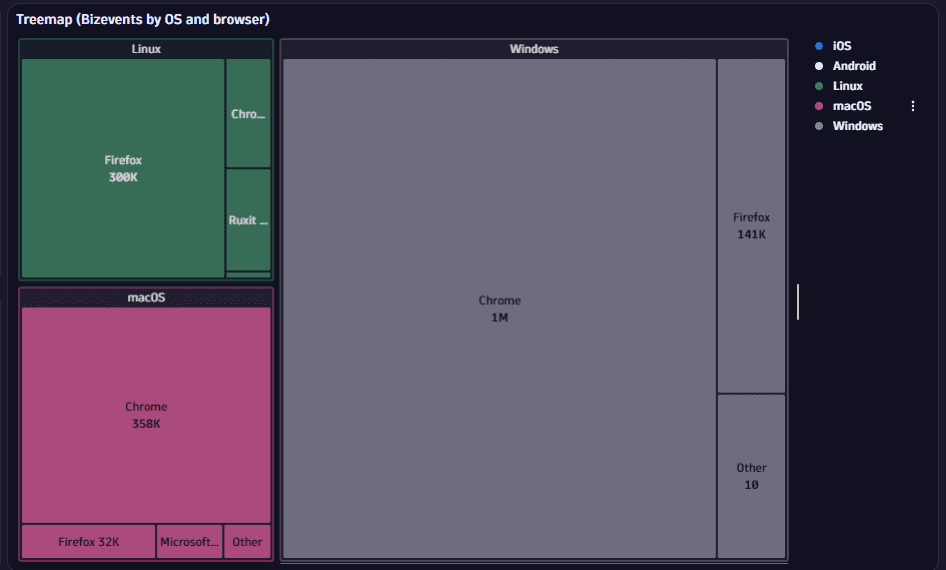
The chart above is based on the following query.
fetch bizevents| filter isNotNull(browser.name)| filter isNotNull(os.name)| summarize count = count(), by:{os.name, browser.name}
Example 2
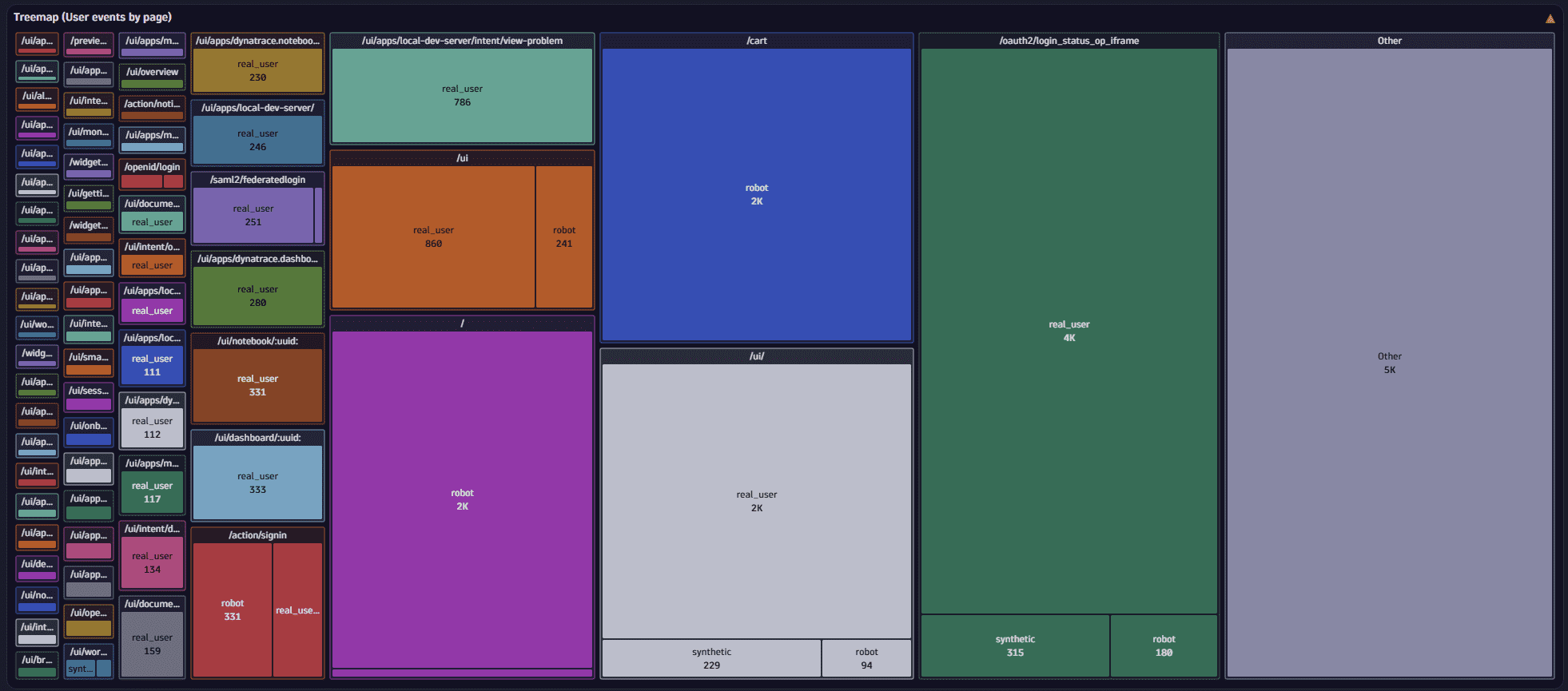
The chart above is based on the following query.
fetch user.events| filter startsWith(page.name, "/")| summarize users = countDistinct(dt.rum.session.id) , by:{page.name, dt.rum.user_type}| sort users desc
Chart interactions
Selection interactions
- Hover to display a tooltip showing details.
- Select to pin the displayed tooltip open; you can then hover over the tooltip to display a menu of selection-specific options.
Available menu options vary according to your data and the selected visualization.
Node submenus offers node-specific options such as:
- Copy node—copy the node.
- Copy value—copy the value of the node.
Title
Use the title field at the top of the options panel (initially Untitled tile or Untitled section) to add a title to your dashboard tile or notebook section.
- You can use emojis such as 😃 and 🌍 and ❤️.
- You can use variables.
Example:
- Define variables called
StatusandEmojiin your dashboard. - Set the title to
Current $Emoji status is $Status. - Set
StatustoGood. - Set
Emojito🌍.
The title will be displayed as Current 🌍 status is Good.
Visualization
If you aren't sure that you chose the right visualization, use the visualization selector to try different visualizations.
Data mapping
The data mapping section shows how a column of your result is mapped to the visualization.
Expand for general rules on data mapping settings
Expand the Data mapping section of your visualization settings to see how data in your result is mapped to your visualization, and to adjust those settings if needed.
-
Mandatory fields are marked with an asterisk (
*). Example: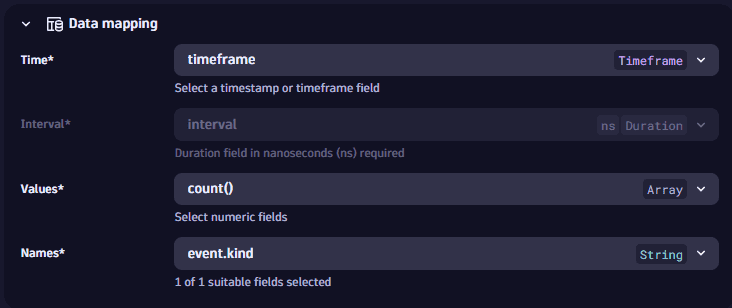 Example data mapping: line chart
 -
Data types are displayed next to field names in dropdowns and mapped fields.
-
Units are displayed when there’s only one assigned.
-
Result fields are grouped into Suitable and Unsuitable. Fields are marked as unsuitable if they cannot be used to display data in the visualization. Example:
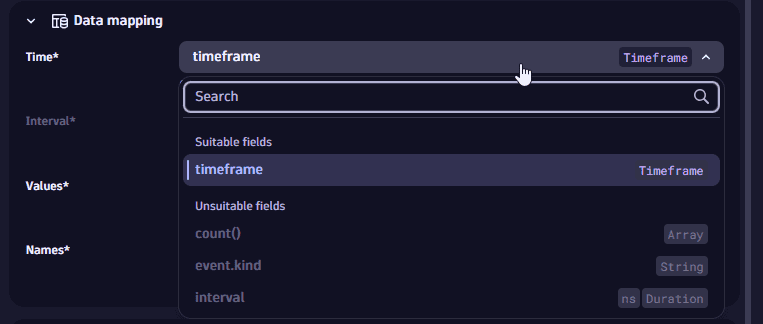 Example data mapping: line chart, Time dropdown
 -
Automatic application of data mapping default settings:
Dynatrace version 1.319+
- Already existing tiles and sections are considered to be user-defined. Their data mapping configurations aren't updated automatically.
- Newly created tiles and sections apply a data mapping setting by default. If you don't modify these settings manually, these settings might change if a new execution of the tile/section modifies the results and there are fields missing or new fields that better suit the data mapping.
Visualization-specific data mapping settings
For a treemap, the data mapping section includes:
- Category: the field to use for the category (upper level of the hierarchy).
- Subcategory: the field to use for the subcategory (lower level of the hierarchy).
- Value: the numeric value that determines the relative sizes of the categories and subcategories in the treemap.
- Color: whether to color the treemap based on the Category, Subcategory, or Value.
Categories
- Show labels: display or hide labels. If Show labels is turned on, you can choose whether to show just category labels, just subcategory labels, or both.
Legend and tooltip
-
Show legend: To display a legend, turn on Show legend and select the legend Position.
-
Position: When Show legend is turned on, Position determines where to display the legend.
- Auto: Selects an appropriate location based on the visualization size and the available space.
- Bottom: Displays a legend under the visualization.
- Right: Displays a legend to the right of the visualization.
-
Text truncation: Determines how to truncate text when the full text can't be displayed.
- A…: Trim from the right end of the text (when the right end is less important)
- A…B: Trim from the middle of the text (when the middle is less important)
- …B: Trim from the left end of the text (when the left end is less important)
Colors
Select a color palette to apply to the treemap.
Units and formats
To override the default units and formats in a dashboard or notebook visualization
-
Select to edit the visualization tile.
-
Select the Visual tab.
-
Expand Units and formats.
The Units and formats section lists all available unit settings for the document (dashboard or notebook). Some units may already be added automatically when querying metrics from their metadata.
Each row has two menus:
- The left menu displays unit settings.
- The right menu displays field mapped to that unit.
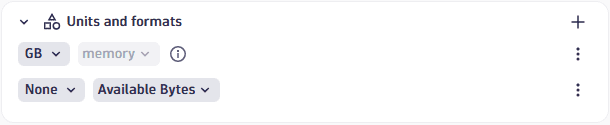 Example rows in "Units and formats" settings
 -
To edit unit settings, open the left menu and review/set the following settings:
-
Unit: The base unit in which the values were captured. It's
Noneif it was not included in the DQL result, or its automatically defined by the unit passed from the DQL result. This field doesn't lead to any conversion but modifies the suffix to correspond to the unit. -
Convert: You can turn on Convert for conversion. For example, if the DQL result defined your numeric value in the result as
Bytes, Convert now offers a suitable list of byte conversions such asKilobyteandMegabyte.Only linear and static conversions are supported. For example, you cannot convert
Degree Celsius(°C)intoDegree Fahrenheit(°F), or convertUsd(US$)intoEur(€).
The Format section determines how the unit is displayed:
- Decimals: displays the default number of decimals (degree of precision) to display. To see it in action, change the Decimals selection and observe the change in the visualization.
- Custom suffix: displays the suffix to display after the unit. To see it in action, turn on Custom suffix, enter a string, and observe the change in the visualization. When you don't find the unit you're looking for, you can use Custom suffix to display the desired unit.
- Abbreviate large numbers: displays large figures in abbreviated form. For example,
1053becomes1.1K. - Multiple units: displays more than one unit. Turn this on and select the number of units to display. For example,
90 secondsbecomes1m 30sif multiple units is enabled and 2 units are selected.
-
-
To choose a different field for a row, open the right menu in that row and select a field from the available fields.
Units and formats: Additional actions
- To add a row, select (Add) and configure it as described above.
- (Actions) opens a menu of further options:
- Duplicate creates a copy of the selected row.
- Delete removes the row.
- Reset resets the settings in the selected row to default/metadata values.
Units and formats: Examples
Chart average CPU across all hosts
This example uses a line chart, but the options apply to other visualizations.
-
In
 Dashboards, create a dashboard.
 -
Select and, in the Library section of the menu, select Chart average CPU across all hosts.
-
In the edit panel, select the Visual tab and select Line.
-
Expand Units and formats.
One row is already defined based on metadata from
avg(dt.host.cpu.usage). -
To override the unit settings for that field, open the left menu in that row to display the unit settings.
-
Define an override for the displayed metric. You can observe your changes in the Y-axis of the chart.
-
Unit displays
Percent, which is the default unit for the selected metric. -
Turn on Convert to try conversions settings. For example, change
AutotoOneto display the result as a fraction of 1. -
Decimals displays the default number of decimal points (degree of precision) to display. For example, enter
Pctand review the dashboard to seePctinstead of%displayed after the percentage value. -
Turn on Custom suffix to try different suffixes to display after the unit. For example, change the Decimals selection and review the dashboard to see the change in the number of decimal points in the percentage value.
-
To reset to defaults (discard override settings for the selected metric), open the (Actions) menu for that row and select Reset.
Links
Use the Links section to manage custom links from your dashboard or notebook.
Add a link
To add a link
- Open the Links section in the visualization tab of your selected visualization.
- Select to open Add link.
- Configure the link:
- Name: Enter a descriptive name such as "Go to Host" to display in the menu.
- Icon: Select an icon such as "Logs" to represent the link in the menu.
- URL: Use dynamic placeholders to insert data fields or variables. For example, select Insert placeholder and add the
:nameplaceholder to the your URL likehttps://myhost/host={{:name}} - Use the Preview section at the bottom to see how placeholders will be replaced with actual data and to test your link.
- Select Add link to save. The link will now appear in the visualization's tooltip menu.
Links: Additional actions
- To add a row, select and configure it as described in Add a link.
- To move a row up or down in the table, select and drag .
- opens a menu of further options:
- Edit displays link fields for editing as described in Add a link.
- Duplicate creates a copy of the selected row.
- Delete removes the row.
For details, Link from visualization via custom links