What's new in Dynatrace SaaS version 1.323
- Release notes
- 10-min read
- Rollout start on Sep 9, 2025
This page showcases new features, changes, and bug fixes in Dynatrace SaaS version 1.323. It contains:
Feature updates
Platform | Settings
Higher limits for number of rules for auto tags and management zones
The default limits for the number of rules for auto tags and management zones, including those based on entity selectors, have been doubled from 150 to 300. This empowers you to create finer-grained rules for auto tags and management zones. Note that applying and processing a larger number of rules may take longer.
Application Observability | Services
SDv2 for OneAgent on Kubernetes (Public Preview)
Service Detection v2 (SDv2) introduces unified, attribute-based service detection for OneAgent on Kubernetes.
The key benefits are:
- Simplified Architecture: One consistent service type replaces multiple categories, giving you a clean, cohesive view of your service landscape
- Cloud-Native: Uses a modern, cloud-based attributes approach to detect, name, split and manage services
- Flexibile Targeting: Precise workload selection via DQL matchers gives you precise control over service boundaries
This public preview is available only for Java workloads in Kubernetes environments.
To enable it:
- Complete the public preview enrollment form.
- Navigate to your Kubernetes namespace or cluster.
- Go to > Service detection settings and turn on Service Detection v2.
For more information, including risks and caveats, see the SDv2 Feedback Channel.
Infrastructure Observability | Kubernetes
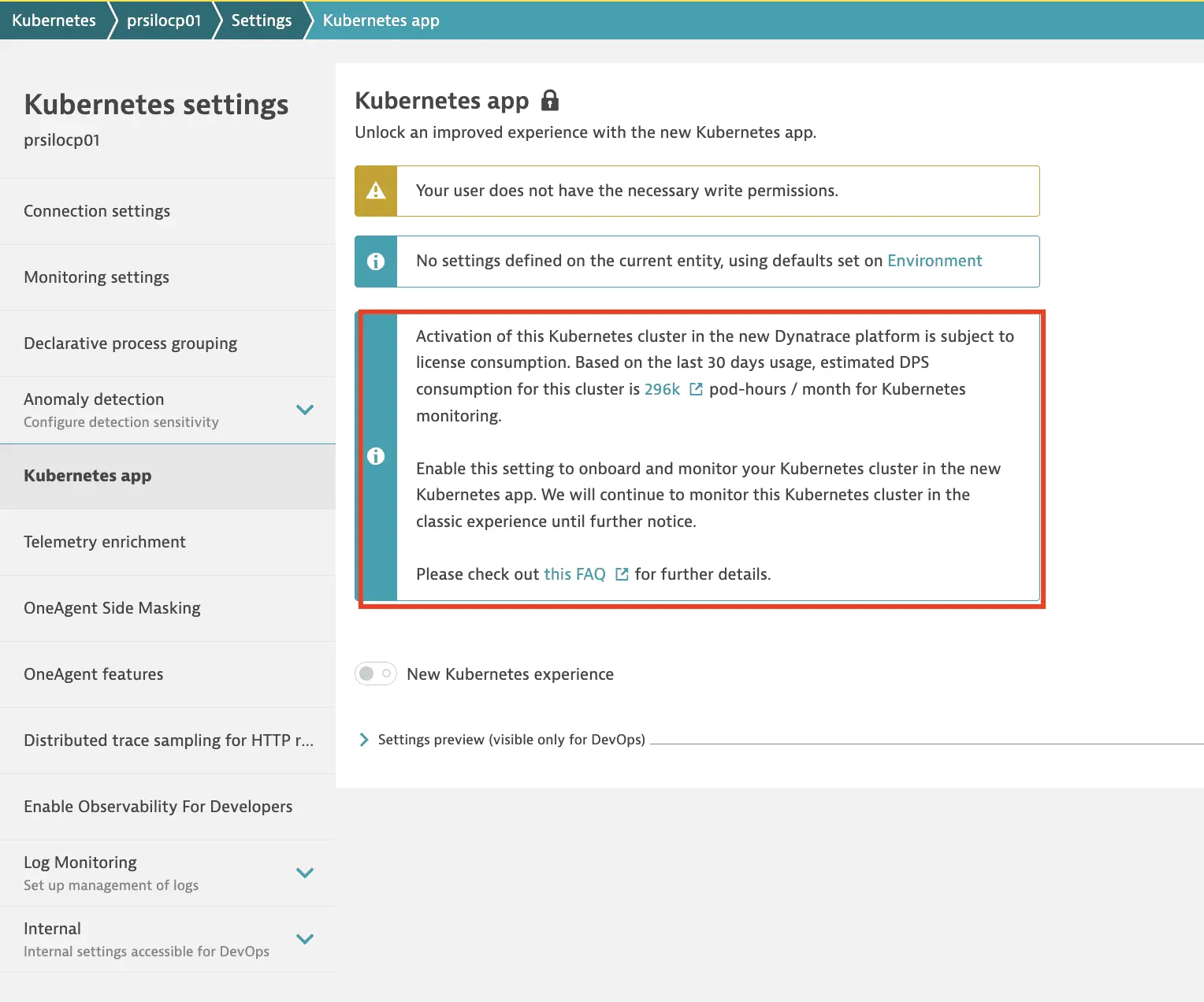
Detailed information about DPS consumption for Kubernetes monitoring
The Kubernetes app settings show a detailed breakdown of total pod-hour consumption for activation of Kubernetes clusters in the new Dynatrace platform, both on tenant and cluster level.
Breaking changes
Platform | OpenPipeline
Empower teams with granular access control and higher scalability in OpenPipeline
This change is being rolled out gradually until September 25, 2025, by which time it will be available in your environment.
You can now delegate configuration ownership for OpenPipeline by assigning fine-grained read and write permissions for each pipeline and ingest source. This enables central teams to share or transfer configuration responsibilities to individual teams or users, supporting self-service and reducing bottlenecks.
The new configuration model leverages the Dynatrace Settings framework, allowing for seamless ownership changes, detailed audit events, and alignment with your organization's existing IAM policies.
- To trigger the migration, go to
 Settings > Process and contextualize > OpenPipeline.
 - This migration is not reversible and is a breaking change.
-
You need to update your policies and API integrations.
-
For environments that use API for OpenPipeline configuration, you need to download the new configuration.
There's no need to manually migrate the configuration's content. Dynatrace will migrate the existing configuration, and the new configuration can then be downloaded.
-
For details, see the migration guide.
Fixes and maintenance
Resolved issues in this release
- Fixed an issue in the Environment v2 Settings API which prevented the use of write-only permissions in some cases. (PS-35737)
- Users without IAM read permissions for log agent feature flags can now access the Log ingest rules page. (OA-52119)
- Fixed a corner case issue that changed Davis event metadata that is considered immutable, such as the event analysis start and end timestamps. (DI-22219)
Dynatrace API
To learn about changes to the Dynatrace API in this release, see Dynatrace API changelog version 1.323.